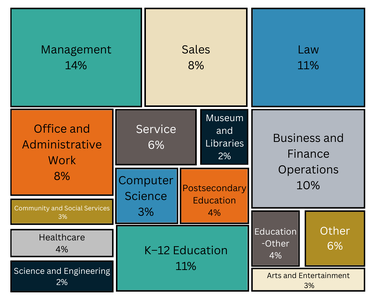
Career Fields of History Majors

donbosco

Legend of ZZL
Messages
6,082
Careers-Box-Graph-COLOR-e1767715208589.png


"History has long been a reliable undergraduate major, both for assuring future job prospects and for building a richly satisfying personal life. A degree in history supports many potential career pathways. Forty percent of America’s social studies teachers have undergraduate degrees in history, but teaching is just one of many options. Twenty percent of history majors choose to work in education, a rate only slightly higher than that for all college graduates (18 percent). Our field can provide a strong foundation for civic participation, leadership, and community engagement. History is the second most common degree among members of Congress. More than one-third of those working in culture fields like libraries, museums, and publishing hold history degrees, and history remains one of the most recommended fields of study to prepare for a career in law."

How many of you (a multitude it often seems) lawyers here majored in History?

Who else?

 
I’ve been self employed for over 40 years with a degree in American Studies which I always felt was a first cousin to a History degree. I guess some lawyers etc . are self employed but thought they would have a category?
 
Interestingly, my wife majored in history with a minor in Spanish and she wound up in military intelligence, specifically counterintelligence with top secret clearance and reported straight to the NSA.

Later she became a teacher - of Spanish, not history or social studies - although she did hold social studies credentials all through her teaching career.

However, lawyering was not on her radar… though she says she basically married a wanna-be lawyer (me) because she says I’d “argue with a fence post”. :cool:
 
Careers-Box-Graph-COLOR-e1767715208589.png


"History has long been a reliable undergraduate major, both for assuring future job prospects and for building a richly satisfying personal life. A degree in history supports many potential career pathways. Forty percent of America’s social studies teachers have undergraduate degrees in history, but teaching is just one of many options. Twenty percent of history majors choose to work in education, a rate only slightly higher than that for all college graduates (18 percent). Our field can provide a strong foundation for civic participation, leadership, and community engagement. History is the second most common degree among members of Congress. More than one-third of those working in culture fields like libraries, museums, and publishing hold history degrees, and history remains one of the most recommended fields of study to prepare for a career in law."

How many of you (a multitude it often seems) lawyers here majored in History?

Who else?
This reminds of the time when the Geography Department at UNC for a few years after 1986 bragged about how their graduates had the highest average starting salary of any four year degree in the University. And then in the small print mentioned how small the number of graduates were each year and that Michael Jordan's salary in the year he graduated might have skewed the "average" up a bit.
 
. . ..
How many of you (a multitude it often seems) lawyers here majored in History? . . ..
Can't speak for anyone else, but when I started law school, my most recent degree was in Chemical Engineering. When I found out (a) that my degree was on the list of degrees that qualified me to take the patent bar (without any prior experience in the field) and (b) that there were more lawyers in the urban county where I was then residing than there were patent lawyers in the entire United States, I really liked those odds. And passing the patent bar the summer after my first year of law school allowed me to participate in the second year job interviews with way more confidence than I usually display. Turns out, being confident is a trait that those conducting the job interviews were looking for.
 
I was a poli sci major but I built my own focus on American foreign policy since WWII (which covered a lot less ground back then than it would now), so took a number of history classes that overlapped that focus.
 
Back
Top