

donbosco
Legend of ZZL
- Messages
- 5,306
DEAN SMITH’S FIRST GAME
“Dean Smith made his head coaching debut on December 2, 1961. The Tar Heels defeated Virginia 80-46.” Coach Smith had come to Carolina two years previously to work as an assistant to Frank McGuire. During those last years of the 1950s and 1960s there were scandals surrounding the college game. Both UNC and NC State were implicated. Chancellor William Aycock required that McGuire resign and hired his young (30 years old) assistant with but one mandate: run a clean program that would reflect well on the university. Coach Smith gave his word and signed a contract that paid him $9,200 a year. In response to the scandals all around, President of the University of North Carolina system Bill Friday permitted the basketball team to play only sixteen regular season games. That meant only two out-of-conference contests. The new coach chose to keep Notre Dame and Indiana on the schedule in games played in Greensboro and Charlotte respectively. At the time the Atlantic Coast Conference consisted of UNC, NCSU, Duke, Wake Forest, Clemson, South Carolina, Maryland, and Virginia. The Tar Heels finished 7-7 in the conference and 8-9 overall. Coach was 66-47 his first five seasons. In 1965 after an embarrassing loss to Wake Forest, students hanged him in effigy.
Of course beginning with that 6th season (1966-67) Coach Smith’s program and system began to pick up momentum. It should never be forgotten that he had, from the first moment of his head coaching career at UNC to the very end, 879 victories later in 1997, kept his word and ran a program that did indeed reflect well on the University of North Carolina. I, and so many more Tar Heels were fortunate to have had our own formative years inhabited by Coach Smith’s presence and philosophy. Early on of course, he was generally quiet and let the unselfish, from-each-according-to-their ability, to-each-according-to-their-need style of play that he taught to speak for him. His teams passed and defended together first and foremost, and they played smart. To me as a boy completely taken with the game the philosophy underlying the type of defensive intensity that sent players diving after loose balls, taking charges, and together trapping opponents in an all-out press was evident…that the whole is greater than the sum total of the parts meant that there was greater strength in cooperation than in individualism. This became a life lesson for me.
I romanticize Coach Smith. I admit it. I cried when he retired. I admit that with no problem. I have poured over the book that he co-wrote with John Kilgo, ‘A Coach’s Life’ and while I appreciate every word and message, my favorite chapter is number eleven, “I May Be Wrong, But!” in which Coach lays out the ideology for working and living. In that chapter Coach Smith reveals the thinking behind his faith (he was a member of Binkley Baptist Church where his pastor Robert Seymour was a long-time counselor). Coach also muses about his decisions to defy White Supremacy as a voice for Equal Rights, take an Anti-War stance in regard to Vietnam, advocate against the death penalty, and support a Nuclear Freeze. In reading ‘A Coach’s Life,’ we find out that reading theology was his passion, with Kierkegaard his ‘go-to.’ We learn about a life spent in thought about how to be a better member of a community, a school, a nation, and a society. I don’t mind saying that I have asked myself on more than one occasion, “How would Coach Smith handle this?” and found the answer helpful.
Those of us who followed his life, either only superficially by simply watching his teams play, or those of us who paid closer attention to the bigger picture painted are all fortunate. The University of North Carolina was wildly blessed when in the midst of dark times of scandal a young coach was hired to de-emphasize the “win at any cost” sentiment afoot in college athletics only to emerge as a champion who proved that doing things the right way did make you a winner. Thanks Coach…Always.
[Photo from the UNC Photo Lab collection, 8 Nov. 1961]
“Dean Smith made his head coaching debut on December 2, 1961. The Tar Heels defeated Virginia 80-46.” Coach Smith had come to Carolina two years previously to work as an assistant to Frank McGuire. During those last years of the 1950s and 1960s there were scandals surrounding the college game. Both UNC and NC State were implicated. Chancellor William Aycock required that McGuire resign and hired his young (30 years old) assistant with but one mandate: run a clean program that would reflect well on the university. Coach Smith gave his word and signed a contract that paid him $9,200 a year. In response to the scandals all around, President of the University of North Carolina system Bill Friday permitted the basketball team to play only sixteen regular season games. That meant only two out-of-conference contests. The new coach chose to keep Notre Dame and Indiana on the schedule in games played in Greensboro and Charlotte respectively. At the time the Atlantic Coast Conference consisted of UNC, NCSU, Duke, Wake Forest, Clemson, South Carolina, Maryland, and Virginia. The Tar Heels finished 7-7 in the conference and 8-9 overall. Coach was 66-47 his first five seasons. In 1965 after an embarrassing loss to Wake Forest, students hanged him in effigy.
Of course beginning with that 6th season (1966-67) Coach Smith’s program and system began to pick up momentum. It should never be forgotten that he had, from the first moment of his head coaching career at UNC to the very end, 879 victories later in 1997, kept his word and ran a program that did indeed reflect well on the University of North Carolina. I, and so many more Tar Heels were fortunate to have had our own formative years inhabited by Coach Smith’s presence and philosophy. Early on of course, he was generally quiet and let the unselfish, from-each-according-to-their ability, to-each-according-to-their-need style of play that he taught to speak for him. His teams passed and defended together first and foremost, and they played smart. To me as a boy completely taken with the game the philosophy underlying the type of defensive intensity that sent players diving after loose balls, taking charges, and together trapping opponents in an all-out press was evident…that the whole is greater than the sum total of the parts meant that there was greater strength in cooperation than in individualism. This became a life lesson for me.
I romanticize Coach Smith. I admit it. I cried when he retired. I admit that with no problem. I have poured over the book that he co-wrote with John Kilgo, ‘A Coach’s Life’ and while I appreciate every word and message, my favorite chapter is number eleven, “I May Be Wrong, But!” in which Coach lays out the ideology for working and living. In that chapter Coach Smith reveals the thinking behind his faith (he was a member of Binkley Baptist Church where his pastor Robert Seymour was a long-time counselor). Coach also muses about his decisions to defy White Supremacy as a voice for Equal Rights, take an Anti-War stance in regard to Vietnam, advocate against the death penalty, and support a Nuclear Freeze. In reading ‘A Coach’s Life,’ we find out that reading theology was his passion, with Kierkegaard his ‘go-to.’ We learn about a life spent in thought about how to be a better member of a community, a school, a nation, and a society. I don’t mind saying that I have asked myself on more than one occasion, “How would Coach Smith handle this?” and found the answer helpful.
Those of us who followed his life, either only superficially by simply watching his teams play, or those of us who paid closer attention to the bigger picture painted are all fortunate. The University of North Carolina was wildly blessed when in the midst of dark times of scandal a young coach was hired to de-emphasize the “win at any cost” sentiment afoot in college athletics only to emerge as a champion who proved that doing things the right way did make you a winner. Thanks Coach…Always.
[Photo from the UNC Photo Lab collection, 8 Nov. 1961]
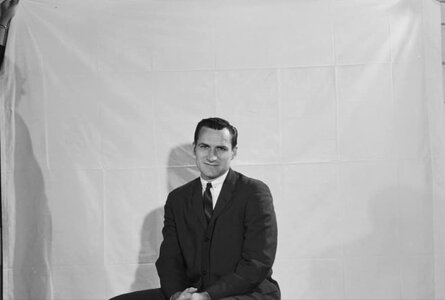
“Dean Smith made his head coaching debut on December 2, 1961. The Tar Heels defeated Virginia 80-46.” Coach Smith had come to Carolina two years previously to work as an assistant to Frank McGuire. During those last years of the 1950s and 1960s there were scandals surrounding the college game. Both UNC and NC State were implicated. Chancellor William Aycock required that McGuire resign and hired his young (30 years old) assistant with but one mandate: run a clean program that would reflect well on the university. Coach Smith gave his word and signed a contract that paid him $9,200 a year. In response to the scandals all around, President of the University of North Carolina system Bill Friday permitted the basketball team to play only sixteen regular season games. That meant only two out-of-conference contests. The new coach chose to keep Notre Dame and Indiana on the schedule in games played in Greensboro and Charlotte respectively. At the time the Atlantic Coast Conference consisted of UNC, NCSU, Duke, Wake Forest, Clemson, South Carolina, Maryland, and Virginia. The Tar Heels finished 7-7 in the conference and 8-9 overall. Coach was 66-47 his first five seasons. In 1965 after an embarrassing loss to Wake Forest, students hanged him in effigy.
Of course beginning with that 6th season (1966-67) Coach Smith’s program and system began to pick up momentum. It should never be forgotten that he had, from the first moment of his head coaching career at UNC to the very end, 879 victories later in 1997, kept his word and ran a program that did indeed reflect well on the University of North Carolina. I, and so many more Tar Heels were fortunate to have had our own formative years inhabited by Coach Smith’s presence and philosophy. Early on of course, he was generally quiet and let the unselfish, from-each-according-to-their ability, to-each-according-to-their-need style of play that he taught to speak for him. His teams passed and defended together first and foremost, and they played smart. To me as a boy completely taken with the game the philosophy underlying the type of defensive intensity that sent players diving after loose balls, taking charges, and together trapping opponents in an all-out press was evident…that the whole is greater than the sum total of the parts meant that there was greater strength in cooperation than in individualism. This became a life lesson for me.
I romanticize Coach Smith. I admit it. I cried when he retired. I admit that with no problem. I have poured over the book that he co-wrote with John Kilgo, ‘A Coach’s Life’ and while I appreciate every word and message, my favorite chapter is number eleven, “I May Be Wrong, But!” in which Coach lays out the ideology for working and living. In that chapter Coach Smith reveals the thinking behind his faith (he was a member of Binkley Baptist Church where his pastor Robert Seymour was a long-time counselor). Coach also muses about his decisions to defy White Supremacy as a voice for Equal Rights, take an Anti-War stance in regard to Vietnam, advocate against the death penalty, and support a Nuclear Freeze. In reading ‘A Coach’s Life,’ we find out that reading theology was his passion, with Kierkegaard his ‘go-to.’ We learn about a life spent in thought about how to be a better member of a community, a school, a nation, and a society. I don’t mind saying that I have asked myself on more than one occasion, “How would Coach Smith handle this?” and found the answer helpful.
Those of us who followed his life, either only superficially by simply watching his teams play, or those of us who paid closer attention to the bigger picture painted are all fortunate. The University of North Carolina was wildly blessed when in the midst of dark times of scandal a young coach was hired to de-emphasize the “win at any cost” sentiment afoot in college athletics only to emerge as a champion who proved that doing things the right way did make you a winner. Thanks Coach…Always.
[Photo from the UNC Photo Lab collection, 8 Nov. 1961]
“Dean Smith made his head coaching debut on December 2, 1961. The Tar Heels defeated Virginia 80-46.” Coach Smith had come to Carolina two years previously to work as an assistant to Frank McGuire. During those last years of the 1950s and 1960s there were scandals surrounding the college game. Both UNC and NC State were implicated. Chancellor William Aycock required that McGuire resign and hired his young (30 years old) assistant with but one mandate: run a clean program that would reflect well on the university. Coach Smith gave his word and signed a contract that paid him $9,200 a year. In response to the scandals all around, President of the University of North Carolina system Bill Friday permitted the basketball team to play only sixteen regular season games. That meant only two out-of-conference contests. The new coach chose to keep Notre Dame and Indiana on the schedule in games played in Greensboro and Charlotte respectively. At the time the Atlantic Coast Conference consisted of UNC, NCSU, Duke, Wake Forest, Clemson, South Carolina, Maryland, and Virginia. The Tar Heels finished 7-7 in the conference and 8-9 overall. Coach was 66-47 his first five seasons. In 1965 after an embarrassing loss to Wake Forest, students hanged him in effigy.
Of course beginning with that 6th season (1966-67) Coach Smith’s program and system began to pick up momentum. It should never be forgotten that he had, from the first moment of his head coaching career at UNC to the very end, 879 victories later in 1997, kept his word and ran a program that did indeed reflect well on the University of North Carolina. I, and so many more Tar Heels were fortunate to have had our own formative years inhabited by Coach Smith’s presence and philosophy. Early on of course, he was generally quiet and let the unselfish, from-each-according-to-their ability, to-each-according-to-their-need style of play that he taught to speak for him. His teams passed and defended together first and foremost, and they played smart. To me as a boy completely taken with the game the philosophy underlying the type of defensive intensity that sent players diving after loose balls, taking charges, and together trapping opponents in an all-out press was evident…that the whole is greater than the sum total of the parts meant that there was greater strength in cooperation than in individualism. This became a life lesson for me.
I romanticize Coach Smith. I admit it. I cried when he retired. I admit that with no problem. I have poured over the book that he co-wrote with John Kilgo, ‘A Coach’s Life’ and while I appreciate every word and message, my favorite chapter is number eleven, “I May Be Wrong, But!” in which Coach lays out the ideology for working and living. In that chapter Coach Smith reveals the thinking behind his faith (he was a member of Binkley Baptist Church where his pastor Robert Seymour was a long-time counselor). Coach also muses about his decisions to defy White Supremacy as a voice for Equal Rights, take an Anti-War stance in regard to Vietnam, advocate against the death penalty, and support a Nuclear Freeze. In reading ‘A Coach’s Life,’ we find out that reading theology was his passion, with Kierkegaard his ‘go-to.’ We learn about a life spent in thought about how to be a better member of a community, a school, a nation, and a society. I don’t mind saying that I have asked myself on more than one occasion, “How would Coach Smith handle this?” and found the answer helpful.
Those of us who followed his life, either only superficially by simply watching his teams play, or those of us who paid closer attention to the bigger picture painted are all fortunate. The University of North Carolina was wildly blessed when in the midst of dark times of scandal a young coach was hired to de-emphasize the “win at any cost” sentiment afoot in college athletics only to emerge as a champion who proved that doing things the right way did make you a winner. Thanks Coach…Always.
[Photo from the UNC Photo Lab collection, 8 Nov. 1961]

