Happy Birthday Coach Smith: This Date in History

  • Thread starter Thread starter donbosco
  • Start date Start date
  • Replies: 1K
  • Views: 411K
  • Off-Topic 
I don’t think Oliver played football at UNC.

It was Ken Willard, Junior Edge (great name), and others who led UNC to its first bowl win, 35-0 in the 1963 Gator Bowl.

John Swofford was a FR in 1965. Freshmen didn’t play. His varsity career was ‘66-‘68.

Sullivan’s introduction of John Swofford was pretty white bread, neutral, and meaningless. John Swofford stood up, waved, and sat down.
You are correct. I mistyped Oliver (one time) when I should have typed Johnny. Ed Sullivan introduced Oliver's younger brother, John Swofford, as a football player. Quite honestly, for a memory that was about 55 years old, I don't think I did all that bad. It was a game against Vanderbilt, not Air Force. I didn't say anything about a bowl game. My recollection was that it was just a regular season game. But you are correct that I misremembered the details of an Ed Sullivan show from 55 years ago. I am sorry for doing so.
 
Last edited:
You are correct. I mistyped Oliver (one time) when I should have typed Johnny. Ed Sullivan introduced Oliver's younger brother, John Swofford, as a football player. Quite honestly, for a memory that was about 55 years old, I don't think I did all that bad. It was a game against Vanderbilt, not Air Force. I didn't say anything about a bowl game. My recollection was that it was just a regular season game. But you are correct that I misremembered the details of an Ed Sullivan show from 55 years ago. I am sorry for doing so.
During Swofford’s UNC career, UNC football SUCKED.
 
IMG_3686.jpeg

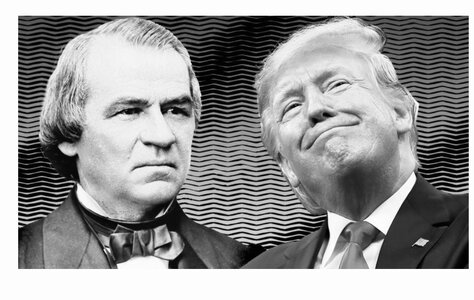
#OTD (Feb. 24) in 1868, Raleigh-born and raised Andrew Johnson, who became the 17th US President upon the assassination of Abraham Lincoln, became the First President Impeached for High Crimes and Misdemeanors. Until Donald Trump took office he had been rated our nation’s worst Chief Executive by many. In May of that year the Senate acquitted. Andrew Johnson Impeached, 1868

The Impeachments of the two were quite different affairs. Johnson was impeached in a dispute with the Radical Republican faction in U.S. Congress over control of Reconstruction (though the charges were violating the Tenure of Office Act by removing Secretary of War Edwin M. Stanton without Senate approval). Trump was impeached twice, the first time over foreign policy crimes related to The Ukraine. He pressured that country to investigate his rival Joe Biden and then obstructed Congress. The second time he was impeached for attempting to overthrow the electoral process — i.e., the January 6 Insurrection. Both times a Senate 2/3 majority could not be achieved. While Johnson was hardly the man he replaced his impeachment was pure political maneuvering. The impeachments of trump, as we are living at present, were well-founded efforts to protect the constitutional democratic republic from his criminal depredations and personal greed.
 
Modified from a post in 2025 on the state motto.

IMG_3705.jpeg

Did you ever wonder? ‪The motto has always struck me as a good bit of oxymoronic prideful humility — North Carolina is, after all, well-recognized as a paradox of a state. ‬ A place where elections that go Jim Hunt and Jesse Helms at once (or trump and Roy Cooper more recently), fights over sauce ingredients (tomato or no), world-class universities and struggling underfunded rural schools, a tobacco-rooted past and a Med Tech present, and historically something called, without a speck of irony — Progressive Plutocrats.

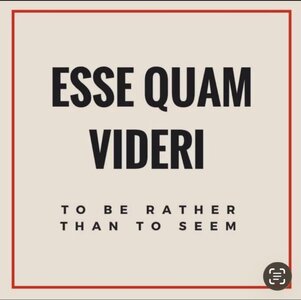
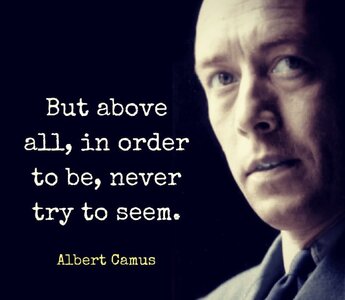
Deepening (Anticipating?) those head-scratchers, in late February (the 21st) of 1893 the N.C. General Assembly adopted ‘Esse Quam Videri’ (To Be, Rather Than To Seem) as the state motto. The erudite phrase has associations with Cicero (de Amnicitia), Aeschylus, Socrates, and in modern times Albert Camus.

The maxim was chosen by that 1893 General Assembly as one “expressive of some noble sentiment and indicative of some leading trait of our people.” Indeed, the 1890s saw the rise of the Populist Party in North Carolina and that 1893 congress, dominated by conservative Democrats must have been aware of the growing dissatisfaction in the outlands. The Farmers Alliance was a major — really THE major — factor in that movement to reform finance, transportation, and education, wrestling control of all three from the state’s, and the region’s, historic elites. The Populist’s national goal, outlined in its Omaha Platform, went so far as to call for government ownership of railroads.

The 1892 election had resulted in the Democrat, Elias Carr only taking 48% of the vote. Carr was a reluctant populist of sorts, a former leader of the Farmers Alliance, but an advocate of stronger railroad regulation rather than the seizure of ownership by the state. Despite his relatively conservative stance, it must have been clear that radical ideas were gaining in The Old North State and perhaps farther afield.

Indeed, an alliance of Populists (young, disgruntled once-upon-a-time Democrats) and Republicans (the party of African Americans in those days in The South) did take control of the NC General Assembly in 1894. This was termed as ‘Fusion’ and held great promise for Progressive policies and true Constitutional Democratic Republicanism in the state. This Fusion would even take the office of Governor in 1896. Outrageously NC conservatives mounted a mercenary and anti-democracy White Supremacist campaign in 1898 and retook the reins of government, installed Jim Crow, and suppressed the African American vote until the 1964 Voting Rights Act began the still ongoing effort to re-enfranchise voters.

But back to 1893…remembering this backdrop of growing challenge to the status quo by Populists, farmers mainly, from The Left, I have long wondered about the choice of “To Be Rather Than To Seem” as a motto. The phrase seems hardly the kind that a traditional ruling class such as still maintained control of the General Assembly in 1893 would promote. It is…well…too human, even humane…it is flush with humanity.

Did some radical thinking slip into the Sanctum Santorum of the conservative plurality in the General Assembly still hanging on in 1893 and infuse those legislators with, at least briefly, a sense of humility such as would have given them pause to choose such a humble, even self-effacing, motto as “Esse Quam Videri?” Or should I imagine the phrase as rather a bone tossed to the masses in a time when the state’s traditional elite were casting about anywhere for painless ways to pacify a populace on the rise? Perhaps I’ve overthought it - only more digging will prove one way or the other. At any rate, it IS my second favorite humble brag — after “A Vale of Humility Between Two Mountains of Conceit” of course.

Classical Origins of the State’s Motto ‬ ‪Kudos to @ncpedia for the research into the original texts. State Motto of North Carolina: Esse Quam Videri
 
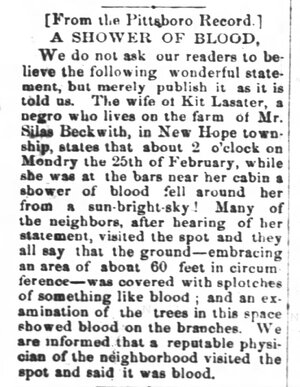
#OTD in 1884: BLOOD SHOWER IN CHATHAM: “On February 25, 1884, Mrs. Kit Lasater, “noted for truthfulness,” was walking near her home in the New Hope township of Chatham County when she heard what she thought was a hard rain fall. Glancing up she saw only clear sky but when she glanced down she saw what appeared to be the aftermath of a “shower of pure blood.”

None of the liquid had fallen on her but it had drenched the ground and surrounding trees for some 60 feet (some accounts say yards) in circumference from the spot where she stood. Upon hearing her story, neighbors rushed to see for themselves and, when later interviewed, confirmed the story as related by Mrs. Lasater.

Samples were collected and sent to Dr. F. P. Venable, a professor at UNC, for evaluation. By mid-April he addressed the topic to the Mitchell Scientific Society. In every test performed except one, the conclusion was the same. The samples appeared to be blood. Venable could offer no explanation beyond the results of the tests, suggesting that “the subject is quite a puzzle and offers a tempting field for the theorist blessed with a vivid imagination.”


A month later the reprint from The Pittsboro Record, posted as first the comment, appeared in Orange County Observer. Of course I’m intrigued by the information that is recounted there that I had never before read - most specifically the reference to “the bars near her cabin” in the newspaper account. New Hope Township, where Mrs. Lasater (her first name goes unmentioned) lived is the part of Chatham most inundated by the creation of Jordan Lake in the 1970s and by my judgment one of the wilder parts, rivaled only by the flat woods on the far other end of the county.

IMG_7512.jpeg

The time was just post-Reconstruction, and the governor Thomas Jarvis was a Democrat, as was always the case in those days. An ex-Confederate, he was a Redeemer (Conservative, White Supremacists who worked to thwart post-Civil War Republican and African American power) and closely tied to Zebulon Vance. Indeed, he took over the office of governor when Vance went to the U.S. Senate and later filled his seat when he died in that office. In the interim he served as ambassador to Brazil.

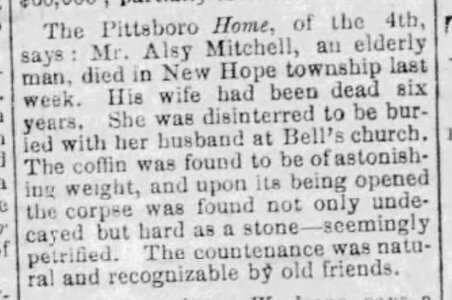
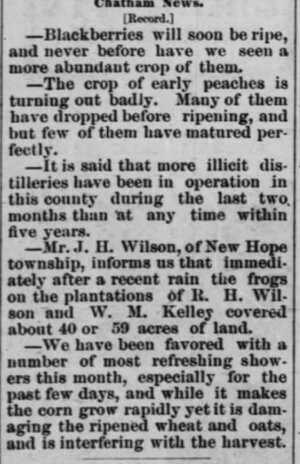
Of course these are just musings about the tenor of the times - a particular time long past - the kind of thing my students and I try and work out as exercises in “doing history.” I’ll add that perusing the News of Chatham during that time reveals a tumultuous and mysterious place. A news report (included) from September 12, 1884 writes of a disinterred body found petrified and another from June 13, 1883 tells of a rain of frogs covering “40 or 59 acres of land” (also posted here).

IMG_7514.jpeg
Petrified Body

IMG_7516.jpeg
Frog Rain

And I thought it was The Devil’s Tramping Ground over in Bear Creek Township and down by Harpers Crossroads that was the only “Weird Chatham.” It seems #DeepChatham just gets deeper and deeper. Maybe the flooding over of New Hope was meant to be.
Bringing Weird Chatham back around.
 
Before there were the modern MAGA Motormouths pouring forth Mendaciously and wasting our time there was Felix Walker of Buncombe. ‪#OTD (Feb. 25) in 1820 in the US House Of Representatives, NC Congressman Felix Walker ‘spoke for Buncombe,’ #AVL #WNC. His speech was rambling nonsense but he refused to yield the floor though beseeched. He also interrupted the important, though ultimately futile, work of framing “The Missouri Compromise.” His colleagues came to call this ‘Bunkum’ or ‘Bunk’ & a new term for worthless bloviation was born.
https://www.ncdcr.gov/blog/2014/02/25/felix-walker-north-carolina-congressman-and-the-origins-of-bunk‬


BUNK!!!!
 
Before there were the modern MAGA Motormouths pouring forth Mendaciously and wasting our time there was Felix Walker of Buncombe. ‪#OTD (Feb. 25) in 1820 in the US House Of Representatives, NC Congressman Felix Walker ‘spoke for Buncombe,’ #AVL #WNC. His speech was rambling nonsense but he refused to yield the floor though beseeched. He also interrupted the important, though ultimately futile, work of framing “The Missouri Compromise.” His colleagues came to call this ‘Bunkum’ or ‘Bunk’ & a new term for worthless bloviation was born.
https://www.ncdcr.gov/blog/2014/02/25/felix-walker-north-carolina-congressman-and-the-origins-of-bunk‬


BUNK!!!!
Before today, I never knew that a politician from Buncombe County was the origin of the expression "BUNK!" It's little tidbits of information like this that make life just a little bit better. NEVER skip an opportunity of make your life a little bit better when doing so harms absolutely no one else. Reading little things like this make me feel like a dog rolling around on a warm, sunny spot on the carpet when it is cold outside.
 
Last edited:
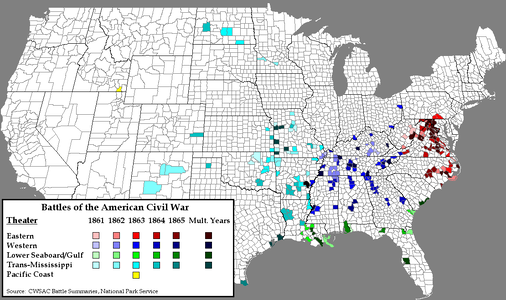
#OTD (Feb. 28) in 1861 North Carolinians voted not to talk about secession. In a statewide referendum prompted by the creation of The Confederacy by states in the Deeper South three weeks earlier the North Carolina government called for a vote on the will of the people. With 93,995 citizens casting ballots the “Do Not Hold A Convention To Talk About Secession” tally carried the day by 651 votes.

The Southern Democrat John C. Breckinridge had won North Carolina’s electoral votes in the presidential election three months earlier. Abraham Lincoln had not appeared on the ballot. But of course Lincoln had won the presidency - a reality that had set wheels spinning in Southern Slave Societies to thoughts of leaving the Union to perpetuate human bondage as the foundation of that economy.

The states most heavily invested in enslavement broke away first - the Alabamas and Mississippis of the world - as well as our immediate neighbor, South Carolina. The Old North State watched and waited. Not until President Lincoln requested troops of the states to address the South Carolinian attack on Fort Sumter did North Carolina cast its lot to break the Union. To be sure, Virginia and Tennessee had already signaled their intention to secede before NC joined in. Some have contended that North Carolina's hand was forced by that hemming in as much as anything.

Accounts seem to indicate that when North Carolina finally made this decision there was no remorse. The state saw the most casualties of any in fact while paradoxically it was also the source of the highest number of deserters. It would appear that the first vote - the February 28, 1861 in which Tar Heels frankly said, “Let’s don’t talk about this,” was the course closest to the hearts of the majority of Tar Heels -- while also clearly the wisest.

CivilWarBattlesNational.png
 
IMG_7556.jpeg

For @heelinhell

Chapter 11 in ‘A Coach’s Life’ is titled “I May Be Wrong, But!” It is my favorite in a book that is never out of reach. It is Coach Smith’s “This is what I believe” essay. In it Coach Smith writes that the game of basketball gives no advantage for wealth, nor race, nor religion, nor nationality and is “about as fair as humans can make something.”


In his assisted autobiography (John Kilgo and Sally Jenkins), ‘A Coach’s Life,’ Coach Smith thinks out loud about theology, one of his favorite topics. As a man of faith he expressed his reluctance to see God’s favor in a victory — “I may be wrong, but the idea that God cheers for one team to win over another is not my idea of God.” You may not like it, or perhaps you will love to hear it, but Coach Smith was firmly and thoughtfully Left-of-Center. And that Worldview was rooted in Christian Theology and The Bible.


He stood in opposition to White Supremacy, Nuclear Proliferation, and the Death Penalty. He saw right through the Moral Majority. He protested the Vietnam War. Coach Smith spoke for ‘Gay Rights’ and Civil Rights and the dismantling of segregation - all in a state that sent Jesse Helms to the Senate five times and has, disgracefully, more recently been carried in presidential elections three times by trump.


Many of us loved him for his coaching style long before we knew these things about him. But that style exemplified the baseline philosophy — share the ball, work hard to make your teammates’ opportunities better, and selfless sacrifice — that all of his teams displayed on the court. Maybe even for some of us it was Coach Smith’s example that helped to bring the light into our own lives. Like another UNC thinker, Frank Porter Graham, Coach Smith generated great heat in the lives of a great many people. Understandably, some did not like him, but if you did not respect him then you were/are a pitiable case.


Fred Hobson, born and raised in Yadkinville, NC, and who played Junior Varsity basketball at Carolina and later served as an English Professor at his Alma Mater, said, “To be quite frank, many of the people who idolized him in the state did not know his politics and would not have agreed with them if they had. So what everyone saw in him was not his politics. It was simply his leadership — that calm in the face of crisis.”


Continuing with the frankness, I’m personally very glad that I came to know the full measure of Coach Smith - because he showed us a path forward through darkness and did so with tact and by example. In the meantime, Coach Smith brought that same thoughtfulness to the game itself and to the relationship that he forged with each of his players over his 36 years on the sidelines. Yes, he thrilled us and taught us never to give up and that the only way was the right way, the human way, the kind and considerate way, but he also won the game far, far more than he lost.


He worked to turn the Front Porch of The University of North Carolina into a welcoming entryway for all people. Quite literally because of him the world had a focus other than Helms or KKK violence or Bathroom Bills when they looked to North Carolina and had to know that we all weren’t — clearly we couldn’t be — like that. He demonstrated that regression was contested in The Tar Heel State. If you don’t see this or are skeptical, read up - start with ‘A Coach’s Life’ then move on to the testimonials of his players, fellow coaches, folks that he worked and prayed with, and even most of all - the people that he bested. Happy Birthday Coach (1931-2015). Never, ever forgotten.

It is Coach Smith's Birthday...Feb 28, 1931

My happy birthday thoughts are above. Bringing them back around with this repost.
 
Back
Top