
Navigation
Install the app
How to install the app on iOS
Follow along with the video below to see how to install our site as a web app on your home screen.
Note: This feature may not be available in some browsers.
More options
You are using an out of date browser. It may not display this or other websites correctly.
You should upgrade or use an alternative browser.
You should upgrade or use an alternative browser.
Jack Kerouac joins Steve Allen: Poetry and Piano (now with other Beats)
- Thread starter donbosco
- Start date
- Replies: 16
- Views: 148
- Off-Topic
Beautiful and bleak at the same time. He was nervous and reluctant to be there, it was the culmination of a lifetime’s love/hate relationship with fame. When he finally stepped into that literal spotlight, he was no longer up to the task of navigating it. By that point he was pushing 40, a cynical and paranoid alcoholic in a slow steady spiral to an early death about 10 years later. Well past his legendary youthful escapades around the country and world. He wrote about how he bailed on these rehearsals to go get drunk at a bar around the corner. He didn’t believe in rehearsals or rewriting, of course.
But once he cracks that book it’s like he escapes into it and takes on his younger and more optimistic and even idealistic self, and he makes it sing. A lifetime of wandering and searching for answers, companionship, fame, respect, love… it all flickered for him in that moment, and the world was granted just a glimpse, and so was he. There’s a sense of comfort, serenity, and satisfaction which was always so elusive for him. It was a brief moment of peace in that reading. And then it dissolved and faded into the shadows again.
It’s always been a very raw and bittersweet, very human clip.
But once he cracks that book it’s like he escapes into it and takes on his younger and more optimistic and even idealistic self, and he makes it sing. A lifetime of wandering and searching for answers, companionship, fame, respect, love… it all flickered for him in that moment, and the world was granted just a glimpse, and so was he. There’s a sense of comfort, serenity, and satisfaction which was always so elusive for him. It was a brief moment of peace in that reading. And then it dissolved and faded into the shadows again.
It’s always been a very raw and bittersweet, very human clip.
Shit I honestly don’t know where I read that. It may have been in a book of his letters or maybe the Ann Charters biography. Or maybe in Big Sur. I’ll see if I can find it."He wrote about how he bailed on these rehearsals to go get drunk at a bar around the corner."
Where did he write that?
Wow, the internet never ceases to amaze. Took some digging but it is indeed from Big Sur:
 en.wikisource.org
…the hell with the hot lights of Hollywood” (remembering that awful time only a year earlier when I had to rehearse my reading of prose a third time under the hot lights of the Steve Allen Show in the Burbank studio, one hundred technicians waiting for me to start reading, Steve Allen watching me expectant as he plunks the piano, I sit there on the dunce’s stool and refuse to read a word or open my mouth, “I dont have to REHEARSE for God’s sake Steve!”—“But go ahead, we just wanta get the tone of your voice, just this last time, I’ll let you off the dress rehearsal” and I sit there sweating not saying a word for a whole minute as everybody watches, finally I say “No I cant do it” and I go across the street to get drunk) (but surprising everybody the night of the show by doing my job of reading just fine, which surprises the producers and so they take me out with a Hollywood starlet who turns out to be a big bore trying to read me her poetry and wont talk love because in Hollywood man love is for sale)…
Big Sur/Chapter 6 - Wikisource, the free online library
…the hell with the hot lights of Hollywood” (remembering that awful time only a year earlier when I had to rehearse my reading of prose a third time under the hot lights of the Steve Allen Show in the Burbank studio, one hundred technicians waiting for me to start reading, Steve Allen watching me expectant as he plunks the piano, I sit there on the dunce’s stool and refuse to read a word or open my mouth, “I dont have to REHEARSE for God’s sake Steve!”—“But go ahead, we just wanta get the tone of your voice, just this last time, I’ll let you off the dress rehearsal” and I sit there sweating not saying a word for a whole minute as everybody watches, finally I say “No I cant do it” and I go across the street to get drunk) (but surprising everybody the night of the show by doing my job of reading just fine, which surprises the producers and so they take me out with a Hollywood starlet who turns out to be a big bore trying to read me her poetry and wont talk love because in Hollywood man love is for sale)…
- Messages
- 999
“The only people for me are the mad ones, the ones who are mad to live, mad to talk, mad to be saved, desirous of everything at the same time, the ones who never yawn or say a commonplace thing, but burn, burn, burn like fabulous yellow roman candles exploding like spiders across the stars.”
Cannot remember where I was at time but Kerouac’s original manuscript for On the Road was on display but did not get a chance to go see it. Still really regret that.
Cannot remember where I was at time but Kerouac’s original manuscript for On the Road was on display but did not get a chance to go see it. Still really regret that.

donbosco
Legend of ZZL
- Messages
- 6,683
“The only people for me are the mad ones, the ones who are mad to live, mad to talk, mad to be saved, desirous of everything at the same time, the ones who never yawn or say a commonplace thing, but burn, burn, burn like fabulous yellow roman candles exploding like spiders across the stars.”
Cannot remember where I was at time but Kerouac’s original manuscript for On the Road was on display but did not get a chance to go see it. Still really regret that.
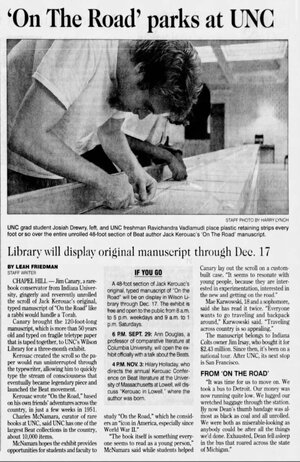
I saw it on display in Wilson Library...probably in the late 1980s or early 1990s.
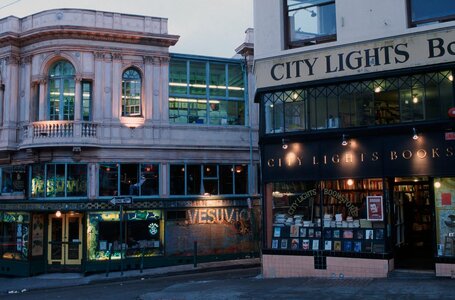
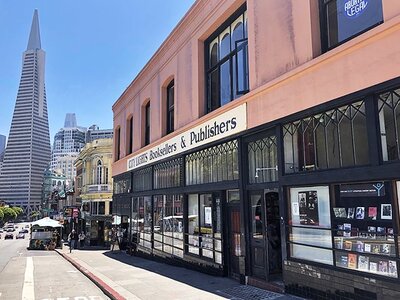
As I’m sure you know, his City Lights Bookstore in North Beach, SF is of course an institution. It’s where I bought my copy of On the Road in my early 20’s.
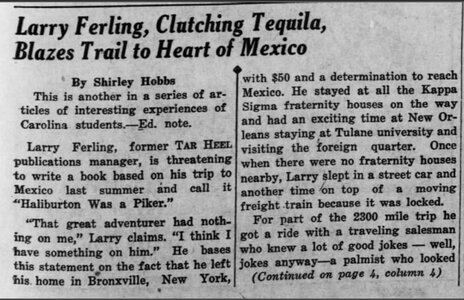
Beat Ally and Carolina grad (‘41), Larry Ferling (nee Ferlinghetti) made his own trip to Mexico. Though he never produced a book of his travels ultimately he wrote much about time spent there.
And about 30 feet from there, across Jack Kerouac alley, is Vesuvio, their old watering hole. It still has some old world charm left, last I was there.
donbosco
Legend of ZZL
- Messages
- 6,683
Naropa Archive Presents 5,000 Hours of Audio Recordings of William Burroughs, Allen Ginsberg & Other Beat Writers
Naropa Archive Presents 5,000 Hours of Audio Recordings of William Burroughs, Allen Ginsberg & Other Beat Writers.
Schools like Harvard, Oxford, and the Sorbonne surely have qualities to recommend them, but to my mind, nothing would feel quite as cool as saying your degree comes from the Jack Kerouac School of Disembodied Poetics. If you aspire to say it yourself, you’ll have to apply to Naropa University, which Tibetan Buddhist teacher (and, incidentally, Oxford scholar) Chögyam Trungpa established in Boulder, Colorado in 1974. This rare, accredited, “Buddhist-inspired” American school has many unusual qualities, as you’d expect, but, as many of us remember from our teenage years, your choice of university has as much to do with who has passed through its halls before as what you think you’ll find when you pass through them. Naropa, besides naming a school after the late Kerouac has hosted the likes of Allen Ginsberg, Anne Waldman, William S. Burroughs, Gregory Corso, Philip Whalen, and Lawrence Ferlinghetti.
But you don’t actually have to attend Naropa to partake of its Beat legacy. At the Naropa Poetics Audio Archives, freely browsable at the Internet Archive, you can hear over 5000 hours of readings, lectures, performances, seminars, panels, and workshops recorded at the school and featuring the aforementioned luminaries and many others. “The Beat writers had intervened on the culture,” says Waldman in an interview about her book Beats at Naropa. “It wasn’t just a matter of simply offering the usual kind of writing workshops, but reading and thinking lectures, panels, presentations as well. The Beat writers have been exceptional as political and cultural activists, investigative workers, translators, Buddhists, environmental activists, feminists, seers. There’s so much legendary history here.” Emphasis — I repeat, 5000 hours — on so much.
To help you dive into this legendary history, we’ve rounded up today some previously featured highlights from Naropa. Begin here, and if you keep going, you’ll discover varieties of Beat experience even we’ve never had — and maybe you’ll even consider putting in a Kerouac School application, and doing some cultural intervention of your own.
Naropa Archive Presents 5,000 Hours of Audio Recordings of William Burroughs, Allen Ginsberg & Other Beat Writers.
Schools like Harvard, Oxford, and the Sorbonne surely have qualities to recommend them, but to my mind, nothing would feel quite as cool as saying your degree comes from the Jack Kerouac School of Disembodied Poetics. If you aspire to say it yourself, you’ll have to apply to Naropa University, which Tibetan Buddhist teacher (and, incidentally, Oxford scholar) Chögyam Trungpa established in Boulder, Colorado in 1974. This rare, accredited, “Buddhist-inspired” American school has many unusual qualities, as you’d expect, but, as many of us remember from our teenage years, your choice of university has as much to do with who has passed through its halls before as what you think you’ll find when you pass through them. Naropa, besides naming a school after the late Kerouac has hosted the likes of Allen Ginsberg, Anne Waldman, William S. Burroughs, Gregory Corso, Philip Whalen, and Lawrence Ferlinghetti.
But you don’t actually have to attend Naropa to partake of its Beat legacy. At the Naropa Poetics Audio Archives, freely browsable at the Internet Archive, you can hear over 5000 hours of readings, lectures, performances, seminars, panels, and workshops recorded at the school and featuring the aforementioned luminaries and many others. “The Beat writers had intervened on the culture,” says Waldman in an interview about her book Beats at Naropa. “It wasn’t just a matter of simply offering the usual kind of writing workshops, but reading and thinking lectures, panels, presentations as well. The Beat writers have been exceptional as political and cultural activists, investigative workers, translators, Buddhists, environmental activists, feminists, seers. There’s so much legendary history here.” Emphasis — I repeat, 5000 hours — on so much.
To help you dive into this legendary history, we’ve rounded up today some previously featured highlights from Naropa. Begin here, and if you keep going, you’ll discover varieties of Beat experience even we’ve never had — and maybe you’ll even consider putting in a Kerouac School application, and doing some cultural intervention of your own.
- Hear Allen Ginsberg Teach “Literary History of the Beats”: Audio Lectures from His 1977 & 1981 Naropa Courses
- William S. Burroughs Teaches a Free Course on Creative Reading and Writing (1979)
- Allen Ginsberg’s “Celestial Homework”: A Reading List for His Class “Literary History of the Beats”
- “Expansive Poetics” by Allen Ginsberg: A Free Course from 1981
- William S. Burroughs’ Short Class on Creative Reading
- Allen Ginsberg’s Short Free Course on Shakespeare’s Play, The Tempest (1980)
- 13 Lectures from Allen Ginsberg’s “History of Poetry” Course (1975)
- Sonic Youth Guitarist Thurston Moore Teaches a Poetry Workshop at Naropa University: See His Class Notes (2011)
- Messages
- 3,939
On the Road was so influential for me along with Electric Kool -Aid Acid Test by Tom Wolfe and The Teachings of Don Juan by Carlos Castaneda
Here is Natalie Merchant paying homage to Jack Kerouac
Here is Natalie Merchant paying homage to Jack Kerouac
On the Road was so influential for me along with Electric Kool -Aid Acid Test by Tom Wolfe and The Teachings of Don Juan by Carlos Castaneda
Here is Natalie Merchant paying homage to Jack Kerouac
It’s a great song and an appropriate reading of it doesn’t let the boys off the hook in the least. I’ve always thought she used it to acknowledge their many shortcomings and failures, while also appreciating their contributions and positive impact. Especially from the perspective of a woman, i.e. Jack’s mother, and Natalie herself as the writer.
It calls out that they were highly imperfect, but not undeserving of the love and admiration they were always so desperate for. With not quite pity, but something close. Empathy maybe.
Last edited:

Bigs23
Inconceivable Member
- Messages
- 2,920
Always loved her and the Maniacs.It’s a great song and an appropriate reading of it doesn’t let the boys off the hook in the least. I’ve always thought she used it to acknowledge their many shortcomings and failures, while also appreciating their contributions and positive impact.
It calls out that they were highly imperfect, but not undeserving of the love and admiration they were always so desperate for.
- Messages
- 3,939
It’s a great song and an appropriate reading of it doesn’t let the boys off the hook in the least. I’ve always thought she used it to acknowledge their many shortcomings and failures, while also appreciating their contributions and positive impact.
It calls out that they were highly imperfect, but not undeserving of the love and admiration they were always so desperate for.

I agree 100%
Kerouac was a brilliant but tortured soul and Merchant captures that in her song. I think the song also speaks more generally to the Beat Generation that continued after Kerouac's death but was destined to eventually die with the passage of time...
Share: