donbosco
Legend of ZZL
- Messages
- 7,553
North Carolina FIRST IN FREEDOM — April 12, 1776 appears on the NC State Flag (words and numbers on flags have always struck me as somewhat wrong-headed but that is an aside). The "Halifax Resolves" noted below are the reason for that banner placement. Way back in 1975 our license plates began to sport the phrase "First in Freedom" in honor of that resolution and the nation’s impending Bi-Centennial. I have always been a license plate reader — often trying to create words or phrases from the letter sequences as a ‘mind game.’ I remember that when I lived in the Boone area many plates began with the three letters, “BRR.” In my game that became, naturally, Blowing Rock Road! I also remember that in 1975 in protest (since, of course, NC did not freely abolish slavery but clung to it with the other confederate states - the very height of UN -Freedom - but rather had to be forced to end that antithetical institution) some North Carolinians placed Duct Tape over that phrase on their plates. I don't rightly remember how that protest turned out but evidently the "First in Freedom" promoters won the day some forty years later when the option of either “First In Flight” or “First In Freedom” became available.
In reference to our #OnThisDay, the Halifax Resolves have long intrigued me because they seemed so “out of North Carolina character.” After all, we’ve not often been at the forefront of radical moves, instead historically taking a “watch what the other guy does” sort of approach. In regard to Independence, while the Halifax Resolves came early in the deliberations toward breaking with Great Britain, when push came to shove, we were the 12th of the 13 colonies to actually separate. There is even a kind of tentativeness to the Resolves in my opinion as ultimately that agreement only gave North Carolina’s representatives to the Continental Congress permission to agree, it did not order them to do such a thing — Read for yourself and you be the judge: “Resolved, that the delegates for this colony in the Continental Congress be empowered to concur with the delegates of the other Colonies in declaring independency, and forming foreign alliances, reserving to this Colony the sole and exclusive rights of forming a Constitution and laws for this Colony, and of appointing delegates from time to time (under the direction of the general representation thereof), to meet the delegates of the other Colonies for such purposes as shall be hereafter pointed out.” (Go to page 512 of the document itself: https://docsouth.unc.edu/csr/index.html/document/csr10-0250 ).
#OTD (April 12) 1776 The Fourth Provincial Congress of North Carolina unanimously approved a resolution to move for Independence from England. This was the first such intention put to paper. Named for the site of the meeting, this declaration is known as The Halifax Resolves. Halifax Day Celebrates Embrace of Independence
(Apologies - was driving all day yesterday and missed it - day late)
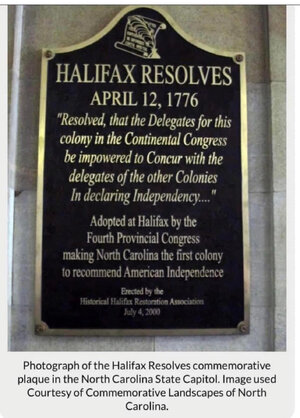
This is, at least from a certain historical perspective, the first major step taken toward “independency” 250 years ago.