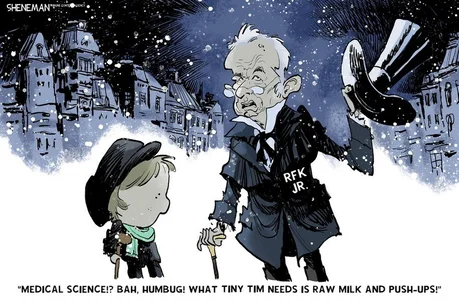
U.S. plans to stop recommending most childhood vaccines, defer to doctors
The plan, which is not finalized, suggests children get fewer shots and shifts to a model telling parents to consult doctors to make their own vaccine choices.

—>
https://wapo.st/4aXfzn5
“… The current U.S. schedule calls for vaccinations to protect against 18 infectious diseases, including covid-19, according to a Food and Drug Administration presentation in December, compared with calls for vaccinations to protect against
10 infectious diseases in Denmark.Denmark does not recommend vaccinating children for influenza, respiratory syncytial virus (RSV) and chicken pox, among other common pathogens.
Public health experts say comparisons to Denmark are misleading, noting the countries differ sharply in population, health systems and disease burden. They argue that what works in Denmark’s small, universal health care system does not easily translate to the far larger and more diverse U.S. population with uneven access to quality care.
“You don’t just superimpose policies from other countries without context onto the United States,” said Demetre Daskalakis, who oversaw the Centers for Disease Control and Prevention’s center for respiratory diseases and immunization before
he resigned from the agency in August. “This is not gold standard science.”
A Danish health official questioned why the U.S. would follow his country’s lead.
“Personally, I do not think this makes sense scientifically,” Anders Hviid, an official in Denmark’s Statens Serum Institute, which prevents and controls infectious diseases as part of the country’s ministry of health, wrote in an email early Saturday. “Public health is not one size fits all. It’s population specific and dynamic. Denmark and the U.S. are two very different countries.”
Unlike Denmark, the U.S. is planning a more limited approach for recommending vaccines to children known as shared clinical decision-making,which has not been reported. This means people should consult a doctor, pharmacist or other medical professional before getting a shot, and insurers would still be required to pay for them. It’s not clear how broad the shift would be and when it would happen.…”