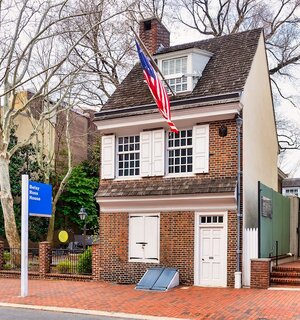
Continued...
Ross married upholstery apprentice John Ross in 1773, and the pair launched a small shop. John died in January 1776. Ross’ second husband, mariner
Joseph Ashburn, served the Revolution as a privateer and died in an
English prison. In 1783, another privateer, John Claypoole, became Ross’ third husband, and the couple raised a large family and lived full lives in the city.
My take on the legend’s veracity is that it is partly accurate, partly not, and there isn’t really any “first” flag.
What is certainly true is this: Ross found herself widowed in 1776 just as Philadelphia braced for British forces, an effort that required the building of a navy and new flags representing the Americans.
Women all around the seaport were getting contracts to stitch flags, and Ross surely wanted in.
The “Did she or didn’t she sew the ‘first flag’?” question is usually framed as a story of design, but it’s not: It’s a story of production.
Ross, drawing on years of experience, was saying to these potential clients, “If you want a lot of these flags, and fast, five-pointed stars work better.”
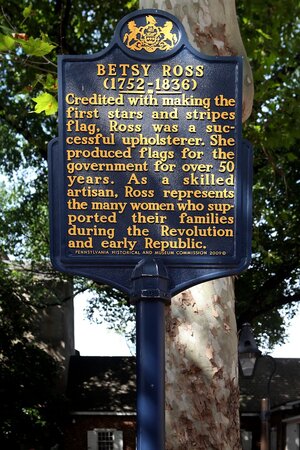
This 2009 historical marker outside the Betsy Ross House museum reflects evolving scholarly understandings of the real Betsy Ross.
Raymond Boyd/Michael Ochs Archives via Getty Images
Women’s massive wartime effort
When Betsy Ross told this story later to her children and grandchildren, at the heart of the story is a young craftswoman who met the “Father of Our Country” – and believed she taught him something.
Understanding Ross’ real life is important because her story offers a view of women’s massive wartime production of flags, uniforms, tents, knapsacks and more – and because of the deep pride she and women like her felt in their contributions to the independence movement.
Hundreds of Philadelphia women – including, briefly, Ross – manufactured ordnance for the Schuylkill arsenal. White, Black, Indigenous, enslaved and free women provided labor in the form of nursing, cooking, and making and maintaining clothes that was essential to military encampments. Women shaped diplomacy directly,
especially among Indigenous peoples, and indirectly as they shared their perspectives with husbands, fathers and sons. They also managed affairs for absent family and stretched scarce resources to sustain wartime households.
Whatever she did or did not offer to the making of the first U.S. flag, Elizabeth Griscom Ross Ashburn Claypoole certainly enjoyed a long career in flagmaking.
The best documentation for this came just before the War of 1812. When Purveyor of public supplies Tench Coxe needed flags, he steered contracts to the onetime Elizabeth Ross, now known as Elizabeth Claypoole. In 1808, for instance, Coxe recorded that yards of blue fabric were en route to her; weeks later, the craftswoman submitted a bill for two garrison flags, two silk flags and seven regimental colors.
In 1810, she was contracted for six 18-by-24-foot garrison flags for a military installation at New Orleans. These flags unfolded to 432 square feet and required more than 100,000 stitches. They must have been well received because another order followed, for 46 garrison flags, which she was to deliver “with all dispatch” to the arsenal. Orders also came in from the Indian Department to produce dozens of flags used in diplomatic exchanges with Native nations.
By the time the U.S. went to war with England a second time in 1812, flags by Elizabeth Claypoole, aka “Betsy Ross,” flew all around the United States.
Over her long career, Betsy Ross produced an unknown number of flags – the
hundred or so recorded in archival sources represent a fraction of her total output. As the U.S. observes the 250th anniversary of its independence, Ross’ real life – today fully interpreted by the dedicated staff of the Betsy Ross House – offers a view into the lives of working women across America whose wartime labor helped build a nation.
Betsy Ross probably did not sew the first American flag, but she was one of many craftswomen whose wartime labor helped build a nation.

theconversation.com