donbosco
Legend of ZZL
- Messages
- 7,250
Pasting this whole article because I'm not sure that the Gift link will work (there are images there)
Rare 1.24-acre listing in Chapel Hill’s historic core could test ‘missing middle’ era By Chantal Allam and Tammy Grubb Updated March 19, 2026 1:25 PM
Aerial photo of Chapel Hill. Grasty Realty Key Takeaways AI-generated summary reviewed by our newsroom.
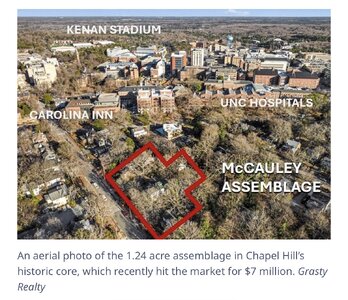
CHAPEL HILL — A 1.24‑acre cluster of properties has hit the market in Chapel Hill’s historic core, setting up a test of how aggressively investors are willing to bet on redevelopment inside one of the town’s most fiercely protected neighborhoods. Tucked inside the Cameron-McCauley Historic District and listed for $7 million, the four parcels at 213, 215, 219, and 223 McCauley St. hold five single-family homes dating back to the 1840s and early 1900s — four of which are registered contributing structures to the district. It’s south of the Franklin Street business district near UNC’s campus and The Carolina Inn.
Listing agent Tom Grasty of Chapel Hill-based Grasty Realty is marketing the site as the “largest residential downtown infill opportunity” to come online since the town’s new zoning changes. Land-use rules adopted in January are meant to attract more “missing middle” housing types — including duplexes, triplexes, quadplexes and apartments — to historically single-family neighborhoods like Cameron-McCauley. “The site is uniquely positioned to serve as a real-world test case for how the town’s recent zoning reforms could address the ‘missing middle’ housing gap, both locally and across the Triangle region,” Grasty said.
An aerial photo of the 1.24 acre assemblage in Chapel Hill’s historic core, which recently hit the market for $7 million. Grasty Realty
Since 2021, the town has been working to implement parts of its controversial Housing Choices strategy. The reforms seek to streamline development and attract more builders and developers interested in low- and middle-income housing projects. It’s part of a growing trend across the Triangle as the region grapples with a chronic housing shortage and affordability crisis. But over the years, it has sparked public outcry and thousands of emails to the town’s mayor and council.
Some experts say this listing raises fresh questions about growth and preservation.
Under the new rules, a developer could “by right” subdivide the assemblage into 13 lots or build up to 26 units. No public hearing would be required. Experts note, however, that the project couldn’t move forward without approval from the Historic District Commission, the body that decides whether proposed exterior changes are compatible with the district’s historic fabric. Depending on the buyer, “[we’ll] see if the [town] has the appetite to allow for gentle density within a historic district,” Grasty said. He said he’s received strong interest from “a handful of investors.”
The seller is Bibb Latané, 88, a retired social psychologist who directed UNC’s Institute for Research in Social Science in the 1980s. (Latané co-discovered the “bystander effect,” a landmark finding that showed people are less likely to help when others are present.) Latané acquired the parcels, which are now valued at $3.86 million, over a span of decades, according to deed records. He recently established the Center for Understanding Racism and Slavery and plans to use the sale’s proceeds to set up a small research and educational center from his home around the corner at 212 Vance St., he said.
Former UNC social psychology professor Bibb Latané is selling a collection of properties on McCauley Street in Chapel Hill, NC. He plans to use the proceeds to fund the Center for Understanding Slavery and Racism. Dan Sears UNC-Chapel Hill file photo
The homes are currently rental units. Latané said he’s open to a buyer who will either keep them as rentals or develop what is allowed “by-right.” The next phase “will largely fall to whoever ultimately acquires the property,” he told The N&O in an email. “Of course, one must respect the past without freezing a community in place,” he added. “My hope is that whoever acquires the property will demonstrate that those two goals — preservation and adaptation — are not mutually exclusive.”
Rare 1.24-acre parcel in Chapel Hill’s historic core Cameron–McCauley is one of Chapel Hill’s three local and National Register historic districts, alongside Franklin-Rosemary and Gimghoul. It’s known for its quiet, tree-lined streets, mature trees and mix of Craftsman, Colonial Revival and early 20th-century bungalow-style homes. Among the features: deep porches, exposed rafters, low-pitched roofs, and classical columns, all of which are visible from the listing’s photos. Together, the property offers 26 “income-producing” rooms, 22 full baths, four half-baths, 30 parking spaces, a detached garage and a small courtyard.
It includes the two-story, white Colonial revival at 219 McCauley St., built in 1907 and one of the district’s “earliest substantial homes”; and a small pastel-colored cottage at 215 McCauley St. known as the “Pink House,” especially among UNC students and longtime residents.
Here’s a closer look. A listing photo of 223 McCauley St., one of a cluster of historic homes for sale in Chapel Hill. Grasty Realty 219 McCauley St. in Chapel Hill Grasty Realty 219C McCauley St. (”Andrews House”) in Chapel Hill Grasty Realty 213 McCauley St. Grasty Realty 215 McCauley St. (”The Pink House”) in Chapel Hill
Grasty Realty Aerial photo of McCauley Commons in Chapel Hill. Grasty Realty High‑stakes housing test: Can Chapel Hill add density without losing its past? Why this retired UNC professor is selling his estate to fund racism education
“On the Market: Keep up with the latest Triangle real estate news by subscribing to On the Market, The News & Observer's free weekly real estate newsletter.” Look for it in your inbox every Thursday morning. Sign up here. This story was originally published March 19, 2026 at 7:30 AM. Related Stories from Raleigh News & Observer
Read more at: https://www.newsobserver.com/news/business/real-estate-news/article315073997.html#storylink=cpy
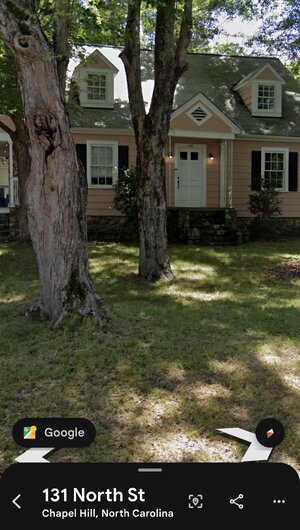
PS, the house referred to here as "The Pink House" is most definitely NOT the "Pink House" that I knew for years (the Real Pink House is on North Street)
Rare 1.24-acre listing in Chapel Hill’s historic core could test ‘missing middle’ era By Chantal Allam and Tammy Grubb Updated March 19, 2026 1:25 PM
Aerial photo of Chapel Hill. Grasty Realty Key Takeaways AI-generated summary reviewed by our newsroom.
CHAPEL HILL — A 1.24‑acre cluster of properties has hit the market in Chapel Hill’s historic core, setting up a test of how aggressively investors are willing to bet on redevelopment inside one of the town’s most fiercely protected neighborhoods. Tucked inside the Cameron-McCauley Historic District and listed for $7 million, the four parcels at 213, 215, 219, and 223 McCauley St. hold five single-family homes dating back to the 1840s and early 1900s — four of which are registered contributing structures to the district. It’s south of the Franklin Street business district near UNC’s campus and The Carolina Inn.
Listing agent Tom Grasty of Chapel Hill-based Grasty Realty is marketing the site as the “largest residential downtown infill opportunity” to come online since the town’s new zoning changes. Land-use rules adopted in January are meant to attract more “missing middle” housing types — including duplexes, triplexes, quadplexes and apartments — to historically single-family neighborhoods like Cameron-McCauley. “The site is uniquely positioned to serve as a real-world test case for how the town’s recent zoning reforms could address the ‘missing middle’ housing gap, both locally and across the Triangle region,” Grasty said.
An aerial photo of the 1.24 acre assemblage in Chapel Hill’s historic core, which recently hit the market for $7 million. Grasty Realty
Since 2021, the town has been working to implement parts of its controversial Housing Choices strategy. The reforms seek to streamline development and attract more builders and developers interested in low- and middle-income housing projects. It’s part of a growing trend across the Triangle as the region grapples with a chronic housing shortage and affordability crisis. But over the years, it has sparked public outcry and thousands of emails to the town’s mayor and council.
Some experts say this listing raises fresh questions about growth and preservation.
Under the new rules, a developer could “by right” subdivide the assemblage into 13 lots or build up to 26 units. No public hearing would be required. Experts note, however, that the project couldn’t move forward without approval from the Historic District Commission, the body that decides whether proposed exterior changes are compatible with the district’s historic fabric. Depending on the buyer, “[we’ll] see if the [town] has the appetite to allow for gentle density within a historic district,” Grasty said. He said he’s received strong interest from “a handful of investors.”
The seller is Bibb Latané, 88, a retired social psychologist who directed UNC’s Institute for Research in Social Science in the 1980s. (Latané co-discovered the “bystander effect,” a landmark finding that showed people are less likely to help when others are present.) Latané acquired the parcels, which are now valued at $3.86 million, over a span of decades, according to deed records. He recently established the Center for Understanding Racism and Slavery and plans to use the sale’s proceeds to set up a small research and educational center from his home around the corner at 212 Vance St., he said.
Former UNC social psychology professor Bibb Latané is selling a collection of properties on McCauley Street in Chapel Hill, NC. He plans to use the proceeds to fund the Center for Understanding Slavery and Racism. Dan Sears UNC-Chapel Hill file photo
The homes are currently rental units. Latané said he’s open to a buyer who will either keep them as rentals or develop what is allowed “by-right.” The next phase “will largely fall to whoever ultimately acquires the property,” he told The N&O in an email. “Of course, one must respect the past without freezing a community in place,” he added. “My hope is that whoever acquires the property will demonstrate that those two goals — preservation and adaptation — are not mutually exclusive.”
Rare 1.24-acre parcel in Chapel Hill’s historic core Cameron–McCauley is one of Chapel Hill’s three local and National Register historic districts, alongside Franklin-Rosemary and Gimghoul. It’s known for its quiet, tree-lined streets, mature trees and mix of Craftsman, Colonial Revival and early 20th-century bungalow-style homes. Among the features: deep porches, exposed rafters, low-pitched roofs, and classical columns, all of which are visible from the listing’s photos. Together, the property offers 26 “income-producing” rooms, 22 full baths, four half-baths, 30 parking spaces, a detached garage and a small courtyard.
It includes the two-story, white Colonial revival at 219 McCauley St., built in 1907 and one of the district’s “earliest substantial homes”; and a small pastel-colored cottage at 215 McCauley St. known as the “Pink House,” especially among UNC students and longtime residents.
Here’s a closer look. A listing photo of 223 McCauley St., one of a cluster of historic homes for sale in Chapel Hill. Grasty Realty 219 McCauley St. in Chapel Hill Grasty Realty 219C McCauley St. (”Andrews House”) in Chapel Hill Grasty Realty 213 McCauley St. Grasty Realty 215 McCauley St. (”The Pink House”) in Chapel Hill
Grasty Realty Aerial photo of McCauley Commons in Chapel Hill. Grasty Realty High‑stakes housing test: Can Chapel Hill add density without losing its past? Why this retired UNC professor is selling his estate to fund racism education
“On the Market: Keep up with the latest Triangle real estate news by subscribing to On the Market, The News & Observer's free weekly real estate newsletter.” Look for it in your inbox every Thursday morning. Sign up here. This story was originally published March 19, 2026 at 7:30 AM. Related Stories from Raleigh News & Observer
Read more at: https://www.newsobserver.com/news/business/real-estate-news/article315073997.html#storylink=cpy
PS, the house referred to here as "The Pink House" is most definitely NOT the "Pink House" that I knew for years (the Real Pink House is on North Street)