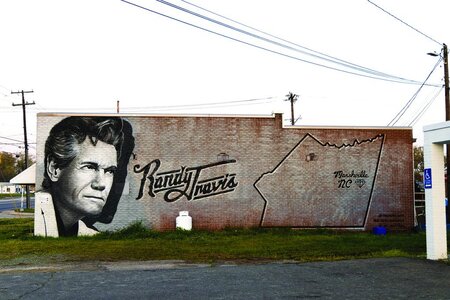
“I kept thinking, ‘How cool would it be if I could go to towns across the state and paint outdoor murals of these North Carolina musicians in their hometowns?’” he said. “These are people — like blues guitarist and singer ‘Blind Boy Fuller’ from Wadesboro — that we never heard about in fourth grade history class, yet these people have had an impact on my life.”
“When I found out that trailblazers like Roberta Flack, Randy Travis, Nina Simone and Earl Scruggs are all from the same state, I had to tell everybody I knew.”
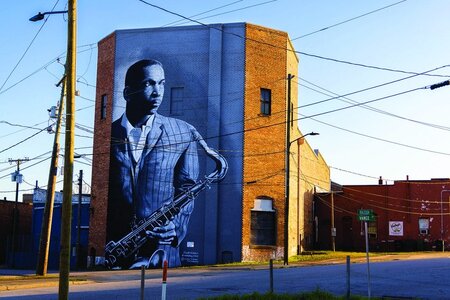
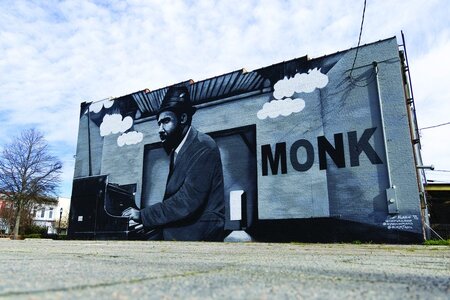
Nurkin painted his first mural — of jazz saxophonist John Coltrane — in Hamlet. Coltrane received two Grammy Awards. (photo by Jared Caldwell)
When COVID-19 hit and towns were canceling music festivals, that freed up some arts funding. An idea that Nurkin and fellow Tar Heel Greg Lowenhagen (American studies ’99) had pitched to the city of Hamlet to paint a mural of jazz saxophonist John Coltrane finally came to fruition. (Coltrane was born in Hamlet but grew up in High Point.) With the completion of that first mural in June 2020, the N.C. Musician Murals Project was born.
“It’s a six-story mural on the back of the Hamlet Theatre, which has its own legendary history,” Nurkin said. “Black people were not allowed in that building for the better part of the 20th century, and now you have this 60-foot portrait of Hamlet’s most famous musician.”
Nurkin’s website for the project describes Coltrane as a “composer who helped define jazz as an American art form.”
A drummer’s dream
In January, Nurkin completed his 22nd mural in the N.C. Musician Murals Project in Elizabeth City.
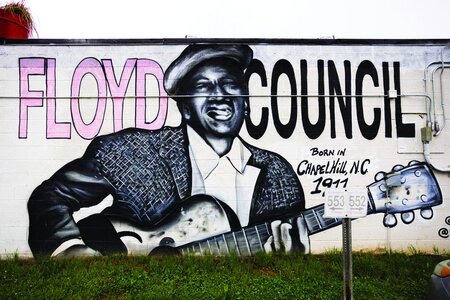
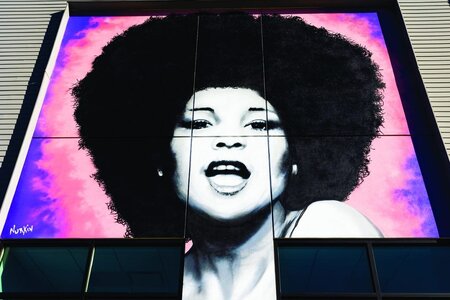
Chapel Hill-born Floyd Council and fellow blues musician Pink Anderson were the inspiration for rock band Pink Floyd’s name. (photo by Jared Caldwell)
This latest one was special.
Nurkin had idolized jazz drummer Max Roach for years. Roach is considered one of the most important drummers in history and among the most widely recorded modern percussionists — having worked with jazz legends like Dizzy Gillespie, Duke Ellington and Miles Davis. He was born in the township of Newland, near Elizabeth City.
“Since I was a boy, I’ve looked at Max Roach as a hero, a larger-than-life icon,” Nurkin wrote on Instagram. “I remember very distinctly an issue of
Modern Drummer that had him on the cover with the caption, ‘The man who changed the way you play drums.’”
Roach, who died in 2007, would have been 100 this year. Not only did Elizabeth City commission a mural of Roach downtown on Water Street, city and cultural officials have planned multiple centennial celebrations this year in Roach’s honor.
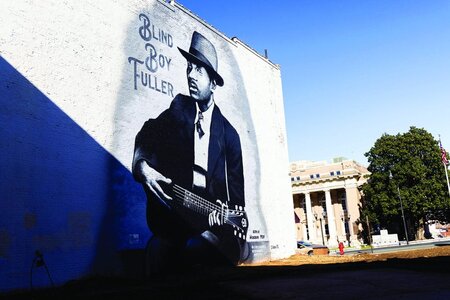
Fulton Allen, known as “Blind Boy Fuller,” was a pioneering Piedmont blues guitarist and singer; his mural is in Wadesboro. (photo by Jared Caldwell)
Deborah Malenfant, executive director of Elizabeth City Downtown Inc., said Nurkin’s murals “make you stop in your tracks to admire them from a distance, and then again close up to check out the details. They have a ‘wow’ factor.”
Malenfant calls each mural in the N.C. Musician Murals Project “a destination piece.” She believes the Roach mural will have a positive impact on tourism, and she said it has already received quite a bit of attention.
“I love the dialogue it has started,” she said. “Many people did not realize Max Roach was from here. It’s been a great opportunity to engage people in learning about our local cultural history. It not only connects people to Max Roach’s story, but our community stories.”
Nurkin has more murals in the works this year, including one of Kinston native Maceo Parker, a funk and soul jazz saxophonist who played with James Brown and Prince.
His creative inspiration
It is a blustery 35-degree day in mid-January when Nurkin agrees to meet in Carrboro for a photo session at one of his murals.
This brings to mind a question about what it is like to work as a muralist in extreme weather.
“I typically stop at 45 degrees if I can, but if it’s freezing cold or wet, I don’t do it because it can affect the work,” he said.
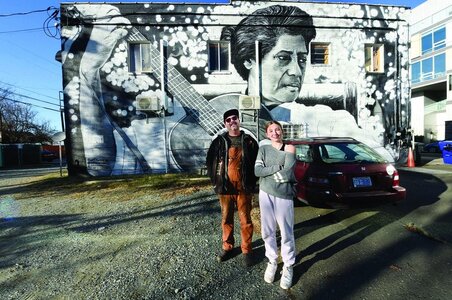
Nurkin says his 12-year-old daughter, Finch, is his “creative inspiration.” (photo by Donn Young)
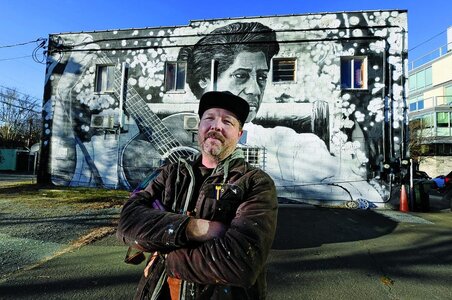
Behind Nurkin, painted on the side of an old barber shop at 111 N. Merritt Mill Road, is a mural honoring folk and blues musician Elizabeth Cotten, who wrote her most famous song, “Freight Train,” at age 11. She learned to play guitar upside down, an adaptation by a left-handed guitar player with a right-handed guitar. Cotten won a Grammy at the age of 91 in 1984 and was posthumously inducted into the Rock & Roll Hall of Fame in 2022.
Katz walks by that mural in Carrboro regularly, and the music professor said it always brightens his day.
“I love to see Elizabeth Cotten recognized so boldly in her hometown,” Katz said. “These murals are a great recognition of and contribution to our state’s cultural heritage.”
When asked about his creative inspiration, Nurkin doesn’t hesitate: “My 12-year-old daughter, Finch.”
Finch, who is also an artist, is with her dad on this particular day, hanging out after school. The two enjoy painting together, and Finch said she loves bragging about her dad to her friends.
In the summer, she sometimes accompanies Nurkin as he heads to another North Carolina town for an assignment. The two enjoy seeing new places and chatting with locals.
“I love it when we’re doing a painting and someone will stop by and say, ‘I really love that you’re highlighting this particular person,’” Finch said. “‘And I love that you’re doing it
here.’”
Learn more about Nurkin’s project and where to find the murals on Instagram, @ncmusicianmurals, or at musicanmuralsproject.com.
By Kim Weaver Spurr ’88
Scott Nurkin celebrates North Carolina’s contributions to the American songbook by painting murals of legendary musicians in their hometowns.

magazine.college.unc.edu