1moretimeagain
Inconceivable Member
- Messages
- 4,772
Scuse! lol

Follow along with the video below to see how to install our site as a web app on your home screen.
Note: This feature may not be available in some browsers.


 time.com
Scuse! lol
Here's why this sort of thing happens. The way these things are trained is to put sensors on a car with real drivers. In Tesla's case, that sensors a camera and in Waymo's case those sensors are cameras, sonar, lidar, maybe radar.
So you have human giving inputs to the car, wheel turns left wheel turns right, touch the brake 30%, touch the accelerator 50%, etc. these inputs are recorded at the same time the sensors output recorded.
Over millions of hours of driving, the AI model gets an idea about what to do. It doesn't see a red light but it does see pixels of red coming from the camera and it figures out that whenever the pixels look like this, the drivers tend to do that. It can then try to duplicate those actions later in self-driving mode.
It works very well for normal driving. It's trained on millions of hours of following the road and stopping at stoplights and merging into a different lane when there's a slower car in front of you. But it doesn't do a good job for edge cases or things that are not common that it never sees. It definitely sees flashing police lights in the normal course of driving and it knows to avoid them but it's very rarely sees a shootout happening so it doesn't really know what to do. The same thing happened a few years ago when a car encountered horses or an overturned vehicle. It hadn't seen that before and behaved badly.
I took 2 waymo trips last month on San Fran. Some of motion was abrupt but it was great. Even witnessed some confusion/stall due to an empty, parked car jutting to far into the road. We actually hit the support button and chatted with a human just as it was doing a 10-pt turn to figure it's move to slightly swerve around it.This was actually an Elon call not to put lidar and other non-opical sensors on Tesla cars. Lidar is really expensive. They also used to have big maintenance issues because there were more moving parts that broke. So while Tesla's cars are able to be sold at a more realistic price in line with the consumer car market, the self driving outcomes may not be as good long-term. Waymo's cars cost about $200,000 a piece to make, although that could come down with mass production but doubtful it would come down to the regular car market.



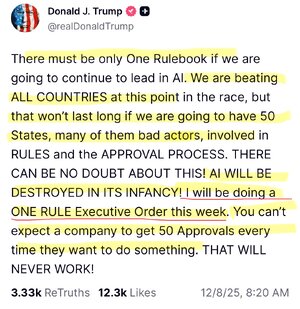
I assume my home state of Massachusetts is a bad actor. For shame. Maybe we could become part of Canada. That would suit me fine.
I definitely agree with this. It worked for the internet.
You think Trump was implying congress would have a say in the matter?I definitely agree with this. It worked for the internet.
I get that states like to throw their weight around with things like cars and textbooks but I would very much prefer that this sort of rulemaking be done at the federal level with the guidance of representatives from the states in Congress.
I’m impressed by the PR team’s creativity and possibly their sense of humor as well.
If only someone would create a federal educational department. Oh, wait.I definitely agree with this. It worked for the internet.
I get that states like to throw their weight around with things like cars and textbooks but I would very much prefer that this sort of rulemaking be done at the federal level with the guidance of representatives from the states in Congress.