A guy at the PAAS/SAAS software co i work for demo'd some really impressive stuff (it is already making our jobs way easier) which could probably replace 90% of our QA, Engineering, Support and Docs folks at some point in the future. The company could be fine with a few product managers, an architecture type person who understands the full pic and can drive the prompting, and a few junior architect and SME types who can routinely provide feedback and fine-tuning for the system which creates the code, the testing, maintains the code, the monitoring, writes the docs and provides the support. Once image generation gets better it could even create training materials in case the architect retires.I feel like we are all dead men walking at this point, with respect to our careers. In 200 years, if we are still around, we will have probably figured it out, and I doubt money, ownership of real estate, etc. will still exist. But the question is - how do we get there? The next few decades will be very strange. If you are 35, I’m not even sure how you begin to plan for retirement.

Navigation
Install the app
How to install the app on iOS
Follow along with the video below to see how to install our site as a web app on your home screen.
Note: This feature may not be available in some browsers.
More options
You are using an out of date browser. It may not display this or other websites correctly.
You should upgrade or use an alternative browser.
You should upgrade or use an alternative browser.
Coding, Data Science, A.I., Robots |
- Thread starter nycfan
- Start date
- Replies: 804
- Views: 31K
- Off-Topic
gtyellowjacket
Inconceivable Member
- Messages
- 3,248
I don't think it's quite there yet but it is getting a whole heck of a lot closer. The problem we run into is the context memory. You'll be working on a problem and give it requirements. It'll start doing requirements one and two and three but forget requirements 4 through 10. So you prompted with the requirement for four and it forgets one two and three. It doesn't do a great job putting everything together but when it comes to individual pieces, it is amazing.A guy at the PAAS/SAAS software co i work for demo'd some really impressive stuff (it is already making our jobs way easier) which could probably replace 90% of our QA, Engineering, Support and Docs folks at some point in the future. The company could be fine with a few product managers, an architecture type person who understands the full pic and can drive the prompting, and a few junior architect and SME types who can routinely provide feedback and fine-tuning for the system which creates the code, the testing, maintains the code, the monitoring, writes the docs and provides the support. Once image generation gets better it could even create training materials in case the architect retires.
gtyellowjacket
Inconceivable Member
- Messages
- 3,248
Try this. Put your code into something like Claude and ask it to create documentation and then see how good it is coming out. I think it's going to be really good but would be interested in what you see.It is official: i'm slacking on internal documentation at work for sake of job security. I don't love this job, but I don't want to hasten my demise. The better our internal docs, the better our AI projects will be at minimizing the need for expensive humans on payroll.
If I were you, I would try to start sliding into a product owner and product manager type roles. Good ones are still going to offer a lot of value.
Let's hope for the general white collar labor market the context issues remain a problem. And power gets expensive, chips don't get more efficientI don't think it's quite there yet but it is getting a whole heck of a lot closer. The problem we run into is the context memory. You'll be working on a problem and give it requirements. It'll start doing requirements one and two and three but forget requirements 4 through 10. So you prompted with the requirement for four and it forgets one two and three. It doesn't do a great job putting everything together but when it comes to individual pieces, it is amazing.

Honestly, my mind had some trouble just keeping up with the black magic behind the black magic. Using "DeepEval" to improve the black magic created graphs and stuff.I don't think it's quite there yet but it is getting a whole heck of a lot closer. The problem we run into is the context memory. You'll be working on a problem and give it requirements. It'll start doing requirements one and two and three but forget requirements 4 through 10. So you prompted with the requirement for four and it forgets one two and three. It doesn't do a great job putting everything together but when it comes to individual pieces, it is amazing.
Last edited:
gtyellowjacket
Inconceivable Member
- Messages
- 3,248
Some of the black magic, even the geniuses don't know. LLMs are mostly black boxes that get a little gray around the edges.Honestly, my mind had some trouble just keeping up with the black magic behind the black magic. Using "DeepEval" to improve the black magic created graphs and stuff.
The tools are a little bit better for determining why agents make decisions one way versus the other. Not great but better than evaluating why an llm gave one answer versus another.
I haven't heard of deepeval though and that is a project our team is literally working on right now. Thank you.

ChapelHillSooner
Iconic Member
- Messages
- 1,412
So I was thinking about something the other day and am curious about all your thoughts on it.
First, I and others I work with have noticed rapid improvements in AI’s ability to digest software systems, fix problems, and create code for enhancements. If you set it up to recursively troubleshoot (and it can figure out a lot itself on how to do so) it can be very solid. It is to the point where I am barely writing code anymore. It would just take me far too much time compared to what Claude Code can do.
It is terrifying. I think AI is approaching that level in most white collar fields.
That got me to thinking on how AI is better at intellectual tasks than every day tasks like navigating through an environment, etc. Blue collar jobs will be the last to be replaced. I think that that is pretty well the consensus.
That got me to think about brain power and how our subconscious mind is likely far more complex than our conscious mind, and jobs that require altering a physical environment rely on those subconscious parts. Things like quickly digesting the 3d world we occupy is something that is mostly subconscious yet it is an extremely complex task. Facial recognition is another. (AI can be really good at that but only because it can quantify a limited set of facial features which is far more simplistic than what the human brain fines.).
I know it’s a pretty simple question that neuroscience can answer but I suspect we are only aware of a fraction of what our brain does. And that (along with required robotics advancements) is why blue collar jobs will remain long after white collar jobs disappear.
What do you think?
First, I and others I work with have noticed rapid improvements in AI’s ability to digest software systems, fix problems, and create code for enhancements. If you set it up to recursively troubleshoot (and it can figure out a lot itself on how to do so) it can be very solid. It is to the point where I am barely writing code anymore. It would just take me far too much time compared to what Claude Code can do.
It is terrifying. I think AI is approaching that level in most white collar fields.
That got me to thinking on how AI is better at intellectual tasks than every day tasks like navigating through an environment, etc. Blue collar jobs will be the last to be replaced. I think that that is pretty well the consensus.
That got me to think about brain power and how our subconscious mind is likely far more complex than our conscious mind, and jobs that require altering a physical environment rely on those subconscious parts. Things like quickly digesting the 3d world we occupy is something that is mostly subconscious yet it is an extremely complex task. Facial recognition is another. (AI can be really good at that but only because it can quantify a limited set of facial features which is far more simplistic than what the human brain fines.).
I know it’s a pretty simple question that neuroscience can answer but I suspect we are only aware of a fraction of what our brain does. And that (along with required robotics advancements) is why blue collar jobs will remain long after white collar jobs disappear.
What do you think?

- Messages
- 46,577
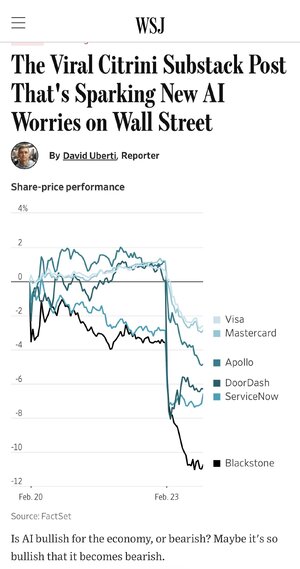

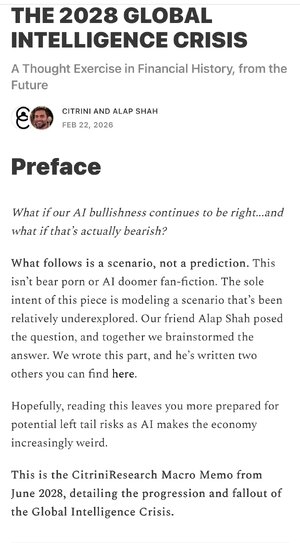
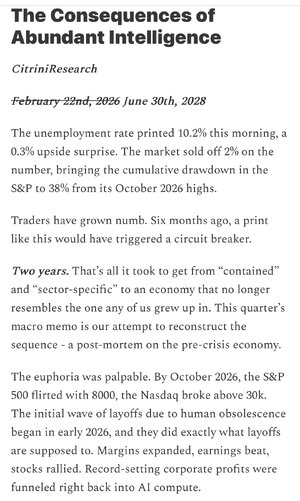
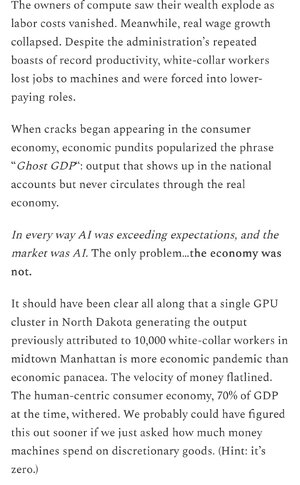
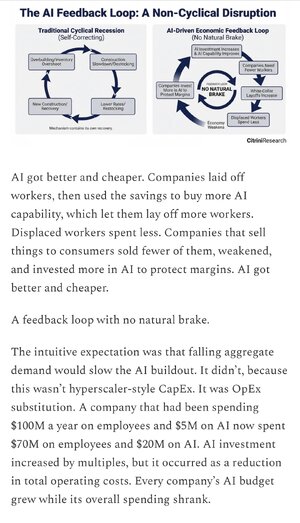
THE 2028 GLOBAL INTELLIGENCE CRISIS
A Thought Exercise in Financial History, from the Future
 www.citriniresearch.com
gtyellowjacket
Inconceivable Member
- Messages
- 3,248
I didn't follow much of it, but I do think certain blue collar jobs will remain while others won't. Some started declining 20 years ago like manufacturing. Others like truck driver and cabbie are heading towards eclipse. Train driver/engineer and maybe even airline pilot might go that way in our lifetimes.So I was thinking about something the other day and am curious about all your thoughts on it.
First, I and others I work with have noticed rapid improvements in AI’s ability to digest software systems, fix problems, and create code for enhancements. If you set it up to recursively troubleshoot (and it can figure out a lot itself on how to do so) it can be very solid. It is to the point where I am barely writing code anymore. It would just take me far too much time compared to what Claude Code can do.
It is terrifying. I think AI is approaching that level in most white collar fields.
That got me to thinking on how AI is better at intellectual tasks than every day tasks like navigating through an environment, etc. Blue collar jobs will be the last to be replaced. I think that that is pretty well the consensus.
That got me to think about brain power and how our subconscious mind is likely far more complex than our conscious mind, and jobs that require altering a physical environment rely on those subconscious parts. Things like quickly digesting the 3d world we occupy is something that is mostly subconscious yet it is an extremely complex task. Facial recognition is another. (AI can be really good at that but only because it can quantify a limited set of facial features which is far more simplistic than what the human brain fines.).
I know it’s a pretty simple question that neuroscience can answer but I suspect we are only aware of a fraction of what our brain does. And that (along with required robotics advancements) is why blue collar jobs will remain long after white collar jobs disappear.
What do you think?
Based on current technology, I think blue collar jobs like electrician, and plumber are a long way from being AI'd away. There is just way too much variability and fine motor skill needed and the training data is really hard to acquire.

1moretimeagain
Inconceivable Member
- Messages
- 4,894
Even assuming blue collar jobs aren’t eliminated, if the white collar jobs are eliminated then the supply of potential blue collar employees would expand significantly.
1moretimeagain
Inconceivable Member
- Messages
- 4,894
1moretimeagain
Inconceivable Member
- Messages
- 4,894
“What if, I think there are 2 million commercial truckers in the United States, and there are lots of other examples you can give. There's a thought exercise, and you could push a button, eliminate all of them, and they make $120,000 on average. Save fuel, save lives, save time, a more efficient system, less disrupted highways, all that beautiful stuff. Would you do it if you put 2 million people on the street where even if there are jobs available, that next job is $25,000 a year, stocking shelves. I was saying, "That's kind of really bad, kind of civilly, should we as society agree to that?" I don't think so. I was talking about the business and government, and they should start thinking today, not when it happens, what would we do to deal with the [AI] issue? It's got to be business and government."

- Messages
- 4,675
“What if, I think there are 2 million commercial truckers in the United States, and there are lots of other examples you can give. There's a thought exercise, and you could push a button, eliminate all of them, and they make $120,000 on average. Save fuel, save lives, save time, a more efficient system, less disrupted highways, all that beautiful stuff. Would you do it if you put 2 million people on the street where even if there are jobs available, that next job is $25,000 a year, stocking shelves. I was saying, "That's kind of really bad, kind of civilly, should we as society agree to that?" I don't think so. I was talking about the business and government, and they should start thinking today, not when it happens, what would we do to deal with the [AI] issue? It's got to be business and government."
I am glad someone is discussing this
superrific
Master of the ZZLverse
- Messages
- 13,514
Glad Jamie Dimon is finally clued in. We've had that discussion in legal academia for more than a decade now. Almost since the first self-driving cars.“What if, I think there are 2 million commercial truckers in the United States, and there are lots of other examples you can give. There's a thought exercise, and you could push a button, eliminate all of them, and they make $120,000 on average. Save fuel, save lives, save time, a more efficient system, less disrupted highways, all that beautiful stuff. Would you do it if you put 2 million people on the street where even if there are jobs available, that next job is $25,000 a year, stocking shelves. I was saying, "That's kind of really bad, kind of civilly, should we as society agree to that?" I don't think so. I was talking about the business and government, and they should start thinking today, not when it happens, what would we do to deal with the [AI] issue? It's got to be business and government."

JCTarheel82
Inconceivable Member
- Messages
- 2,896
“What if, I think there are 2 million commercial truckers in the United States, and there are lots of other examples you can give. There's a thought exercise, and you could push a button, eliminate all of them, and they make $120,000 on average. Save fuel, save lives, save time, a more efficient system, less disrupted highways, all that beautiful stuff. Would you do it if you put 2 million people on the street where even if there are jobs available, that next job is $25,000 a year, stocking shelves. I was saying, "That's kind of really bad, kind of civilly, should we as society agree to that?" I don't think so. I was talking about the business and government, and they should start thinking today, not when it happens, what would we do to deal with the [AI] issue? It's got to be business and government."
Trump and his billionaire oligarchs will gleefully put workers on the streets to further enrich themselves.
1moretimeagain
Inconceivable Member
- Messages
- 4,894
Share: