Crypto News

  • Thread starter Thread starter nycfan
  • Start date Start date
  • Replies: 298
  • Views: 10K
  • Politics 
IMG_4590.jpeg


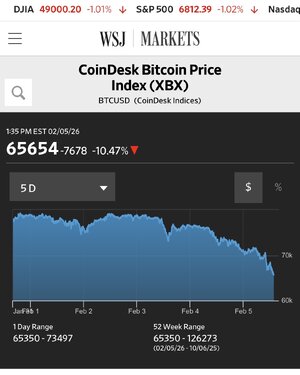
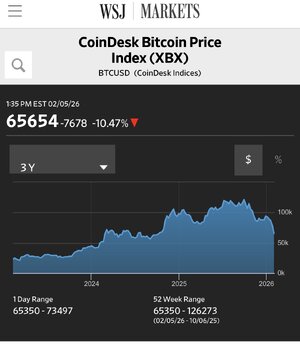
“… That decline is actually not unusual at all. Crypto is notoriously volatile, and it’s gone through numerous crashes that are bigger than this one.

… fear has powered a record rally in gold prices, which recently blew past $5,500 a troy ounce. Gold is the ultimate safe haven: a relatively rare and tangible asset that stores value – and is able to be literally hidden under a mattress if worse came to worst.

But bitcoin isn’t coming along.

It’s lost 20% this year despite all the uncertainty.

In fact, Michael Burry, (the “Big Short” guy), recently wrote on his Substack that he believes gold and silver’s extreme volatility in recent days is because bitcoin bulls are selling off their metal positions to save face from crypto’s slide.

… Bitcoin’s bust means it lost its entire “Trump bump.”

… So what’s behind this new crypto winter? Mostly doubts that bitcoin is “digital gold,” after all….”
 
One wonders in crypto has been used for collateral for things like commercial real estate loans. Could get ugly.
growing rapidly, but still small
 
growing rapidly, but still small
Mostly to the extent it is happening, the LTV is at a steep discount with a mandatory prepay obligation if the loan gets out of formula — so if you put up Bitcoin, you can only borrow at 50-60% of the value (calculated daily or weekly average or whatever) of the collateral (plus usually a fixed cap on aggregate borrowing regardless how much the price increases) and if you borrowed heavily when Bitcoin was $115,000, you’ve probably had to either provide more collateral and/or pay down the loan to get back in formula.

For example, say a borrower put up Bitcoin valued at $10 million (we’ll say 100 coins then trading at $100,000 each), the borrowing base is probably 50% of the collateral value and no more than 60% of the value of the collateral at that time (maybe based on a week/month/quarter average). So in that case, the borrower could borrow no more than $5 million against the collateral (50% of $10 million) at the time and no more than $6.5 million max outstanding at any time even if the value of the Bitcoin doubled.

So even if Bitcoin had jumped to $200,000 per coin, which would’ve meant you could borrow up to $10 million based on the 50% borrowing base, the borrower could only actually borrow up to $6.5 million (the hard cap), though might be allowed to remove some collateral if the value remains that high for a sustained period.

But if the borrower borrowed $5 million and now the coins are $67,000 each, then his/her borrowing cannot exceed $3.35 million, so he/she has a mandatory prepayment to reduce the borrowing to $3.35 million (or even less depending on the terms) or provide sufficient collateral to cover the 50% borrowing base.

Anyway, that is the simple version and some lenders are more aggressive than others and might be giving much riskier terms than I describe above. And most major lenders have yet to get comfortable with crypto has primary collateral for all kinds or reasons.

 
I honestly wonder how much bitcoin has caused our current employment situation.

Let's say a company raises money and builds a factory for $500M. It hires people when building the factory = jobs. After the factory is built, it operates = jobs. It produces goods, which are transported and sold = jobs.

But if you invest $500M in bitcoin, you can create jobs akin to the construction costs of the factory. I mean, I suppose -- lots of people do work in crypto, though I don't know exactly what they do. But regardless, the investment returns nothing macroeconomically. There are no jobs created at the back end. There are no jobs downstream.

And the money that is "invested" in crypto just sits there. A bank that gets $100K in deposits from someone can loan out the majority of that money, thus fueling economic activity. I don't know if "de fi" allows crypto to be treated as deposits in this way, but I doubt it.

In other words, the crypto economy has: a) taken real assets; b) dumped them into electricity consumption and disposable trash hardware; c) diverted labor; and d) pulls money out of the financial system in order to produce a bunch of numbers in a data table. This is the kind of thing that makes a society poorer and we are taking the hit.
 
I honestly wonder how much bitcoin has caused our current employment situation.

Let's say a company raises money and builds a factory for $500M. It hires people when building the factory = jobs. After the factory is built, it operates = jobs. It produces goods, which are transported and sold = jobs.

But if you invest $500M in bitcoin, you can create jobs akin to the construction costs of the factory. I mean, I suppose -- lots of people do work in crypto, though I don't know exactly what they do. But regardless, the investment returns nothing macroeconomically. There are no jobs created at the back end. There are no jobs downstream.

And the money that is "invested" in crypto just sits there. A bank that gets $100K in deposits from someone can loan out the majority of that money, thus fueling economic activity. I don't know if "de fi" allows crypto to be treated as deposits in this way, but I doubt it.

In other words, the crypto economy has: a) taken real assets; b) dumped them into electricity consumption and disposable trash hardware; c) diverted labor; and d) pulls money out of the financial system in order to produce a bunch of numbers in a data table. This is the kind of thing that makes a society poorer and we are taking the hit.
Hence the apparent decoupling of GDP growth and employment.


I knew the computing power and electrical power and supporting infrastructure were expensive but didn’t realize how big the gap was becoming.
 
I really don’t know much about this stuff because I’m not buying bitcoin so I’d rather read a book or doom scroll Donald Trump news. If bitcoin crashing helps the environment, sign me up.


I knew the computing power and electrical power and supporting infrastructure were expensive but didn’t realize how big the gap was becoming.

A successful bitcoin "mine" -- i.e. finding a key to post a block -- gives 3 BTC as a reward (per google). So it's 90K in cost against 180K in benefit. That's an inherent return justified by the risk of never actually finding one.
 
Back
Top