
CURRENT EVENTS General | March

  • Thread starter Thread starter nycfan
  • Start date Start date
  • Replies: 394
  • Views: 7K
  • Politics 
IMG_5747.jpeg


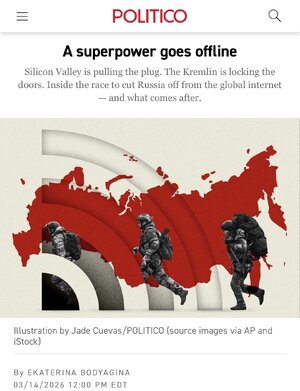
“…Telegram would be joining a home screen’s worth of apps that have become useless to Russians.

Kremlin policymakers have already blocked or limited access to WhatsApp, along with parent company Meta’s Facebook and Instagram, Microsoft’s LinkedIn, Google’s YouTube, Apple’s FaceTime, Snapchat and X, which like SpaceX is owned by Musk. Encrypted messaging apps Signal and Discord, as well as Japanese-owned Viber, have been inaccessible since 2024.

Last month, President Vladimir Putin signed a law requiring telecom operators to block cellular and fixed internet access at the request of the Federal Security Service. Shortly after it took effect on March 3, Moscow residents reported widespread problems with mobile internet, calls and text messages across all major operators for several days, with outages affecting mobile service and Wi-Fi even inside the State Duma.

Those decisions have left Russians increasingly cut off from both the outside world and one another, complicating battlefield coordination and disrupting online communities that organize volunteer aid, fundraising and discussion of the war effort.

Deepening digital isolation could turn Russia into something akin to “a large, nuclear-armed North Korea and a junior partner to China,” according to Alexander Gabuev, the Berlin-based director of the Carnegie Russia Eurasia Center.…”
 
IMG_5747.jpeg


“…Telegram would be joining a home screen’s worth of apps that have become useless to Russians.

Kremlin policymakers have already blocked or limited access to WhatsApp, along with parent company Meta’s Facebook and Instagram, Microsoft’s LinkedIn, Google’s YouTube, Apple’s FaceTime, Snapchat and X, which like SpaceX is owned by Musk. Encrypted messaging apps Signal and Discord, as well as Japanese-owned Viber, have been inaccessible since 2024.

Last month, President Vladimir Putin signed a law requiring telecom operators to block cellular and fixed internet access at the request of the Federal Security Service. Shortly after it took effect on March 3, Moscow residents reported widespread problems with mobile internet, calls and text messages across all major operators for several days, with outages affecting mobile service and Wi-Fi even inside the State Duma.

Those decisions have left Russians increasingly cut off from both the outside world and one another, complicating battlefield coordination and disrupting online communities that organize volunteer aid, fundraising and discussion of the war effort.

Deepening digital isolation could turn Russia into something akin to “a large, nuclear-armed North Korea and a junior partner to China,” according to Alexander Gabuev, the Berlin-based director of the Carnegie Russia Eurasia Center.…”
“… Telegram founder Pavel Durov, a Russian-born entrepreneur now based in the United Arab Emirates, says the throttiling is being used as a pretext to push Russians toward a government-controlled messaging app designed for surveillance and political censorship.

… That app is MAX, which was launched in March 2025 and has been compared to China’s WeChat in its ambition to anchor a domestic digital ecosystem. Authorities are increasingly steering Russians toward MAX through employers, neighborhood chats and the government services portal Gosuslugi — where citizens retrieve documents, pay fines and book appointments — as well as through banks and retailers. The app’s developer, VK, reports rapid user growth, though those figures are difficult to independently verify.

… Unlike China’s centralized “Great Firewall,” which filters traffic at the country’s digital borders, Russia’s system operates internally. Internet providers are required to route traffic through state-installed deep packet inspection equipment capable of controlling and analyzing data flows in real time.

“It’s not one wall,” Klimarev said. “It’s thousands of fences. You climb one, then there’s another.”

The architecture allows authorities to slow services without formally banning them — a tactic used against YouTube before its web address was removed from government-run domain-name servers last month. Russian law explicitly provides government authority for blocking websites on grounds such as extremism, terrorism, illegal content or violations of data regulations, but it does not clearly define throttling — slowing traffic rather than blocking it outright — as a formal enforcement mechanism. “The slowdown isn’t described anywhere in legislation,” Klimarev said. “It’s pressure without procedure.”…”
 
and you thought Trump making the White House gaudy plan was limited to a tacky stupid ballroom...

 
and you thought Trump making the White House gaudy plan was limited to a tacky stupid ballroom...

Like most narcissistic authoritarian figures, Trump is determined to leave a physical legacy that will force people to remember and think about him long after he's dead and gone. Hitler and his favorite architect Albert Speer, if the Nazis won the war, were planning to build some grandiose buildings (including a Capitol dome that would dwarf that on the US Congress), and Mussolini and other dictators (including, of course, the Roman Emperors and Egyptian Pharaohs) all built massive monuments to themselves that they thought would last forever. He's betting that if he remakes the White House in his image, and the grandiose ballroom, and can redo the Kennedy Center to suit his style, and so on, that it will be the ultimate triumph over his enemies and none of it will be torn down or remodeled. Frankly I hope that everything he builds is remodeled and/or torn down and replaced - that man doesn't deserve a decent burial within a footnote, much less huge buildings named after him.
 

RALEIGH, N.C. — Former U.S. Sen. Kyrsten Sinema acknowledges having a romantic relationship with a member of her security detail that began while she was a lawmaker, according to legal documents. But she also contends she shouldn’t be subject to a lawsuit by the man’s ex-wife who blames Sinema for the marriage breakup.

The North Carolina federal court litigation seeks financial damages from Sinema, who represented Arizona in the U.S. House and later the Senate for one term that ended early last year.

Heather Ammel contends in a lawsuit that she and husband Matthew had “a good and loving marriage” and “genuine love and affection” existed between them before Sinema interfered, pursuing him despite knowing he was married.

In a signed March 7 declaration attached to a lawsuit motion filed this week, Sinema said her relationship with Matthew Ammel “became romantic and intimate” at the end of May 2024 and “physically intimate” over the next several months in California, New York, Colorado, Arizona and Washington, D.C. The Ammels separated in November 2024, the lawsuit said.
 
Back
Top