Films Featuring North Carolina (With an original focus on Chapel Hill): Posted,Hillsborough 1937

  • Thread starter Thread starter donbosco
  • Start date Start date
  • Replies: 131
  • Views: 4K
  • Off-Topic 
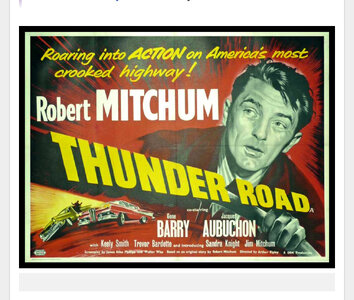
That movie was based on the life of NASCAR great Junior Johnson from Wilkes County who ran moonshine as a young lad. He actually had to serve some prison time after getting arrested for running moonshine.

If Junior Johnson’s Wikipedia page is accurate, his conviction was for having an illegal still, not running ‘shine. Supposedly, he was never caught transporting moonshine. He’d already won several NASCAR races when he was arrested for the still.
 
If Junior Johnson’s Wikipedia page is accurate, his conviction was for having an illegal still, not running ‘shine. Supposedly, he was never caught transporting moonshine. He’d already won several NASCAR races when he was arrested for the still.
I stand corrected :)

The good news is that Reagan pardoned him in 1986.
 
The film was released in 1958 while Tom Wolfe didn't write his famous article about Junior Johnson until 1965...probably the other way around, i.e., the film turned Wolfe's attention to that world where he found Johnson and wrote about his life.

Here is the Wolfe Article, titled: "The Last American Hero": The Last American Hero Is Junior Johnson. Yes! | Esquire | MARCH 1965

There was a film about Johnson made in 1973 spun off of the article.
 
That movie was based on the life of NASCAR great Junior Johnson from Wilkes County who ran moonshine as a young lad. He actually had to serve some prison time after getting arrested for running moonshine.
One summer while in college, I worked a job where my direct supervisor (a black man) had previously been a moonshine runner and the evening security guard (a white man) was a retired policeman. Sitting in the breakroom hearing them swap stories about when one of them had fooled the other was just memorizing. I so wished I had written those stories down as soon as I had gotten home. But I didn't. When one of them would tell a story about when the other was fooled, the one that was fooled would just burst out laughing at the memory. For example, my supervisor told a story about getting pulled over by the former policeman and once he stopped, he got out of his car and immediately popped open his trunk to show he wasn't transporting any moonshine. And then added, "You never even looked in the back seat, that was full of crated bottles of moonshine." The former policeman just burst out laughing. None of the stories were about souped-up cars. It was all stealth and misdirection.

And the stories the guys at my Dad's store would tell about delivering sugar before there were reporting requirements were wild. Stuff like backing up a truck, carrying an entire load of 100 lb bags of sugar, to another truck and shifting the entire load from one truck to the other. By the time I was working in my Dad's store, i.e., after I had my driver's license, the limit on daily purchases of sugar before reporting was required was 250 pounds. One of my Dad's customers would come in every day and buy four cases of 10-pound bags of sugar (240 pounds, 6 ten-pound bags per case.) After the reporting guidelines kicked in, my Dad stopped selling 100-pound bags of sugar because moonshiners were the only customers buying the 100-pound bags.

When the price of sugar spiked in the early to mid 1970's, due to market speculation, it just wiped out the entire moonshine industry in Eastern NC. All those years the feds tried to stop it and it was finally unintentionally crushed by some NYC finance bros speculating on the price of sugar.
 
Last edited:
My Deddy knew who all the moonshiners were in our neck of the woods -- he ran a hardware store. My grandpa made, that's how he got the nickname of Applejack. My Deddy didn't drink...at least not by the time I came along.

BTW, I grew up 3-miles from The Devil's Tramping Ground...it was moonshiners that did most of the scaring off people from that historic site.
 
A few years ago, I represented a gentleman in a moonshine case. He was the real deal. And old school moonshiner from Wilkes County. He was in his mid-70s at the time, and had been doing it pretty much his whole life, having learned how to do it from his father. He was a bit of a folk hero in his neck of the woods. I went to his house and he had all these pictures of him with Junior Johnson.

While it was a moonshine case, he and his co-defendants were charged with tax crimes. They would transport the moonshine from NC to VA and obviously did not report the sales so did not pay the required excise taxes.
 

Description​

"The North Carolina General Assembly of 1963 is shown at work. General sessions, committee work, rump sessions in hotel rooms and lobby are illustrated and explained. Members of the General Assembly are interviewed about their legislative functions and the role of the lobbyist. A representative is followed home for the weekend to show his contacts with his constituents. An informative documentary film." Description taken from the North Carolina Public Library Film Service Catalog of 16mm films, 1972 edition.“

 
"Land Beneath the Waters" is a 35-minute documentary tracing the history of the New Hope River valley through the development of Jordan Lake and covers native population, early settlement, Revolutionary and Civil Wars, acquisition of properties and construction of the dam, and present-day recreational activities.

You'll note that the video is old-school. It was originally produced on video cassettes--if you remember those. But the information is still valid and covers an important part of Chatham's history.

You can view it here on our YouTube channel:


#ChathamNCHistory #ChathamCountyNC #NewHopeRiverValley #JordanLake
 

"Lance, Inc and Philip L Van Every" | Trail of History​

Episode 21 | 26m 10sVideo has Closed Captions|CC

"Where did the iconic peanut butter cracker come from? Right here in Charlotte. This is the story of how a shipping error and a bit of American ingenuity launched a multi-million dollar snack food company right here in the Carolinas."

01/28/2020


H. Lee Waters, Hillsborough, NC, January 19 and 20, 1937 [MPF.87.1]​

19:38

15,501 views Dec 20, 2013

"From the collections of the State Archives of North Carolina. This silent, black-and-white film contains footage shot by H. Lee Waters (1902-1997) of Hillsborough, North Carolina in Orange County on 19-20 January 1937. The call number for this item is MPF.87.1. Length: 19 minutesProduction Year: 1937Closed captions: Not availableH. Lee Waters (1902-1997) operated a photography studio on Main Street in Lexington, North Carolina, for more than 60 years. For most of that time, his work covered the standard range of commercial still photography-weddings, portraits, school groups-but during the lean years of the late Depression Waters hit the road with a 16mm camera and projector and created "Movies of Local People" eventually accumulating a body of work depicting at least 118 communities primarily in North Carolina but also including nineteen places in South Carolina, nine in Virginia, and one in Tennessee. Waters' films reveal the comings and goings of everyday life on the streets of the towns he filmed-men, women, and children going in and out of stores, walking down the sidewalks, often smiling and waving at the camera but sometimes unaware of its presence. Often parades, festivities, and school children were featured. Waters developed a fluid and expressive style, and the films feature an often vivacious depiction of community life along with beautiful portraits and experimental special effects. His movies would be screened with feature films in the local theater for a modest fee, and they served as a marketing tool for the theater by enticing more people to come to the movies. These short silent films were a commercial and artistic success, and in the mill towns and the small cities of the Textile Belt, thousands of people saw themselves and their communities on the big screen. These films record ordinary and extraordinary people, businesses, and events at a pivotal time in small town southern America, and they often show individuals and places that would not have been documented on film in any other circumstance. Waters' films provide the only extant visual documentation of commercial enterprises and events in many instances.-------------The Waters family maintains the copyright to the films made by H. Lee Waters (1902-1997). As public access has improved, we are pleased with the interest being shown in this unique collection and feel that the community building activities and educational purposes for which they are being used would be greatly appreciated by Mr. Waters.The family takes seriously its obligation to protect the integrity of this large body of work and it is our wish that the original intended uses be respected. The films digitized by The State Archives of North Carolina should be exhibited or displayed in the form of videos and not screen captured as still photographs. The still image collection by H. Lee Waters is housed at the Davidson County Historical Museum (DCHM). The family’s agreement with DCHM states that there will be no duplicate collection of still photographs. We encourage groups wishing to identify individuals in the films to utilize other ways of viewing this material. We ask that people who have received permission to use the films refrain from sharing this material with third parties. Any commercial requests should be directed to the State Archives of North Carolina, Office of Registrar for review. The family (Tom Waters and Mary Waters Spaulding) asks the State Archives of North Carolina to notify us of any commercial requests. Such requests would then need to be negotiated with the family."
 
Back
Top