Happy 70th Birthday to Phil Ford: This Date in History

  • Thread starter Thread starter donbosco
  • Start date Start date
  • Replies: 1K
  • Views: 353K
  • Off-Topic 
DeddyInTheSnowFebThird.jpg


“Snow in the South is wonderful. It has a kind of magic and mystery that it has nowhere else. And the reason for this is that it comes to people of the South not as a grim, unyielding tenant of Winter’s keep, but as a strange and wild visitor from the secret North.” ~ Thomas Wolfe’ “The Child by Tyger.”

&&&&&&&&&&&&&&&&&&&&&&&&&&&&&&&&&&&&&&&

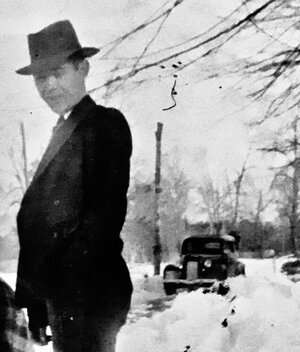
That’s my father-like I’ve never really seen him. He’s 23 years old in this wintry photograph. It is Saturday, February 3, 1940. I suspect that’s his car back there. His left hand is thrust into his pocket — it consisted of only a thumb and palm because at 13 he reached too far ‘in’ and was pulled into a molasses mill twisting off the other four. He seems to have always been cognizant or self-conscious of that physical trauma as no photos exist of that hand — it exists only in my memory — it was not an ugly thing nor a handicap but rather a dramatically ‘different’ thing — and never did I see it slow him, only cause him to think something through since the ways that other folks did it didn’t usually work for him. “Going around your elbow to get to your thumb” had true and daily resonance for him.

He’s in my mother’s front yard of the old farmhouse near Blood Run Creek, near Siler City. He must have driven the 7 miles over the ice and snow from Sandy Branch to see her. The roads would have been a rough go but such are the ways of true love. They were married 5 months later.
 
IMG_3323.jpeg

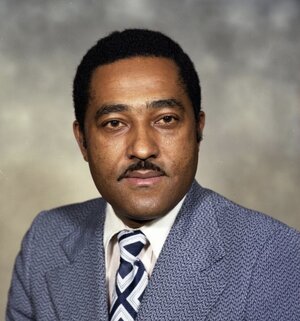
On February 3, 1983, Henry Frye was sworn in as North Carolina’s first African American Supreme Court Justice. Governor Jim Hunt appointed Frye as an associate justice. In 1999, Hunt named Frye to the unexpired term of retiring Chief Justice Burley Mitchell. After Frye lost his bid for a full term as chief justice in 2000, he retired after serving over 17 years on the state’s highest court.

In 1968, Frye became the first African American elected to the North Carolina General Assembly in the twentieth century. The first bill he introduced was a constitutional amendment to abolish the literacy test. Frye served six terms in the House and one in the Senate before starting his judicial career.

Image credit: Henry Frye, N.C. House of Representatives, 1973-74.
From the Waller Studio Collection, PhC.14. State Archives of North Carolina
 
"#OnThisDay in 1963, the General Assembly met in the Legislative Building on Jones Street in Raleigh for the first time. A commission was formed in 1957 to acquire land and construct a new building due to dwindling space in the State Capitol building. Fun fact: There are more than two miles of water piping and 51 miles of electrical wire in the building."
 
Dean Smith passed away on this day in 2015. He had been a presence in my life for all the years of which I had conscious memory. I was born in 1958 and he came to Carolina as an assistant men’s basketball coach to Frank McGuire in that same year. In 1961 he became the head coach, a job he was offered because he was known to be honest and because that team’s comportment had recently been dishonest. He also had no true head coaching experience and would come cheap. His slate was basically clean.

Coach Smith went on to become a legend of intellect, honesty, fair play, education, and “snatching victory from the jaws of defeat.” He coined the phrase “athletics are the front porch of the university” and from 1961 until he retired in 1997 kept his program — a program because it was so much more than just a team that played games — invitingly respectable.

I was a ‘sporty’ kid, first captivated by baseball. Because I ended up playing third base in Little League I gravitated to the Baltimore Orioles, where the greatest fielder of all time, Brooks Robinson, played that position. It was around that time, 1967 or so, that Batman, Zorro, and Tarzan began to give way to real life heroes of the diamond and the hard court. My first basketball icons were very local - the high school Chatham Central Bears whose wins and losses I saw live on chilly Chatham evenings in the packed and partisan gym in Bear Creek.

Thanks to C.D. Chesley, by 1970 we were getting two Atlantic Coast Conference basketball games a week on television. I lived in a Carolina home so we knew where to find the rest of ‘our’ games on the radio. Deep echoes of Bill Currie, “The Mouth of the South” are embedded in my memory but it was Woody Durham that really came to voice the Tar Heels for the many untelevised games ‘back then.’ But between the sometimes broadcast TV games, the always-on-the-radio ones, the heavy basketball coverage in ‘The Greensboro Daily News,’ and the not-to-be-missed “Dean Smith Show” on Sunday I came to know my coach. My Deddy also flavored how I valued Coach Smith with his carefully chosen words spoken during time outs, post game, and pasture walks counting cows. When he respected someone there was no doubt left in his tone of voice. And he truly revered Coach Smith.

I became a basketball player, a point guard, and Coach Smith’s principled and rational ‘Carolina Way’ was my inspiration. I was fortunate beyond any of my imaginings in those days to attend the ‘Carolina Basketball School’ in the early 1970s. I mowed a lot of yards and tilled gardens to foot that bill but it may have been the best money I ever spent. Really.

Coach Smith very intentionally called his summer programs in Chapel Hill a school and not a camp. So much more than game skills were communicated there. “Play hard, play smart, play together,” seems like such a simple precept - and it is - but when embraced fully it is a blueprint for living. I’m not going to go all full blown testimonial here but I will say that I came to find Coach Smith’s worldview as one worthy of emulation in times of challenge.

Had Coach’s life not been lived so openly and had he not so crucially met enduring challenges so much bigger than a 40-minute game he’d be but a personality I suppose. But instead he was a philosopher - Kierkegaard was one of his muses. At the risk of being sacreligious I admit that I have indeed asked myself, “What Would Dean Smith Do?” and his book, “A Coach’s Life” has been a guide to living.

It is not lost on me - in fact it struck me hard many years ago - that Coach Smith’s ideology was born of Christian theology and Progressive political thought. He found the left side of the aisle to be by far the most human, giving, honest, and by application, the most successful. He was as hated for that as he was loved.

I miss him and from the heat of “down eight points with seventeen seconds” moments to what is the genuinely ethical thing to do when I vote to every interaction in between, I do my best when I include a reflection of Coach Smith’s philosophy in my decision-making. I don’t say that with even an inkling of flippancy. Coaches can be our guides as readily as teachers or preachers - they can lead us for the common good or toward selfish ends.

Teams, collective enterprises, moments when the sum total is greater than the parts, communities — all succeed when the individuals in them work for a common goal that brings to each what they most need to thrive. Coach Smith taught that on a small scale with 15 young men at a time, modeling how we could be our best selves.

“Play Hard, Play Smart, Play Together” friends and we can carry the day.

Dean Smith, 2/29/31 — 2/7/15.


Eleven years gone now. Much missed and forever with us. My Captain, my captain.
 
50 years ago today:
1770574306787.gif
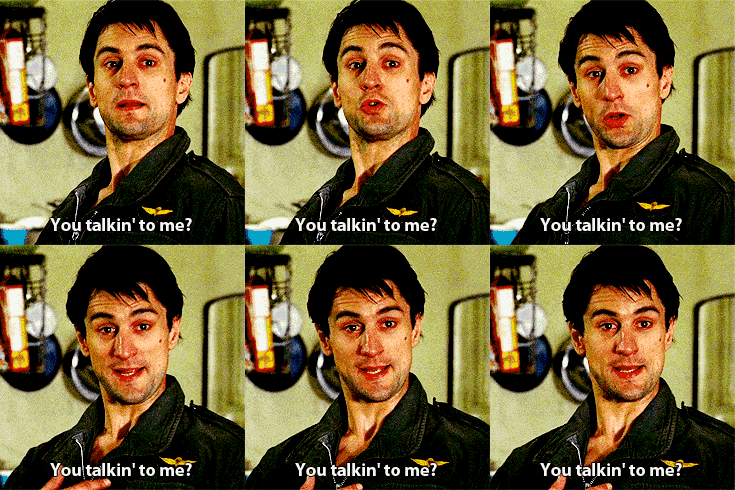
Taxi Driver came out in theaters.
"Taxi Driver" released in February 1976. "One Flew Over the Cuckoo's Nest" released in November 1975. Those were two movies that profoundly influenced me at a time in my life where I was giving serious thought to what I liked and didn't like about the America Art Scene. While both movies touched on areas of American life I was completely incompetent to judge, they help me cope with two things I needed to understand.
1. When I was very young, my Mother was committed to a psychiatric hospital and was treated with insulin shock therapy. By the time "One Flew Over the Cuckoo's Nest" had been released, my Mother had talked to me about her treatment at the psychiatric hospital. She said while the treatments had absolutely no effect on the voices she heard, they were so traumatic that she told the doctors the voice had stopped just to get the doctors to stop the treatments. While my mother continued to hear voices the rest of her life, the longer she lived the better she became at understanding what the voices were saying was not an insight into the world or others but were merely reflections of her own frustrations.
2. "Taxi Driver" came out when I was in the Army. Until I saw "Taxi Driver" I implicitly assumed all combat veterans were people like my Dad and Lucius Quinctius Cincinnatus, who left their plows in the field, took up arms to protect their homes, and when the fighting was over returned to their plows and homes. "Taxi Driver" taught me not everyone had homes to return to once their "service to country" ended. And any failures I observed in such people should be tempered by the welcoming family lives that my father and I returned to when we finished our time in service.

ETA: In case someone reading this has or had a family situation like my own, telling the younger slibling that it is a shame that you weren't old enough to know the affected parent parent before he or she started overtly manifesting symptoms of the "problem," really isn't the wistful, harmless comment you think it is. I have been told this by more than one sibling, completely out of the blue.
 
Last edited:
That North Carolina makes official note of his birthday says everything about the nigh sacred place that the game of basketball once held in the state. #OTD (Feb. 9) in 1956 Basketball Legend Phil Ford was born in Kannapolis. He grew up in Rocky Mount and starred in Chapel Hill at UNC and in the NBA. Unselfish and Clutch, he was the Wooden Award winner his Senior Season at Carolina. He was a coach on the floor and so much more.

He was a hero to thousands and a villain to thousands more as the floor general of a basketball strategy that placed strong emphasis on calculation and skill, thus tempering the role of sheer physicality in the game. Whether belovedly or begrudgingly, Fans, Friends, and Foes alike could ne’er deny the thoughtfulness of The Four Corners Offense with the ball in the hands of wily, nimble, and deadeye Number Twelve. Here’s to the original GOAT of Point Guard University. At Point Guard, From Rocky Mount, Phil Ford
 
One of the unfortunate things about my Carolina fandom is that Ilived far away from 1968-76
Back then there was not a lot of TV coverage nationally-was no internet for WCHL
So I missed seeing most games from Charlie Scott to Phil Ford-except NCAA tournament games
I did see Phil and Walter in a summer game at Carmichel-some kind of World Games or some such
 
One of the unfortunate things about my Carolina fandom is that Ilived far away from 1968-76
Back then there was not a lot of TV coverage nationally-was no internet for WCHL
So I missed seeing most games from Charlie Scott to Phil Ford-except NCAA tournament games
I did see Phil and Walter in a summer game at Carmichel-some kind of World Games or some such
That makes me wonder: For those who are older than me and started following basketball in or before the 1970s, how often did you get to catch games on TV around the Phil Ford era? I started following Tar Heel basketball in the mid-80s, and back then I remember that most of the non-conference games against unranked opponents were not televised. Though rare, even some conference games weren’t televised. I listened to a lot of games on the radio back then.
 
By 1971-72 it seems that I could tv watch a couple or three games a week and Carolina was usually in at least one and very often two once the ACC started up. With only 7 teams the rotation was tight. Preseason games were more of a radio thing as I recall. By 1976 I was on campus and never missing a home game.
 
That makes me wonder: For those who are older than me and started following basketball in or before the 1970s, how often did you get to catch games on TV around the Phil Ford era? I started following Tar Heel basketball in the mid-80s, and back then I remember that most of the non-conference games against unranked opponents were not televised. Though rare, even some conference games weren’t televised. I listened to a lot of games on the radio back then.
For ever it was a Radio thing. I remember having a transistor radio in the mid 60s and listening to games "illegally" in bed . I also remember Pre Woody.............
 
For ever it was a Radio thing. I remember having a transistor radio in the mid 60s and listening to games "illegally" in bed . I also remember Pre Woody.............


Bill Currie, The Mouth of The South.

Feb. 28, 2008
by Rick Brewer


"When Bill Currie passed away recently it ended the life of one of the most flamboyant and popular broadcasters this state has ever known.

And the Mouth of The South was known by everybody. He was the man who first put together the Carolina Radio Network that has grown into perhaps the best in the nation. He did it with a style unlike any other.

He began his career in the 1950's, but young people who weren't even born at the time have heard stories about him, his humor and irreverence that tried to keep sports in proper perspective.

Currie came along at a time before games were being televised. Fans wanting immediate information on their team got it strictly from radio. In this state they got vivid descriptions of the action.

Currie got his start at WRAL in Raleigh, serving as color commentator for Ray Reeve on the Tobacco Road Radio Network. Individual schools did not have official networks so Reeve and Currie probably had bigger audiences than any broadcaster today.

Reeve's gravely voice and Currie's flowery comments dominated the radio during the college football and basketball seasons. Hundreds of thousands of people first heard about college sports from these men. The Baby Boomers, in particular, were just beginning to develop an interest in sports and turned to Reeve and Currie for up-to-date coverage.

They could get it almost any day. The Tobacco Road Network covered all the Big Four schools. Reeve and Currie might be at Virginia on Monday, in Clemson the following night, at South Carolina on Wednesday, back to Wake Forest on Thursday and in Chapel Hill on Saturday. Sometimes if two of the Triangle teams were at home on Saturday, they would do one game in the afternoon and another that night. If a Big Four team was playing, they were there.

They knew more back roads and shortcuts than a local bootlegger. In fact, that may be where Reeve got his directions. Ray's love for the bottle was well documented. He often went on the air slightly inebriated, and sometimes more than just slightly. That's where Currie really developed his broadcasting skills. He had to do most of the work without making it seem so obvious.

The first televised games were done by broadvision on WUNC-TV and the rest of the state's public broadcasting system. This was the airing of games without sound. Fans listened to radio for the details. WRAL and other stations used it when Carolina went to the 1957 Final Four. Only Reeve was sent to Kansas City. Currie was in Raleigh doing color commentary by watching the games on television.

Currie moved to WVOC in Wilson in the early 1960's. That's where he formed the Carolina Sports Network. Reeve was nudged aside as Carolina, N.C. State, Duke and Wake Forest formed their own official networks. Reeve had helped create radio interest and it was people like Currie, Bill Jackson at State, Ed Higgins at Duke and Ad Penfield at Wake who built on that.

When Currie went to WSOC in Charlotte he took the network with him. By that time he had become as well known as Reeve and one of the most popular personalities on radio with his humor and colorful, rambling style. He almost became a cult figure with his nickname "The Mouth of the South." He once had a heart attack at a football game in State's old Riddick Stadium. As he was being carried down through the stands he waved to the crowd and joked with fans.

"I got WSOC more publicity with one heart attack than our promotions department did in an entire year," he said.

But, Currie was a hard worker, too. There were few powerful stations, no sports on FM radio or satellite broadcasts at that time.

"Bill probably built Carolina a network of over 60 stations," said Woody Durham, now Carolina's radio voice. "Each night AM radio was filled with static because there were more stations than there are today. All small towns had a station, but usually it wasn't a powerful one. So he had to get stations everywhere to blanket the state with Carolina sports."

Currie was more at ease behind a microphone than a Presidential candidate. You certainly could count on him to be more specific.

He tried to give his listeners a good picture of what was happening. That included more than just the action itself. He would talk about the cheerleaders, fans, officials, arena food and everything else. If a game got out of hand he might even turn to politics, religion or current events. He might interview someone in the stands. Or he would good-naturedly berate his "incoherent" sidekick, "Rowdy" Richard Raley. No one had any idea what might be heard during one of his broadcasts.

Because Currie was so outlandish, he could get away with almost anything. His most often quoted line came from the 1969 ACC Tournament. That's when he described N.C. State's 12-10 win over Duke as "about as exciting as artificial insemination."

He enjoyed and respected the coaches, players and others with whom he worked. But, he knew sports were not the most important thing in the world and wanted his listeners to understand that.

Away from the microphone Currie could tell more off-color jokes and stories than just about anyone. He was a great after-dinner speaker and could dominate a room, regardless of the audience.

Conversely, he could quote scripture easily and even mixed some with his broadcasts. He was asked to preach by many churches. Pews would be filled on the Sunday mornings when he was in the pulpit. Bob Bradley, Clemson's longtime sports information director, nicknamed him "Reverend Currie."

As one writer put it, "He could preach you a hellfire and damnation sermon or sing a hymn with an angelic look on his face, a tremor in his voice and a drink in his hand."

Currie was the subject of two Sports Illustrated features over the years. Once the magazine ran a picture of him laying in the coffin he kept in his office. He would sometimes get in there for an afternoon nap.

Despite all the jokes and escapades Currie was serious about his job. He was named the state's sportscaster of the year eight times.

Almost every year another station offered Carolina substantially more money to handle the network. But the athletic department stayed with WSOC.

"I credit Dean Smith for that," said Currie. "We had gotten the network going and he was loyal to us."

Midway in the 1971 basketball season, KDKA-TV in Pittsburgh offered Currie the sports anchor job there on the condition he take it immediately. He did his last Carolina broadcast in February, thanking anyone who had ever given him a job and everyone at Carolina.

People in Pittsburgh didn't know what to make of him with his loud jackets and wide ties. It took a while for them to appreciate the way he mixed straight sports reports with jokes, scripture and literary references. Some never liked him, but he won over a majority of his viewers.

He still kept up with Carolina athletics with calls back here and eventually by computer.

Bill was living in Washington when he passed away and donated his body for research at the University of Washington Medical School.

I hope the people there aren't interested in his larynx. I'm sure the Mouth of the South wore that out years ago."


Related...but only slightly.

 
. . .. I also remember Pre Woody.............
Pre Woody - "The Mouth of the South," Bill Currie. When I lived in Pittsburgh, he was a sportscaster for KDKA. The anniversary of his death, February 12, 2008 is coming up. I loved listening to Bill Currie when Charley Scott would go on one of his outside shooting runs. Bill Currie would just lose his mind, on air.

ETA: I type so slow that Don Bosco beat me to the punch, twice.
 
Last edited:
Back
Top