
Navigation
Install the app
How to install the app on iOS
Follow along with the video below to see how to install our site as a web app on your home screen.
Note: This feature may not be available in some browsers.
More options
You are using an out of date browser. It may not display this or other websites correctly.
You should upgrade or use an alternative browser.
You should upgrade or use an alternative browser.
—> ICE / Immigration |
- Thread starter nycfan
- Start date
- Replies: 7K
- Views: 336K
- Politics


‘It’s Worse Than What You’re Seeing on the News’: The Hospitality Workers on the Front Lines of ICE Raids | SevenFifty Daily
In Minneapolis and beyond, immigration crackdowns are destabilizing local bar and restaurant communities. Workers describe fear, loss, and the urgent need for industry-wide action…
 daily.sevenfifty.com
This is from last week, but the first person mentioned in the story is Mike. A couple weeks ago, I saw an Instagram post from him, he woke up to his dog throwing up and didn't want to go too far from home to find a vet. I sent him a text to see if he and/or his dog needed a ride. He had already taken care of it (and his dog is fine).
Bars and restaurants are getting killed here. Basically an extinction level event. If you know anyone in the twin cities area, buy them a gift card to one of these struggling restaurants if you can, it'll help them with cash flow for a while.
The family who cleans our condo has been afraid to work for the past couple weeks. We advanced them next month's fee so they could pay rent. (It'll end up being a gift, we're going to pay them their full rate when we see them next.)
Most people who live here could probably tell a couple similar stories just about people they know.
Chinga la Migra

- Messages
- 46,007

Exchange of the Day
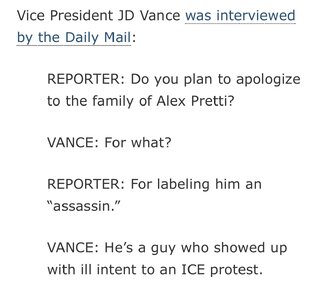
Vice President JD Vance was interviewed by the Daily Mail: REPORTER: Do you plan to apologize to the family of Alex Pretti? VANCE: For what? REPORTER: For labeling him an “assassin.” VANCE: He’s a guy
 politicalwire.com
- Messages
- 46,007
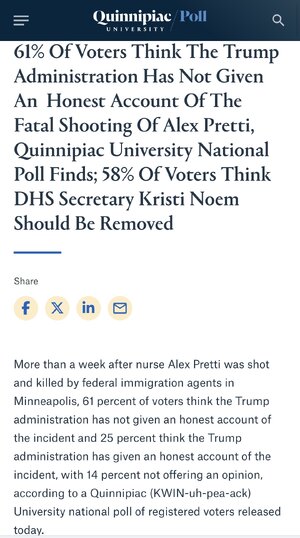

61% Of Voters Think The Trump Administration Has Not Given An Honest Account Of The Fatal Shooting Of Alex Pretti, Quinnipiac University National Poll Finds; 58% Of Voters Think DHS Secretary Kristi Noem Should Be Removed | Quinnipiac University Pol
"We need more facts and an independent investigation is the way to get them, say voters who cast doubt on the honesty of the account of how Alex Pretti ended up dead on a Minneapolis street," said Quinnipiac University Polling Analyst Tim Malloy.
 poll.qu.edu
- Messages
- 46,007

OldSchoolBlueBlood
Active Member
- Messages
- 32
[Sorry if this has been posted already]
I'm a former Houston police chief. This immigration crackdown isn't policing. It's theater.
Opinion
When fear replaces trust, writes Art Acevedo, public safety collapses. Department of Homeland Security must adopt basic policing principles.
By Art Acevedo
Jan 27, 2026
As a career police chief who has served in some of America’s largest and most diverse cities, including Houston and Austin, I have learned one truth that never changes: Public safety is built on trust. You cannot police effectively without the cooperation of the community. You cannot solve crimes if witnesses are afraid. You cannot protect victims if they fear calling for help.
That is why I am deeply concerned by the tactics increasingly used by federal immigration enforcement agencies. What many communities are witnessing today feels like a campaign designed to intimidate. Masked agents, minimal identification, sudden apprehensions in public spaces, and highly visible raids send a powerful message: Interacting with authorities is dangerous.
That message is devastating.
In neighborhoods across the United States, many families are mixed-status households. Parents worry about their children. Workers fear reporting crimes. Victims hesitate before calling 911. Witnesses leave scenes early. When federal agents operate in ways that appear indiscriminate or theatrical, residents do not distinguish between agencies. To them, every badge looks the same. The result is simple and predictable: Law enforcement becomes something to fear rather than trust.
And when fear replaces trust, public safety collapses.
For the past decade, most major police departments have worked hard to rebuild legitimacy. We invested in body-worn cameras, de-escalation training, community policing, crisis intervention teams, and transparent accountability systems. We learned, sometimes painfully, that enforcement alone does not create safety. Relationships do. Respect does. Fairness does.
Modern policing is rooted in procedural justice, the principle that how we enforce the law matters just as much as what law we enforce. Respect, transparency, and restraint are not political concepts. They are operational necessities. Without them, cooperation disappears, clearance rates fall, and violent offenders thrive.
That is precisely why police leaders across the country have consistently warned against turning local law enforcement into immigration agents. When communities perceive police as extensions of federal deportation efforts, everything shuts down. Criminals know this. They exploit it. Domestic abusers, traffickers, gang members, and predators depend on silence. Fear gives them cover.
When victims believe calling the police might put their family at risk, justice dies quietly.
The current federal approach undermines everything professional policing stands for. Operations designed for maximum visibility. Agents whose identities are obscured. Escalation instead of de-escalation. Training pipelines shortened to meet political demand. These tactics may generate statistics, but they also generate trauma. And trauma does not build safer communities.
Law enforcement should be measured by outcomes, not optics. Are violent offenders being removed from the streets? Are trafficking networks being dismantled? Are victims being protected? Or are families being destabilized, children traumatized, and entire neighborhoods driven further into the shadows?
We must be honest: Enforcement driven by fear produces short-term numbers and long-term damage.
No one disputes the federal government’s authority to enforce immigration law.
But authority without legitimacy is fragile. If enforcement methods destroy trust, they undermine public safety for everyone — citizens and immigrants alike.
If the Department of Homeland Security genuinely wants safer communities, it should align its operations with the principles embraced by professional policing nationwide:
• Clear identification of officers
• Transparent operations
• Emphasis on de-escalation
• Rigorous training standards
• Targeting genuine public safety threats — not broad sweeps
• Protecting victims and witnesses from collateral harm
This is not radical. This is policing 101.
Public safety depends on relationships. It depends on trust built over time, not fear imposed overnight. You cannot build legitimacy while simultaneously terrorizing communities. The two are incompatible.
We face significant challenges at our border and within our immigration system.
Those challenges deserve serious, thoughtful solutions — not performative enforcement that fractures neighborhoods and undermines decades of progress in community policing.
Trust is not a public-relations strategy. It is a crime-fighting tool. When trust collapses, criminals win. Victims lose. Communities suffer. America can enforce its laws while still demanding that every badge — local, state, or federal — uphold dignity, restraint and accountability. That is not weakness. That is strength.
-- Art Acevedo is the former police chief of Houston, Austin, Miami and Aurora, Colorado, and a past president of the Major Cities Chiefs Association.
Jan 27, 2026
I'm a former Houston police chief. This immigration crackdown isn't policing. It's theater.
Opinion
When fear replaces trust, writes Art Acevedo, public safety collapses. Department of Homeland Security must adopt basic policing principles.
By Art Acevedo
Jan 27, 2026
As a career police chief who has served in some of America’s largest and most diverse cities, including Houston and Austin, I have learned one truth that never changes: Public safety is built on trust. You cannot police effectively without the cooperation of the community. You cannot solve crimes if witnesses are afraid. You cannot protect victims if they fear calling for help.
That is why I am deeply concerned by the tactics increasingly used by federal immigration enforcement agencies. What many communities are witnessing today feels like a campaign designed to intimidate. Masked agents, minimal identification, sudden apprehensions in public spaces, and highly visible raids send a powerful message: Interacting with authorities is dangerous.
That message is devastating.
In neighborhoods across the United States, many families are mixed-status households. Parents worry about their children. Workers fear reporting crimes. Victims hesitate before calling 911. Witnesses leave scenes early. When federal agents operate in ways that appear indiscriminate or theatrical, residents do not distinguish between agencies. To them, every badge looks the same. The result is simple and predictable: Law enforcement becomes something to fear rather than trust.
And when fear replaces trust, public safety collapses.
For the past decade, most major police departments have worked hard to rebuild legitimacy. We invested in body-worn cameras, de-escalation training, community policing, crisis intervention teams, and transparent accountability systems. We learned, sometimes painfully, that enforcement alone does not create safety. Relationships do. Respect does. Fairness does.
Modern policing is rooted in procedural justice, the principle that how we enforce the law matters just as much as what law we enforce. Respect, transparency, and restraint are not political concepts. They are operational necessities. Without them, cooperation disappears, clearance rates fall, and violent offenders thrive.
That is precisely why police leaders across the country have consistently warned against turning local law enforcement into immigration agents. When communities perceive police as extensions of federal deportation efforts, everything shuts down. Criminals know this. They exploit it. Domestic abusers, traffickers, gang members, and predators depend on silence. Fear gives them cover.
When victims believe calling the police might put their family at risk, justice dies quietly.
The current federal approach undermines everything professional policing stands for. Operations designed for maximum visibility. Agents whose identities are obscured. Escalation instead of de-escalation. Training pipelines shortened to meet political demand. These tactics may generate statistics, but they also generate trauma. And trauma does not build safer communities.
Law enforcement should be measured by outcomes, not optics. Are violent offenders being removed from the streets? Are trafficking networks being dismantled? Are victims being protected? Or are families being destabilized, children traumatized, and entire neighborhoods driven further into the shadows?
We must be honest: Enforcement driven by fear produces short-term numbers and long-term damage.
No one disputes the federal government’s authority to enforce immigration law.
But authority without legitimacy is fragile. If enforcement methods destroy trust, they undermine public safety for everyone — citizens and immigrants alike.
If the Department of Homeland Security genuinely wants safer communities, it should align its operations with the principles embraced by professional policing nationwide:
• Clear identification of officers
• Transparent operations
• Emphasis on de-escalation
• Rigorous training standards
• Targeting genuine public safety threats — not broad sweeps
• Protecting victims and witnesses from collateral harm
This is not radical. This is policing 101.
Public safety depends on relationships. It depends on trust built over time, not fear imposed overnight. You cannot build legitimacy while simultaneously terrorizing communities. The two are incompatible.
We face significant challenges at our border and within our immigration system.
Those challenges deserve serious, thoughtful solutions — not performative enforcement that fractures neighborhoods and undermines decades of progress in community policing.
Trust is not a public-relations strategy. It is a crime-fighting tool. When trust collapses, criminals win. Victims lose. Communities suffer. America can enforce its laws while still demanding that every badge — local, state, or federal — uphold dignity, restraint and accountability. That is not weakness. That is strength.
-- Art Acevedo is the former police chief of Houston, Austin, Miami and Aurora, Colorado, and a past president of the Major Cities Chiefs Association.
Jan 27, 2026

LeoBloom
Esteemed Member
- Messages
- 590
Damn. There goes more bad messaging making the awesome policies look bad.

1moretimeagain
Inconceivable Member
- Messages
- 4,848
1moretimeagain
Inconceivable Member
- Messages
- 4,848

Oddball
Distinguished Member
- Messages
- 430
If not AI generated, that is Biden debate level dementia... but good luck getting any of the cult to admit it
1moretimeagain
Inconceivable Member
- Messages
- 4,848
The wrestler also had a fundraiser this week.
Yes.
61% Of Voters Think The Trump Administration Has Not Given An Honest Account Of The Fatal Shooting Of Alex Pretti, Quinnipiac University National Poll Finds; 58% Of Voters Think DHS Secretary Kristi Noem Should Be Removed | Quinnipiac University Pol
"We need more facts and an independent investigation is the way to get them, say voters who cast doubt on the honesty of the account of how Alex Pretti ended up dead on a Minneapolis street," said Quinnipiac University Polling Analyst Tim Malloy.
Removing Border Patrol Barbie will fix everything.
It’s Noem. It’s not Trump.


donbosco
Legend of ZZL
- Messages
- 7,764
Yes.
Removing Border Patrol Barbie will fix everything.
It’s Noem. It’s not Trump.
Nah. It most definitely is Noem. But the buck stops with trump.
Share: