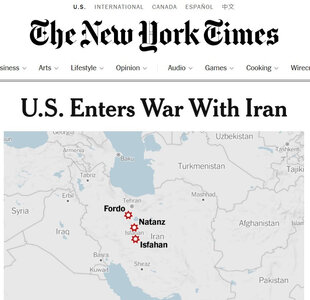
Here’s a solid article about the legality of this type of strike (published a day before the attack took place):
Right or wrong, the executive branch likely thinks Trump has the legal authority to do it—at least until Congress or the courts say otherwise.

www.lawfaremedia.org
“… Both customary international law and the
UN Chartergenerally prohibit “the threat or use of force against the territorial integrity or political independence of any state.” Article 51 of the charter, however, makes clear that this restriction is not intended to “impair the inherent right of individual or collective self-defence if an armed attack occurs against a [state.]” While the United States might be able to justify some military actions against Iran on the basis of individual self-defense,
the more straightforward legal justification for joining Israel’s military campaign against Iran would be to do so on the basis of collective self-defense, wherein Israel would consent to the United States assisting it in exercising its own individual right of self-defense. Whether this option is available, however, will depend on how the Trump administration views the legality of the military campaign Israel is pursuing. …”
——
Hegseth expressly cited collective self-defense in his prepared statement this morning. Not saying it is a legit argument (since I think it hinges on the legality of the Israeli action in the first instance), just noting that the Trump team is going through the motions on this defense.
Anyway, on the domestic front:
“…
The executive branch has—over frequent objections by legal scholars—long maintained that the president has substantial independent constitutional authority to direct the use of military force against foreign adversaries. While some presidents have claimed a near plenary ability to pursue such action, most recent presidential administrations—including
Trump’s during his first term—have generally
described this authority as extending, “at least insofar as Congress has not specifically restricted it,” to situations where the president determines (a) military action would “serve sufficiently important national interests” and (b) the “nature, scope, and duration” of anticipated military operations will not “constitute a war requiring prior specific congressional approval under the Declaration of War Clause.” In addition, during his first term, Trump’s Justice Department
suggestedthat the president “has the constitutional authority to take defensive measures to protect U.S. persons” in a manner not subject to these same constraints, but the exact scope of this national self-defense exception remains unclear.
Congress has “specifically restricted” this authority in one regard: As part of the
1973 War Powers Resolution, it requires that, once U.S. armed forces are “introduced … into hostilities or into situations where imminent involvement in hostilities is clearly indicated by the circumstances[,]” the president must “terminate” the use of those forces within 60 days (extendable to 90 days in certain circumstances), unless Congress has “enacted a specific authorization for such use[,]” extended the time period by statute, or is physically unable to meet. While some past presidents have
suggested that this restriction is unconstitutional, more recent executive branch assessments have
generally disagreed, at least outside the context of the national self-defense exception.…”
——
If you view the bombing of the Iran nuclear facilities as an offensive rather than defensive action, then Trump probably acted illegally. But while this debate needs to play out for long term purposes, as a practical matter no way this Congress challenges this action.