
.
https://www.wsj.com/world/middle-ea...2?st=b5Cjvj&reflink=desktopwebshare_permalink
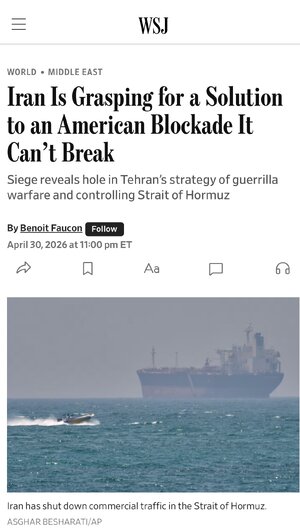
“… In Hormuz, “Iran was able to create a crisis of market confidence. But disruption is not control,” said David Des Roches, a former director responsible for Persian Gulf policy at the Defense Department. “With the U.S. blockade, it’s facing a reckoning.”
…
The risk of a spiraling crisis has split Iran’s political system between moderates such as President Masoud Pezeshkian and hard-liners including Saeed Jalili, a former presidential candidate who leads Iran’s most conservative faction.
The moderates believe in holding fire and negotiating a favorable deal with President
Trump, whom they view as eager to get out of the messy war as soon as possible. They worry Iranians are growing tired of the conflict after an initial nationalist uptick.
“The regime has to do something to break this deadlock,” Saeid Golkar, who studies Iran at the University of Tennessee at Chattanooga. “Moderates want a deal because they think more destruction is political suicide,” he said.
growing camp of hard-liners believe Iran has to take the military initiative and start a shooting war again to send oil prices soaring higher and increase the pressure on Trump. They argue that the blockade goes beyond the sanctions Iran has faced down in the past and amounts to an act of war that must have a military response.
… “The blockade is increasingly viewed in Tehran not as a substitute for war, but as a different manifestation of it,” said Hamidreza Azizi, a visiting fellow specializing in the Middle East at SWP, a Berlin-based research institute. “As a result, Iranian decision makers may soon come to see renewed conflict as less costly than continuing to endure a prolonged blockade.”…”



