Latin America Politics General Thread

  • Thread starter Thread starter CRHeel94
  • Start date Start date
  • Replies: 291
  • Views: 10K
  • Politics 


Hmmmmmmm...
 
"As the Trump administration continues to bombard Iran, a top Pentagon official revealed that U.S. wars in the Western Hemisphere are also expanding, unveiling an effort dubbed “Operation Total Extermination.”

Attacks on Latin American drug cartels are “just the beginning” Joseph Humire, the acting assistant secretary of war for homeland defense and Americas security affairs, told members of the House Armed Services Committee last week."

Pentagon Reveals Attacks in Latin America Are Just the Beginning
 
I’ve not read this entire thread, so I’m sure I’ve missed multiple posts about El Salvador, Bukele, and the Trump admin.

That said, tonight’s episode of Frontline on PBS was really eye-opening and disturbing (for me, at least). I knew some of the story of Bukele’s rise to power and his deals with MS-13, but the show really puts it in perspective with regard to Trump’s inhumane immigration policies and willingness to enable and support the worst of the worst authoritarian strongmen.


The left leads in Brazil; breaking down the election in Colombia; chaos leads in Peru.


A week to forget for Milei: Adorni scandal, skeptical markets, cultural battle collapse. Argentine President Javier Milei's administration closed one of its worst weeks in office, cornered by an expanding judicial front against Cabinet Chief Manuel Adorni, adverse market signals, and the collapse of its discursive offensive on historical memory.

Public opinion indicators deepened the administration's concerns. A Universidad de San Andrés poll recorded just 33% satisfaction with the government, a seven-point drop since November 2025, with presidential approval at 39%. Consultancy 1816 flagged what it called “economic K risk”: unemployment rose in 2025 for the first time this century alongside GDP growth, the registered private real wage for January 2026 was the lowest in 18 months, and household loan delinquency quadrupled in just over a year.
 
From Boz (James Boswell of Latin American Risk Report)

"More than a week after the election, no candidate or party won even 20% of the vote, the margins are tight and controversial, some candidates want the election annulled, rural areas feel that the capital region is trying to once again strip them of their representation, and the final results from the first round could take weeks to sort out. Instead of successfully electing its tenth president in ten years only to kick them out again, Peru is now struggling to complete this election cycle while a weak interim government manages the fallout.
The three leading candidates for president are all awful in their own way. For a country where democracy is already at risk due to an autocratic parliamentary system (strongly influenced by Fujimori and her party) that has systematically weakened the other branches of government and independent regulators, this is a disaster.
[td]
[/td]
[td]
es%2F0bd86fbb-a8fe-44fd-9591-d95c9a2befc1_1041x890.jpg
[/td][td]
[/td]​
Source: RPP
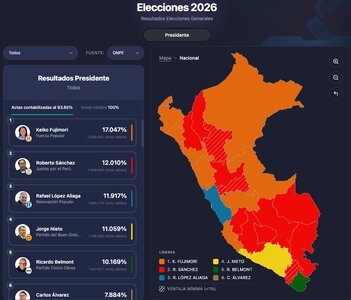
Fujimori leads and will have power under nearly all scenarios. The front-runner among the 35 candidates for president is Keiko Fujimori with 17% of the vote. That may be a record for the lowest percentage of votes won by a first round winner. If there is a second round, she will be going to the second round. Fujimori’s party controls enough votes in the Senate and lower house that 1) she should be able to get legislation passed, and 2) it would be quite difficult (but not impossible!) to form a majority coalition to remove her if she is elected. In contrast, she controls enough votes to threaten Sanchez’s hold on power early on if he becomes president.
Second place remains undetermined. The margin between Roberto Sanchez and Rafael Lopez Aliaga is about 15,000 votes. Only 93% of the vote has been counted. There might be a million ballots to review due to challenges. It’s going to take weeks. Electoral authorities say mid-May. Sanchez is likely to win that battle for second place, but with so many ballots outstanding, it’s far from certain. And if the results flip for Lopez Aliaga, expect mass protests from Sanchez supporters.
The field was unusually split. Seven presidential candidates received over five percent of the vote. There was essentially a four-way tie for second place, with Roberto Sanchez and Rafael Lopez Aliaga receiving 12% of the vote, Jorge Nieto at 11% and Ricardo Belmont at 10%. In an election with almost 16 million valid votes and another three million ballots currently listed as blank or invalid, the margin between second and fourth place was less than 200,000 votes. Voters simply refused to consolidate around any candidates in the first round.
Peru’s geographic divide. Fujimori, the only candidate with a close to national political machine, did well in both the capital region and in some rural areas, but she was crushed in other areas outside of the capital. Lopez Aliaga received votes almost exclusively from the capital area and had almost no votes in many of Peru’s electoral precincts. Sanchez, in contrast, won about a dozen of Peru’s 25 electoral departments, but came in NINTH PLACE in the capital, winning only 3% of the vote. That should give you a sense of the country’s political divide.
Roberto Sanchez is radicalizing. Prior to the election, I warned that Sanchez was the one candidate who could threaten Peru’s economic stability. He would attempt radical reforms more rapidly than the legislature could contain him. His comments since the election have confirmed that analysis. When Pedro Castillo surprisingly made it to the second round in 2021, he retained his central campaign message, but moderated his rhetoric and made a play for centrist voters. Sanchez, who served as a cabinet minister under Castillo and has been endorsed by the former president, has made clear that he plans a more radical agenda for the country. He is critical of the Central Bank and the Lima political and business elite, whom he would need at least some cooperation from to govern effectively. He continues to promise a complete overhaul of the country’s institutions. While he has ruled out a few truly wild proposals, he is running to be even more activist and effective than Castillo, who flamed out in an autogolpe attempt.
Lopez Aliaga calls for an “insurgency” and for the election to be annulled. The rightwing populist former mayor of Lima has used violent and incendiary rhetoric since the election. He has called for his supporters to engage in a civil insurgency if he does not get his way. He has used crude language to threaten sexual violence against the leadership of the electoral institutions.
Fujimori is backing Lopez Aliaga’s effort to annul the election. Why would the candidate who came in first place and whose party leads in both houses of Congress agree to new elections? First, she fears that the 2026 election looks too similar to the 2021 election that she lost to Pedro Castillo. Second, she may believe that a re-run election would put her in a stronger position in both the presidential race and Congress, now that her party has been confirmed as the country’s largest. Third, she needs Lopez Aliaga’s support to win the election and to have a simple working Congressional majority. She can’t afford to alienate him.
Both sides might have a point. Regarding the issue of potential electoral fraud, I think both sides are politically posturing in ways that are almost certain to increase the tensions in the country, and that’s not good. They’re all awful. But, pretending for a moment this was a friendlier, more democratic political environment, you can imagine how both sides make good points. The candidate from the capital says that the dozens of polling locations in the capital that failed to open harmed his ability to win the final votes that would put him over the top, and therefore, the election should be annulled. The candidate from the marginalized areas says that the extra day of voting in a few capital precincts, after everyone could see how close the results were, gave his opponent an unfair advantage, and that the first and third place candidates are conspiring to keep him out of power
There is a logic to both positions that supporters can easily follow and accuse the other side of being undemocratic.
Still, the whole thing appears to have been an honest (though careless) mistake by the electoral authorities, not a conspiracy by one side to undermine the other. Election monitors see contractor-caused logistics problems, not fraud.
 
What would annulling the election mean? How would it work? I don’t know. It would be uncharted territory. Annulling elections in general signals major problems with the electoral system and deeper problems with democracy. Previous annulled elections include Bolivia in 2019 and Haiti in 2015. And maybe on that list you would want to include the Peruvian election in 2000, which President Alberto Fujimori (Keiko’s father) stole and which started the spiral that led to his downfall and a new election in 2001. None of those is a clean analogy to this election. Every screwed up election is different in its own way.
Annulling this year’s election would lead to a shakeup in the candidates and coalitions. It’s possible and even likely that both Fujimori’s and Sanchez’s support would increase as voters consolidated around the known front-runners. But it’s also possible that some other candidate surges as the alternative to the current choices. Meanwhile, the country would need to decide whether to redo the legislative elections again as well. The electoral authorities would face their own challenges in terms of candidates demanding they are ousted and their own ability to police the actions of candidates who are violating electoral rules.
I doubt they will go the route of annulling the election. Whether they do or don’t, many people will disagree with the decision.
Who wins a second round? It’s a coin toss. This is definitely an anti-vote election, with voters who want to reject Sanchez voting for Fujimori and voters who want to reject the Fujimori family voting for Sanchez. Neither candidate has an easy path to 50%. Perhaps the biggest question is abstention, with many voters likely to decide (reasonably) that they hate both candidates. A sub-category of that question is whether Lopez Aliaga tells his voters to choose Fujimori or to sit out the race.
Whoever wins deals with a center-right Congress dominated by Fujimori. That makes the dynamics even more pronounced: a Fujimori win would give her significant control over the country’s political institutions, but mass rejection in parts of the country outside the capital, while a Sanchez win would set up an institutional clash between the president and Congress from day one.
The US role in the election. The Trump administration is calling for calm and for all sides to respect the results. Actually, that was a lie. I wanted to make sure you were still reading and paying attention after 1,300 words. Instead of a calm position, the Trump administration is increasing all the tensions by forcing the unelected interim government to sign a deal to purchase F-16s in the middle of this ugly election process. If the election is Fujimori vs. Sanchez, Trump will almost certainly weigh in to try to influence the race. Meanwhile, Trump is discussing the military purchases and various port issues with Peru; they want to lock down Peru’s ties to the US under the current administration out of fear that Sanchez would win the race because of…
China’s role in the election. Roberto Sanchez will be anti-US. It’s not immediately clear he would be pro-China. There are plenty of Chinese mining and infrastructure projects that Sanchez’s base dislikes. However, Beijing can absolutely win Sanchez over the same way they got along with Pedro Castillo, and the Trump administration will see that as a threat (to be fair, a Democratic administration would share the concern, but they wouldn’t be quite as aggressive about it as the current US president). China does not often overtly involve itself in Latin American elections, even when it has clear preferences, but it definitely works behind the scenes, and it would have strong incentives to do so in a Fujimori vs Sanchez matchup in Peru. This sets Peru up as a major proxy battle in the hemisphere, further complicating an already messy situation."
 
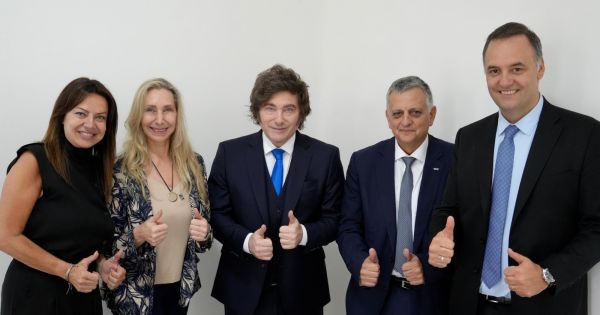
LatinAmericanleaders.jpg

From Boz

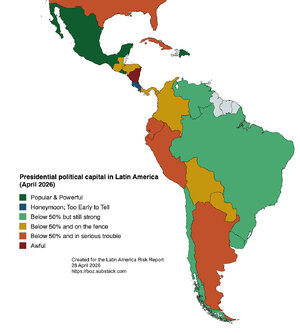
Popular and powerful

Claudia Sheinbaum 🇲🇽 - Mexico’s president has an approval rating in the 60s or even low 70s. However, it is more complicated than the top line number. I discussed Sheinbaum’s popularity in a newsletter for paying subscribers earlier this month, and I’ve unlocked that post for everyone today so you can read more. (If you appreciate the analysis, please upgrade to being a paid subscriber to receive more).

Nayib Bukele 🇸🇻 - Some polls still have his approval rating in the 90s. I think it’s probably closer to the mid- to high-60s, but that is still really good for any president anywhere. He does have weaknesses: the economy is not delivering on the promise of his security achievements, there is significant corruption within his government, and Salvadorans are aware of the authoritarian structures he has built to hold on to power. He is popular today. The concern is the model of a popular politician who eliminates checks and locks down the institutions, ensuring that when he eventually loses that popularity, there is no peaceful mechanism left to hold him accountable.

Luis Abinader 🇩🇴 - The Dominican Republic’s president has sustained high approval ratings across a term and a half in office. He combines economic competence with an anti-corruption stance that has held up better in the public’s eyes than that of many other presidents who have attempted something similar. He manages Haiti-border politics in a way that is domestically popular even if it draws international criticism. He’s steady and effective.

One thing all three of the above presidents share is the lack of a credible opposition. In each country, opposition parties have been weakened by their own past failures, fragmentation, or active pressure from incumbents who use a mix of fair and unfair measures to keep opponents on the defensive. Having a weak opposition doesn’t always guarantee success (see Javier Milei near the bottom of this list despite the discredited Peronist opposition), but high approval is easier to sustain when there is no coherent alternative narrative.

Transition/Honeymoon; too early to tell

Laura Fernández 🇨🇷 - The recently elected successor to Rodrigo Chaves takes office on May 8 after dominating the February election with nearly 48 percent in the first round. She inherits strong baseline approval for the outgoing government and a functioning, stable democracy. The question for her honeymoon period is the economy, and the scenario to fear is that of Kast in Chile or Paz in Bolivia, both of whom have seen their honeymoons cut short by economic challenges.

Below 50% but still strong

Lula 🇧🇷 - Brazil’s president is under real pressure, with multiple polls showing disapproval in the high 40s to low 50s and a simulated runoff against Flávio Bolsonaro now within the margin of error. But I continue to think he’s the slight favorite for reelection in October. He still dominates the political system and controls the country’s agenda in a way that makes him among the most powerful presidents in the region.

Delcy Rodríguez 🇻🇪 - This pains me, but it is hard to deny that Rodríguez’s political situation has solidified in recent months. She controls the legislature and judiciary, every bill she has requested has been rubber-stamped, she has removed members of Maduro’s inner circle and made the government substantively her own, and the economy has shown marginal improvement. Her approval rating is only in the 20s or 30s depending on how the question is asked and who is asking it. I see plenty of political challenges ahead. But she is still in power, still functioning, and has so far managed the balancing act of satisfying Washington’s demands while retaining a Chavista and military coalition to avoid an internal fracture. I place her here not because her approval is strong, but because her political grip on the system is.

José Antonio Kast 🇨🇱 - Chile’s new president has had a disastrous honeymoon. Rising fuel prices led to a rapid approval collapse, dropping him down to the high 30s or low 40s. His corporate tax proposal is facing legislative roadblocks. So why is he still in this tier? Because he won decisively, his core coalition is unified behind him, and the Chilean right is organized in a way it hasn’t been in a generation. The loss of public approval is not the end of his presidency. He still has almost four years to go and the political skill to make something of it.

Yamandú Orsi 🇺🇾 - Uruguay…. Ok, fine, I’ll give more than my usual one-word explanation for this country. Orsi governs a stable, institutionally strong country with a functioning economy and no acute crisis on his desk. Even with a net-negative approval rating, there is no emergency or crisis. The situation is one of routine political wear and tear. Uruguay’s political culture absorbs normal levels of governing disappointment and keeps chugging along.

Below 50% and on the fence

Santiago Peña 🇵🇾 — An absolute darling of international markets. The economy is performing well, he controls the political situation, and Paraguay has maintained the institutional stability. There is a case for moving him into the tier above. The reasons I keep him here are: first, the Colorado Party machine generates a constant corruption drag that limits how high his personal approval can realistically go; and second, he is a politician who is part of that machine, not an independently powerful actor, which makes him more personally exposed to potential crisis than his positive international image suggests. What limited credible polling that is available points to an unhappy public, and protests last year suggest an urban youth population itching for change.

Gustavo Petro 🇨🇴 — Petro’s approval is up compared to this time last year, driven by the minimum wage hike and a generally better governance in his final year than he demonstrated in his first three. His ally Iván Cepeda is doing well in presidential polls, but I believe he is the underdog in a two round election. The economy has underperformed expectations and is taking new hits due to the global environment, corruption scandals linger, and Petro’s agenda has largely failed despite a few small wins in recent months. Whether I should have placed him in a tier above or a tier below will appear obvious in hindsight depending on if his party wins or loses the presidential election.

Rodrigo Paz 🇧🇴- He should be in the honeymoon category, but economic pain, fuel shortages, and the losses in the subnational elections have the new president trending downward and at risk of a crisis.

Bernardo Arévalo 🇬🇹 - It all depends on how the battle with the Attorney General’s office resolves. Arévalo came into office as a genuinely democratic reformer but hasn’t accomplished much. His approval is in the mid-30s, with much of the population disappointed in the lack of progress. Arévalo has spent most of his presidency in a grinding institutional war against Consuelo Porras and her allies, who weaponized the institutions against him before he took office. The fight over the selection of a new AG, going on right now, will determine whether the rest of Arévalo’s term is good, mediocre, or a massive crisis.

Nasry Asfura 🇭🇳 - Honduras’s president entered office after a disputed election in which a significant portion of the population questioned his legitimacy. Given that start, with zero honeymoon bump, being in this tier is arguably a sign that he has managed a difficult opening well. He is not generating enthusiasm, but he is not generating crises either, which in the context of Honduran politics is its own form of success

José Raúl Mulino 🇵🇦 - After an approval rating crash in early 2025 due to the public’s anger at pension reform, Panama’s president has seen a modest ratings recovery in recent months, but it is about the softest 40 percent approval that can be imagined. He continues to navigate the relationship with the US as best as he can, but Trump can turn his eyes back to the Canal any day, and Mulino would have limited leverage if he did. Mulino’s big task is now the reopening of the copper mine, which requires balancing public opinion, constitutional requirements, environmental and labor interest groups, and international investors who want the best deal possible.

 

Below 50% and in serious trouble

Daniel Noboa 🇪🇨 - The security situation in Ecuador has continued to deteriorate despite Noboa’s aggressive posture. 2025 was the country’s most violent year on record. The curfews and states of exception generated short-term approval bumps, but the public can see that they are not working. Noboa’s November referendum failed. And he is now leaning a bit autocratic in his suspension of opposition parties leading up to municipal elections later this year. In some ways, Noboa is proving to be a distorted mirror image of Bukele. His security policies are failing, and his efforts to suppress his political opponents are being done from a position of vulnerability rather than strength.

Javier Milei 🇦🇷 - Milei entered April with approval ratings in the mid-30s across multiple pollsters, his worst readings since taking office, with disapproval crossing 60 percent. The Adorni corruption scandal is dragging his political agenda down. The economic pain remains acute for ordinary Argentines even as macroeconomic indicators show some improvement. See my recent WPR column for more.

Miguel Díaz-Canel 🇨🇺 - There is no credible independent polling in Cuba. The country has experienced its most severe economic crisis in decades, with prolonged blackouts, persistent food shortages, small but persistent protests, and a mass emigration wave. Trump is aiming for some sort of change in Cuba. While democratization in the short term is very unlikely, Trump will want Díaz-Canel ousted as a way to symbolize a shift to a different agenda.

José María Balcázar 🇵🇪 - His only job is to be a transitional president through an election process that has already begun, and he still might be impeached. Peru is not kind to its presidents.

Awful

Daniel Ortega and Rosario Murillo 🇳🇮 - Somehow even more repressive than Cuba or Venezuela. There is little credible polling in the country, but it would be fair to estimate the ruling couple’s approval ratings below 20%. They control the country through brute force. You could argue they are “strong” like Delcy Rodriguez or Nayib Bukele in the sense that their grip on power appears firm. But it is strength built entirely on coercion, with no economic performance, no legitimacy, and no successor structure beyond the family. They rule over a country that they are destroying.
 
Back
Top