SCOTUS Catch-all | Court DECLINES to reconsider Gay Marriage

  • Thread starter Thread starter nycfan
  • Start date Start date
  • Replies: 700
  • Views: 29K
  • Politics 
“… In Wolford v. Lopez, on Jan. 20, the Supreme Court will rule on the constitutionality of a Hawaii law that makes it a crime to carry a handgun on private property without the property owner’s explicit permission – even if you have a license to carry the gun.…”
Can someone explain this one to me because it must be a legal nuance. If it’s private property then even going onto private property, with or without a gun, could be trespassing right? So where does one get the right to go onto someone’s private property packing? Seems like the line should be drawn at whether the person can even be there.

Or is this a case where the property owner invites someone over and they come packing. Friend thinks because he has a right to carry they’re good. But the property owner did not expect this so didn’t sign off on it.

Just wondering as this one struck me as confusing. Private property should supersede someone’s right to carry, I would think ha.
 
Can someone explain this one to me because it must be a legal nuance. If it’s private property then even going onto private property, with or without a gun, could be trespassing right? So where does one get the right to go onto someone’s private property packing? Seems like the line should be drawn at whether the person can even be there.

Or is this a case where the property owner invites someone over and they come packing. Friend thinks because he has a right to carry they’re good. But the property owner did not expect this so didn’t sign off on it.

Just wondering as this one struck me as confusing. Private property should supersede someone’s right to carry, I would think ha.
My guess is it would be something like a privately owned store or restaurant. You aren't trespassing by walking through the door but it is private property.
 
My guess is it would be something like a privately owned store or restaurant. You aren't trespassing by walking through the door but it is private property.
I was gonna ask if it was commercial or residential. So if it is a restaurant and it doesn’t explicitly say you can’t carry, then you’re good. But then have to ask if businesses should have to put up signs saying no firearms allowed. They are really getting some major mileage out of the 2nd amendment. They want the Wild West.
 

US Supreme Court turns away appeal of Texas library book ban​


“The U.S. Supreme Court in a free speech case on Monday opted not to hear an appeal by a group of residents of a rural Texas county of a judicial decision allowing local officials to remove 17 books that these officials deemed objectionable from public libraries.

The justices let stand a lower court's decision allowing the removal of books including ones dealing with themes of race and LGBT identity, from its public library system. The lower court rejected the argument made by the plaintiffs that removing the books was unlawful under the U.S. Constitution's First Amendment protections against government abridgment of free speech.

The decision by the New Orleans-based 5th U.S. Circuit Court of Appeals applies to the states of Texas, Louisiana and Mississippi but does not set a nationwide legal precedent.…”
 

US Supreme Court turns away appeal of Texas library book ban​


“The U.S. Supreme Court in a free speech case on Monday opted not to hear an appeal by a group of residents of a rural Texas county of a judicial decision allowing local officials to remove 17 books that these officials deemed objectionable from public libraries.

The justices let stand a lower court's decision allowing the removal of books including ones dealing with themes of race and LGBT identity, from its public library system. The lower court rejected the argument made by the plaintiffs that removing the books was unlawful under the U.S. Constitution's First Amendment protections against government abridgment of free speech.

The decision by the New Orleans-based 5th U.S. Circuit Court of Appeals applies to the states of Texas, Louisiana and Mississippi but does not set a nationwide legal precedent.…”
“… At issue is a First Amendment principle called the right to receive information. The Supreme Court long ago concluded that the First Amendment encompasses a fundamental right to receive information and ideas, as it is necessary for the meaningful exercise of other First Amendment rights such as freedom of religion, expression, speech, assembly and the press.

A federal judge in 2023 ordered county officials to restore the disputed books to the library system. But the 5th Circuit in a 10-7 decision reversed the judge's ruling and sided with the county. The 5th Circuit concluded that public library patrons have no right to receive information under the First Amendment.

Writing for the 5th Circuit, Judge Stuart Kyle Duncan asserted that "no one is banning" books by removing them from libraries.
"If a disappointed patron can't find a book in the library, he can order it online, buy it from a bookstore or borrow it from a friend," wrote Duncan, a judicial appointee of Republican President Donald Trump. "All Llano County has done here is what libraries have been doing for two centuries: decide which books they want in their collections."…”
 
The whole reason they got so worked up in Citizens United was that it raised the possibilities of banning books. But you know, that's SCOTUS for you.
 

Supreme Court Is Asked to Take Another Ax to Campaign Finance Limits​

The case centers on efforts by Republican officials to lift limits on how much money political parties can spend in coordination with candidates.


“… The case the justices will consider on Tuesday involves one of the remaining limits: how much money political parties can spend in coordination with candidates.

The case, National Republican Senatorial Committee v. Federal Election Commission, was brought by national Republican leaders, who argue that the limits violate the First Amendment, restricting their ability to reach and influence voters.

… Depending on its scope, such a decision could swing the pendulum of power back toward the official political parties and away from super PACs. It could also allow parties to spend huge sums from big donors directly on candidates, potentially expanding the influence of big money compared with small-dollar contributions. Democrats in recent years have done better than Republicans at winning smaller donations….”
 

Supreme Court Is Asked to Take Another Ax to Campaign Finance Limits​

The case centers on efforts by Republican officials to lift limits on how much money political parties can spend in coordination with candidates.


“… The case the justices will consider on Tuesday involves one of the remaining limits: how much money political parties can spend in coordination with candidates.

The case, National Republican Senatorial Committee v. Federal Election Commission, was brought by national Republican leaders, who argue that the limits violate the First Amendment, restricting their ability to reach and influence voters.

… Depending on its scope, such a decision could swing the pendulum of power back toward the official political parties and away from super PACs. It could also allow parties to spend huge sums from big donors directly on candidates, potentially expanding the influence of big money compared with small-dollar contributions. Democrats in recent years have done better than Republicans at winning smaller donations….”

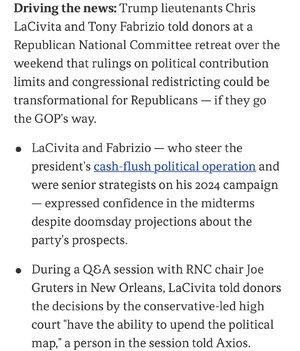
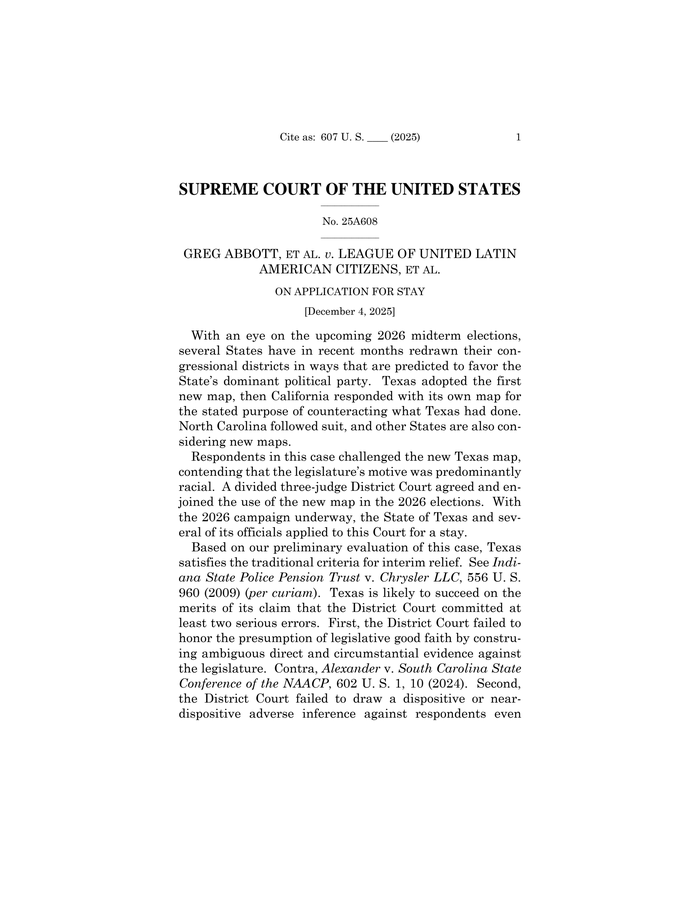
Trump aides bullish on Supreme Court boosting GOP in midterms​


IMG_1654.jpeg
 
“… At issue is a First Amendment principle called the right to receive information. The Supreme Court long ago concluded that the First Amendment encompasses a fundamental right to receive information and ideas, as it is necessary for the meaningful exercise of other First Amendment rights such as freedom of religion, expression, speech, assembly and the press.

A federal judge in 2023 ordered county officials to restore the disputed books to the library system. But the 5th Circuit in a 10-7 decision reversed the judge's ruling and sided with the county. The 5th Circuit concluded that public library patrons have no right to receive information under the First Amendment.

Writing for the 5th Circuit, Judge Stuart Kyle Duncan asserted that "no one is banning" books by removing them from libraries.
"If a disappointed patron can't find a book in the library, he can order it online, buy it from a bookstore or borrow it from a friend," wrote Duncan, a judicial appointee of Republican President Donald Trump. "All Llano County has done here is what libraries have been doing for two centuries: decide which books they want in their collections."…”
A "Right to receive information" sounds very difficult to enforce. Obviously, no library can carry every book ever published, so where is that line drawn between what is realistic and infringing on a right?
 
You'd think it would be drawn somewhere in the vacinity of consideration for books that local citizens and/or patrons of the library have expressed an interest in having available at their local library, which presumably is the case here regarding these books, since said local citizens and patrons went to the trouble of bringing a federal lawsuit. Seems like a request to the head librarian should've sufficed...
 
I'd start with forbidding removing books or material already present. Probably continue by denying any reason other than financial as a standard for the purchase of other materials. Don't see why it's anybody else's business what someone else reads. It would be like shutting down Mike Johnson's porn.
 
You'd think it would be drawn somewhere in the vacinity of consideration for books that local citizens and/or patrons of the library have expressed an interest in having available at their local library, which presumably is the case here regarding these books, since said local citizens and patrons went to the trouble of bringing a federal lawsuit. Seems like a request to the head librarian should've sufficed...
A successful request to the head librarian was sort of what happened. A group of conservatives in a rural county, who were probably in the majority but at the very least were politically organized enough to get representation on the county commission and the library board, removed books dealing with LGBT and some other controversial issues.

The lawsuit was brought by another group, probably in the minority in this rural county, that wanted to put those books back in the library. That group originally won at a lower court level, lost at a higher court level and then the Supreme Court declined to review the case which means the loss stands.

So in this case, the supreme Court effectively decided that this type of issue could be decided by a political majority by whatever governing body controls the library. I don't like it but I understand it and think it's probably the right way to run the railroad. The real fear for me would be if it extended to other bodies that local government agencies control like hospitals, zoning boards or even scarier the police department.
 
A "Right to receive information" sounds very difficult to enforce. Obviously, no library can carry every book ever published, so where is that line drawn between what is realistic and infringing on a right?
When the determination of the library is on the basis of viewpoint or content discrimination, as with all other species of First Amendment rights. That is a complete answer to your question in this context.

To say I have a right to receive information is not to say I have a right to receive all information. It just means that I have stated a valid injury under the First Amendment sufficient to provide standing. Then the courts do a traditional First Amendment content-discrimination analysis. Or they should. The ones in Texas do things differently.
 
Will we seen of the conservative judges step down next year? That way Trump can nominate a replacement and lock in the conservative majority for a generation?
 
Back
Top