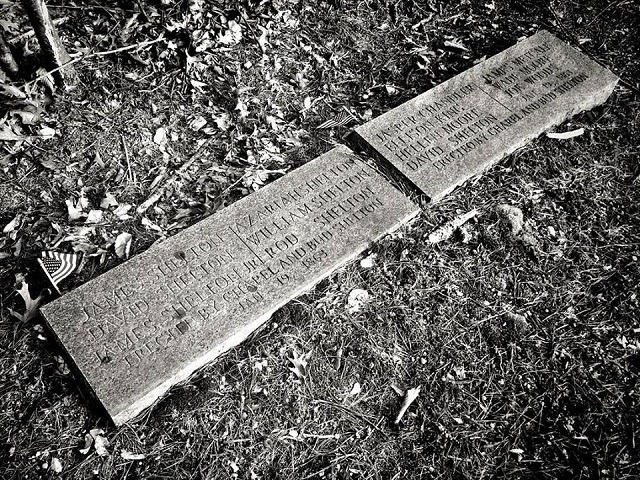
Shelton Laurel Massacre:This Date in History

  • Thread starter Thread starter donbosco
  • Start date Start date
  • Replies: 1K
  • Views: 305K
  • Off-Topic 
My Dad, a WW2 vet, said of the M1 Carbine, that you were better off throwing it at someone than shooting it at someone. But take that with a grain of salt, as he also praised the virtues of a
1903 Springfield bolt action rifle over a M1 Garand rifle. He bragged about shooting at and hitting targets at 1,000 yards on the shooting range with the 1903 Springfield. But when pressed, he admitted that it was uncommon to engage targets at 1,000 yards on South Pacific Islands.
Bolt actions are inherently more accurate because there fewer parts and generally can be more rigidly constructed. The Springfields were chambered in the same caliber but were well known for their accuracy. Rate of fire was the difference. As this shows, our complaints about the accuracy of the Storm Troopers in Star Wars is a bit off base.


The number of shots fired per enemy casualty varies hugely by conflict, from tens of thousands in Vietnam (around 50,000) to lower figures in other wars like WWII (45,000) or even hundreds in specific engagements, with modern conflicts seeing estimates of 250,000 rounds per insurgent kill, often including training and suppressive fire, not just aimed shots. These numbers reflect inefficiency, suppression tactics, and non-combat use (like training), not just direct hits
 
Last edited:
FYI

"Famously, it's estimated that about 75,000 rounds were fired by the Americansduring this long day at Lexington, Concord, and the British retreat to Boston. About one out ofevery 300 of those rounds actually hit a red coat.

Muskets were notoriously inaccurate, but when you have 75,000 rounds being fired, you're going to hit eventually. About 259 British soldiers are wounded, 279 and 79 of them are killed, but the shot heard around the world probably missed. Second, the British quickly discerned that the Americans were shooting, specifically aiming at the officers. And it's true that the Americans eventually made it a practice of aiming at the reddest of the RedCoats, those that were almost vermilion in hue because they were usually worn by officers who could afford the more expensive dyes that made those coats pop. And the belief was that if you kill or incapacitate the officers, discipline falls apart and you've got a leg up. And this begins, really, on April 19th, 1775."

 
FYI

"Famously, it's estimated that about 75,000 rounds were fired by the Americansduring this long day at Lexington, Concord, and the British retreat to Boston. About one out ofevery 300 of those rounds actually hit a red coat.

Muskets were notoriously inaccurate, but when you have 75,000 rounds being fired, you're going to hit eventually. About 259 British soldiers are wounded, 279 and 79 of them are killed, but the shot heard around the world probably missed. Second, the British quickly discerned that the Americans were shooting, specifically aiming at the officers. And it's true that the Americans eventually made it a practice of aiming at the reddest of the RedCoats, those that were almost vermilion in hue because they were usually worn by officers who could afford the more expensive dyes that made those coats pop. And the belief was that if you kill or incapacitate the officers, discipline falls apart and you've got a leg up. And this begins, really, on April 19th, 1775."

Don't know if this is true or just an after-the-fact reimaging, but, . . ., at the Battle of Cowpens in the American Revolution, Dan Morgan hit upon a strategy that caused the British a lot of problems.

Morgan broke his troops into three groups. Backwoods men armed with rifles, the smallest group. Local militia, armed with muskets. And Continental regulars, also armed with muskets. Morgan told the backwoodsmen to go over to the right flank at the edge of the woods and shoot at anyone riding a horse or standing near a cannon. All with their rifles resting on a log, for better accuracy. Morgan directed the local militia to the front, told them to fire one shot, and then they could go home. Morgan told the regular soldiers to back up the militia, and to let them pass through once they had fired their one shot.

Everything worked perfectly. The local militia faced off against the Redcoat regulars, fired their one shot, and turned and ran. This action by the local militia, completely destroyed the Redcoats' discipline. The Redcoats line dissolved as they broke in pursuit of the local militia and slammed as a disorganized mob into the disciplined Continental Regulars who stood their ground against the Redcoats mob. Meanwhile, the backwoodsmen were shooting officers off their horses and keeping the artillerymen ducking so much that any artillery actually fired was infrequent and poorly aimed.

And the cherry on top of this Revolutionary Sundae, was when the fleeing local militia realized what was happening, they returned to stand beside the Continental Regulars, and added their musket fire to Regulars' fire. Quite the American victory that day.

When the British finally got organized enough to flee and get back to Conwallis' HQ, in my imagining, Cornwallis didn't ask what happened, he asked how did they get away.
 
IMG_3060.jpeg


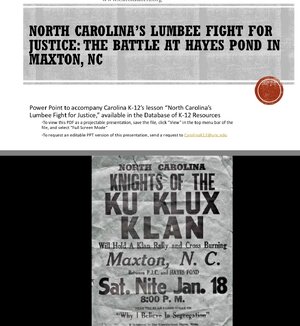
#OTD (January 18) in 1958 “The Shortest Klan Rally in History” was held when Lumbee defenders routed the racists from their Cross Burning in a field near Maxton and the sheet-draped terrorists fled. “The Battle of Hayes Pond” was the end result of the so-called Christian (the crosses and prayers were integral) White Supremacist call to gather that Saturday night in Robeson County to “put the Indians in their place, [and] to end race-mixing.”

Ultimately, “Place” did indeed serve as the focal point of the event as Lumbee asserted the historic point that Robeson was their “Place,” not one run by racists aiming to terrorize. In the weeks before January 18 the klan, led by a South Carolina poobah with the alliterative moniker of Catfish Cole, had been joy-riding through the small towns of the county, irritating folks and imaging themselves fierce. They’d burned crossed on two Lumbee lawns as well. Cole had even used a loudspeaker he employed in his side-gig as Evangelical Preacher to announce the Hayes Pond rally during their little parades.

Around 500 Lumbee showed for the rally and stopped it. Defending their “Place” with shotguns and rifles they sent the 100 or so proto-fascists away, never to return. The January 27, 1958 carried the story under the title, “Bad Medicine for the Klan: North Carolina Indians Break Up Kluxers’ Anti-Indian Meeting.” The Lumbee did the right thing in standing up to thugs who had come from outside to create fear, harm individuals, and violate their human and civil rights.

Here’s some of the ‘Rest of the Story.” Lumbees Rally, Klansmen Scurry, in Robeson County


This is quite well remembered in Buncombe and Madison County...to the point that I've experienced some animosity in conversations.

Ironically, I've also seen a lot of trucks from Madison County flying Confederate Naval Battle Flags -- driven by men whose ancestors probably resisted secession and the draft. I just shake my head at the ignorance...but then maybe they don't care what Great Grandpa did or thought.
 
Back
Top