The first thing I thought of when I saw the new thread title.

Navigation
Install the app
How to install the app on iOS
Follow along with the video below to see how to install our site as a web app on your home screen.
Note: This feature may not be available in some browsers.
More options
You are using an out of date browser. It may not display this or other websites correctly.
You should upgrade or use an alternative browser.
You should upgrade or use an alternative browser.
Situwaki contingent reached Indian Territory on Feb. 2, 1839: This Date in History
- Thread starter donbosco
- Start date
- Replies: 1K
- Views: 337K
- Off-Topic

- Messages
- 1,977
Link: Jim Gardner (politician) - WikipediaThey’ve been doing so since at least 1968. Going on 58+ years.
Jim Gardner was the first Republican politician I was aware of who ran on the hard-right, racist platform that has become emblematic of today's GOP. I had an uncle who was from Connecticut, was a dyed in the wool Republican, and moved to Wilmington. It troubled him greatly to see the NC Republican Party transition from a pro-business group looking to advance North Carolina through better jobs, beyond farming and textiles, into the bastion of racism and prejudice that it morphed into from the late 1960's to the early 1980's, and remains as such today.
Did he move to NC before or after Jesse Helms first ran in 1972?Link: Jim Gardner (politician) - Wikipedia
Jim Gardner was the first Republican politician I was aware of who ran on the hard-right, racist platform that has become emblematic of today's GOP. I had an uncle who was from Connecticut, was a dyed in the wool Republican, and moved to Wilmington. It troubled him greatly to see the NC Republican Party transition from a pro-business group looking to advance North Carolina through better jobs, beyond farming and textiles, into the bastion of racism and prejudice that it morphed into from the late 1960's to the early 1980's, and remains as such today.
- Messages
- 1,977
Before. He assumed Jesse was some sort of joke/protest candidate based on Jesse's "editorials" on the Tobacco Radio Network & WRAL-TV. Ever hear the story of how Jesse got his stake in WRAL? When Jesse was an administrative aide to Sen. Willis Smith, Jesse used his influence to pressure the FCC to grant a TV broadcast license to the WRAL radio station instead of WPTF. In exchange for this legislative courtesy, Jesse was "given" a significant chunk of stock in WRAL and the ability to spew his poison from the public airways. Wiilis Smith was the candidate who defeated Frank Porter Graham largely by screaming the "N" word in every speech.Did he move to NC before or after Jesse Helms first ran in 1972?
And, Jesse and Tom Ellis doctored up a photo to show Mrs. Frank Porter Graham dancing with a black man.Before. He assumed Jesse was some sort of joke/protest candidate based on on Jesse's "editorials" on the Tobacco Radio Network & WRAL-TV. Ever hear the story of how Jesse got his stake in WRAL? When Jesse was an administrative aide to Sen. Willis Smith, Jesse used his influence to pressure the FCC to grant a TV broadcast license to the WRAL radio station instead of WPTF. In exchange for this legislative courtesy, Jesse was "given" a significant chunk of stock in WRAL and the ability to spew his poison from the public airways. Wiilis Smith was the candidate who defeated Frank Porter Graham largely by screaming the "N" word in every speech.
Wonderful men. Right-wing bigoted Democrats who became right-wing bigoted Republicans after the Civil Rights Act became law.

He's Not Here
Distinguished Member
- Messages
- 287
Ditto. Just grabbed the photo to post - should have known someone would beat me to it.The first thing I thought of when I saw the new thread title.

donbosco
Legend of ZZL
- Messages
- 6,376
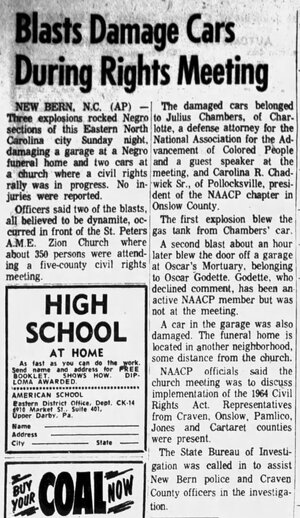
Note that one of the cars bombed #OTD in 1965 in New Bern was that of Julius Chambers. Ten months later his house would be firebombed in Charlotte. In 1970 his law office was set afire. Meanwhile his father's auto repair shop in Mt. Gilead was also set on fire twice. Chambers went on to become the head of the New York City NAACP Legal Defense and Education Fund and then in 1993 became Chancellor of his alma mater, North Carolina Central University.
donbosco
Legend of ZZL
- Messages
- 6,376
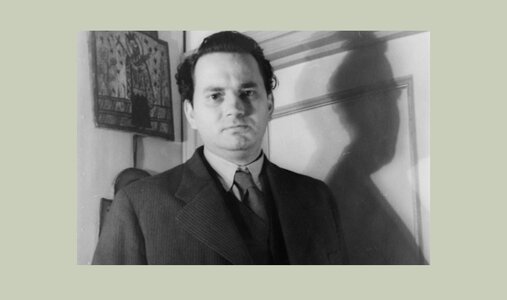
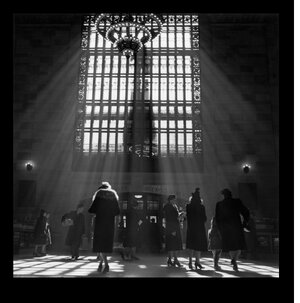
#OnThisDay (January 26) in 1932 Thomas Wolfe "decided not to go to Connecticut with his oh-so-patient editor Max Perkins. But instead of just declining Perkins’ invitation to go to his weekend home, Wolfe opted to board the train and then change his mind at the last moment. He jumped from a moving train on this day in 1932 and landed onto the Grand Central Station platform. But the clumsy 6’5 writer did not make it onto level ground without injuring himself. He severed a vein in his left arm after falling on the concrete platform. Both the writer and his editor had been drinking heavily and had made their way unsteadily to the train. Seeing Wolfe prostrate on the platform, Perkins described the scene as similar to viewing a beached whale on Cape Cod. Onlookers pulled emergency stop wires and a crowd gathered around Wolfe. Of course, Wolfe himself eventually went into a very long description of what he was thinking: shame that he had injured himself and had broken his arm 'uselessly, horribly, stupidly and wastefully.'”
Literary History Today Jan 26: Thomas Wolfe leaps – Better Together Media
The North Carolina born writer decides not to go to Connecticut with his oh-so-patient editor Max Perkins.
 bettertogethermedia.com
donbosco
Legend of ZZL
- Messages
- 6,376
On this day, January 27, 1986, the Flat Duo Jets filmed their legendary segment for the iconic documentary Athens, GA/Inside-Out at the Sigma Alpha Epsilon Fraternity at UGA!
We are thrilled to share that the documentary by produced by Bill Cody and directed by Tony Gayton is being digitally restored by The UGA Special Collections Libraries for this years 40th anniversary! Stay tuned for more info. In the meantime check out the clip of the performance in the comments.
Thanks Mike Cook!
donbosco
Legend of ZZL
- Messages
- 6,376
#OTD in 1901 US Representative George White (NC 2nd) left Congress w/the prediction, “Phoenix-like he (the negro) will rise up some day and come again (to Congress).” White Supremacists had retaken power in The South & suppression of Black voting rights became the rule-No AFAM would be elected to national office from NC until ‘92. George H. White Delivers “Phoenix” Address

donbosco
Legend of ZZL
- Messages
- 6,376
We tend to know about the Greensboro Four & the February 1, 1960 Sit-In. There is a second set of four stories to the Greensboro Sit-In—about workers caught between providing & protesting. I suspect the ‘caught’ nature of matters extended the entire duration of the February 1 — July 25 period that we recognize today & beyond. Indeed, they, like so many workers of color fought daily battles against both white supremacy & class hierarchies. On the flip side, so very many of those white people who stood against the brave actions of the local college students in Greensboro & other places to desegregate were themselves precariously perched workers. Scan the faces of the people who staged counter-protests, profile the KKK who threatened violence on the action by their presence & the historical narrative they brought to bear, & you will find working class folk. Keeping them from recognizing the economic ties that bound them to African American laborers has long been the strategy of those who rule, hire, manage, pay, & dismiss. Don’t forget the working folk. Class solidarity is key.
#OTD (February 1) in 1960 African American customers asked to be served at the Woolworth’s lunch counter in downtown #Greensboro. Sit-Ins, protests, & negotiations had been initiated on February 1 by the four NC A&T University students. On July 25 Woolworth’s employees Geneva Tisdale, Susie Morrison, Anetha Jones & Charles Bess, were the first served by invitation of the store. Bess is the worker in this famous photo of the second day of the sit-in. Sit-in Victory in Greensboro, 1960
AND: The Man Behind the Counter — THE BITTER SOUTHERNER
#OTD (February 1) in 1960 African American customers asked to be served at the Woolworth’s lunch counter in downtown #Greensboro. Sit-Ins, protests, & negotiations had been initiated on February 1 by the four NC A&T University students. On July 25 Woolworth’s employees Geneva Tisdale, Susie Morrison, Anetha Jones & Charles Bess, were the first served by invitation of the store. Bess is the worker in this famous photo of the second day of the sit-in. Sit-in Victory in Greensboro, 1960
AND: The Man Behind the Counter — THE BITTER SOUTHERNER
- Messages
- 3,773
February One - The Story of the Greensboro Four is a great DVD that was produced by someone who supported my run for Congress back in the day. I have the DVD; I'm not sure if it is available today but perhaps it can accessed with one of those new fangled streaming on line do hickies
But for those interested/curious in learning about this landmark civil rights movement event(s), I encourage you to track it down. It is well worth the watch.
My as white woman my grandmother was a charter member of the Greensboro NAACP, and she took me to this event when I was a young boy. My grandmother is to blame for making me the liberal I am today
But for those interested/curious in learning about this landmark civil rights movement event(s), I encourage you to track it down. It is well worth the watch.
My as white woman my grandmother was a charter member of the Greensboro NAACP, and she took me to this event when I was a young boy. My grandmother is to blame for making me the liberal I am today
donbosco
Legend of ZZL
- Messages
- 6,376
February One - The Story of the Greensboro Four is a great DVD that was produced by someone who supported my run for Congress back in the day. I have the DVD; I'm not sure if it is available today but perhaps it can accessed with one of those new fangled streaming on line do hickies
But for those interested/curious in learning about this landmark civil rights movement event(s), I encourage you to track it down. It is well worth the watch.
My as white woman my grandmother was a charter member of the Greensboro NAACP, and she took me to this event when I was a young boy. My grandmother is to blame for making me the liberal I am today
CSPAN appears to have it.
[February One: The Story of the Greensboro Four]
On February 1, 1960, four college students - Ezell Blair, Jr. (now Jibreel Khazan), David Richmond, Franklin McCain and Joseph McNeil - sat down at a "whites only" Woolworth's lunch counter in Greensboro, North Carolina. Joined by black and white allies and enduring daily harassment and threats...
American History TV
February One: The Story of the Greensboro Four
On February 1, 1960, four college students - Ezell Blair, Jr. (now Jibreel Khazan), David Richmond, Franklin McCain and Joseph McNeil - sat down at a "whites only" Woolworth's lunch counter in Greensboro, North Carolina. Joined by black and white allies and enduring daily harassment and threats, the sit-ins continued for months. This award-winning 2003 film documents the non-violent sit-in protest with extensive interviews with three of the Greensboro Four, dramatizations, and archival footage."- Messages
- 3,773
You are the best, Don !CSPAN appears to have it.
"February 1, 2003
[February One: The Story of the Greensboro Four]
On February 1, 1960, four college students - Ezell Blair, Jr. (now Jibreel Khazan), David Richmond, Franklin McCain and Joseph McNeil - sat down at a "whites only" Woolworth's lunch counter in Greensboro, North Carolina. Joined by black and white allies and enduring daily harassment and threats...www.c-span.org
American History TV
February One: The Story of the Greensboro Four
On February 1, 1960, four college students - Ezell Blair, Jr. (now Jibreel Khazan), David Richmond, Franklin McCain and Joseph McNeil - sat down at a "whites only" Woolworth's lunch counter in Greensboro, North Carolina. Joined by black and white allies and enduring daily harassment and threats, the sit-ins continued for months. This award-winning 2003 film documents the non-violent sit-in protest with extensive interviews with three of the Greensboro Four, dramatizations, and archival footage."
Thank you for finding this. There is a video in the doc that shows an older white woman approaching the four sitting at the counter to offer her comfort and support. I can't say for sure, but I believe that was my grandmother.
I especially hope that our under 50yo posters will watch it.
donbosco
Legend of ZZL
- Messages
- 6,376
You are the best, Don !
Thank you for finding this. There is a video in the doc that shows an older white woman approaching the four sitting at the counter to offer her comfort and support. I can't say for sure, but I believe that was my grandmother.
I especially hope that our under 50yo posters will watch it.
I had seen it and have shown it to students back when DVDs were a classroom thing. I'm glad to make this 'find' (which was hardly that difficult) and will make use of it later this semester most likely.

- Messages
- 2,741
When you have to promise to govern “sanely” it is not a good sign
Kinda like asserting that you’re a stable genius.
donbosco
Legend of ZZL
- Messages
- 6,376
Situwaki contingent reached Indian Territory on Feb. 2, 1839
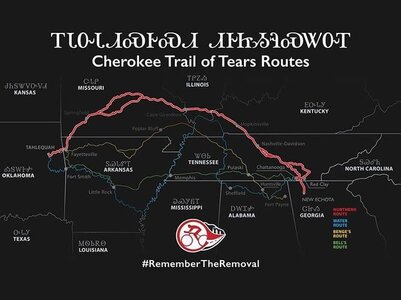
JAY -- On Feb. 2, 1839, one of 13 Cherokee contingents that traveled overland from Tennessee to Indian Territory completed its journey, settling in what are now Delaware and Mayes counties in eastern Oklahoma.
This contingent, led by Cherokee leader Situwaki, left a camp near Charleston, Tennessee, on Sept. 7, 1838, and traveled into Kentucky, Illinois and then across Missouri and Arkansas, stopping in Indian Territory. The route would become known as the Northern Route of the Trail of Tears.
Research archeologist at Western Carolina University, Brett Riggs, Ph.D., has researched and followed this contingent of Cherokees from the Aquohee (The Big Place) Community in North Carolina. He said the contingent voluntarily prepared to be moved west by the U.S. Army in June 1838 and were prepared to move when soldiers arrived to escort them to holding camps.
"This is a group of people, a community that was at Aquohee in North Carolina where present-day Brasstown is, were waiting at the Baptist church of Peter Oganaya. They left there on June 13, 1838, under Army escort," Riggs said.
Before the roundup of Cherokee people began in May 1838, without consent of the Cherokee Nation government, the U.S. government set up forts throughout the CN in North Carolina, Georgia, Alabama and Tennessee in preparation of forcibly removing the Cherokees when title to their lands expired at the end of June 1838, according to the Treaty of New Echota. Gen. Winfield Scott set up headquarters in Charleston and established a process to arrest and remove Cherokee people.
According to the book, "Cherokee Removal: Before and After" by William L. Anderson, thousands of Cherokees were moved to "emigration camps" in May 1838 to await removal. Riggs' research states about 1,500 of the approximately 10,000 Cherokees held in and around Fort Cass near Charleston died from dysentery, starvation, food poisoning from the rancid meat and rotted corn meal, exposure, dehydration and other diseases common to such conditions of imprisonment.
The camps near Fort Cass were located between Charleston and Cleveland, Tennessee, south of and bordering on the Hiawassee River.
Initial plans to move Cherokees by boat in the summer of 1838 had to be changed because of low water levels on the Tennessee River. The first three contingents of Cherokee emigrants, with approximately 2,800 people, were divided and traveled by water on the Tennessee River. The first group, numbering approximately 800, departed June 6, 1838, with the other two detachments leaving after June 15. These three contingents traveled under military supervision.
The first three contingents are thought to have had a much higher death rate and desertions than the 13 subsequent contingents that left under their own supervision and without military escort.
Riggs said decades of artwork depicting U.S. soldiers pushing Cherokee people along the trail with bayonets is not accurate. He said the CN was in charge of the overland removals, so no U.S. soldiers were present.
"The leadership of the Cherokee Nation petitioned the removals be delayed because to move in mid-summer was like a death sentence. The country was dealing with cholera...something no one knew how to deal with," he said.
Cholera infects the small intestine and is transmitted by contaminated water or food. Before the June roundup of Cherokees from North Carolina, Cherokee children were also dealing with whooping cough and dysentery that also affected the intestines and caused diarrhea. So the diseases were prevalent in the camps, and Cherokee and Army doctors could do little to help.
"I'm convinced that the major portion of mortality, of loss of life, in the whole process of the removal of the Cherokee people happened in these camps," Riggs said.
In his research paper titled, "The Road from Aquohee -- The Journey of a Cherokee Community,"�Riggs said the trip to Indian Territory was supposed to take three weeks to nearly a month by steamboat, but because of low water levels on the Tennessee River, Cherokee people were to take an overland trip.�
After a three-month delay, on Sept. 7, 1838, Situwaki led his contingent from Charleston to begin a five-month trip to Indian Territory. Along the way, the approximately 1,250 people from Aquohee endured one of the coldest winters in the 19th century.
Rev. Evan Jones, a white minister who had learned to speak Cherokee, assisted Situwaki. The detachment's manager was Peter Oganaya, whose church the Aquohee people had gathered at to await the soldiers.
"They arrived at Beattie's Prairie near the present-day town of Jay in Delaware County and disbanded at the mouth of Hogeye Creek on Feb. 2, 1839," Riggs said.
Of the approximately 1,250 people who departed from Charleston, Tennessee, 71 died, and there were five births on the trail. Usually not accounted for are the deaths that occurred after the people reached their destination. It's believed 800 to 2,000 more people died in I.T. along with the approximately 2,000 that died in the holding camps and on the trail.
Riggs said the Aquohee Cherokees "fanned out" from Beattie's Prairie to settle in the Spavinaw Creek and Eucha area in what are now Delaware and Mayes counties.
donbosco
Legend of ZZL
- Messages
- 6,376
This was a classic invasion of territorial acquisition though some weak efforts were made to provide a facade of a ‘just’ war by the Polk Administration. This was ultimately a Pro-Slavery Action by the US Government.
#OTD in 1848 the US/Mexico ‘Treaty of Guadalupe Hidalgo’ was signed in the small town of that name- the treaty ceded approximately 55% of Mexico’s land (present-day California, Nevada, Utah, most of New Mexico and Arizona, and parts of Colorado and Wyoming) to the US & ended the Mexican-American War begun w/the annexation of Texas.
https://www.loc.gov/item/today-in-history/february-02
#OTD in 1848 the US/Mexico ‘Treaty of Guadalupe Hidalgo’ was signed in the small town of that name- the treaty ceded approximately 55% of Mexico’s land (present-day California, Nevada, Utah, most of New Mexico and Arizona, and parts of Colorado and Wyoming) to the US & ended the Mexican-American War begun w/the annexation of Texas.
https://www.loc.gov/item/today-in-history/february-02
donbosco
Legend of ZZL
- Messages
- 6,376
#OTD in 1781 Maryland became the 13th colony to ratify the Articles of Confederation. We do not celebrate this date. We limped along decentralized and weakened by states' rights for 8 years until the Constitution in 1789. Now the nation sits divided, imperiled, and under attack from within by kleptocratic oligarchs and their henchmen and women.
 www.theconstitutional.com
The Articles of Confederation are Ratified by Final State - This Day in History - February 2, 1781
Related PostsBuy Tickets for The Constitutional Walking Tour of Philadelphia – See 20+ Sites on a Primary Overview of Independence Park, including the Liberty Bell and Independence HallThe Second Continental CongressIndependence Hall HistoryConstit
Share: