
Navigation
Install the app
How to install the app on iOS
Follow along with the video below to see how to install our site as a web app on your home screen.
Note: This feature may not be available in some browsers.
More options
You are using an out of date browser. It may not display this or other websites correctly.
You should upgrade or use an alternative browser.
You should upgrade or use an alternative browser.
Tariffs Catch-All
- Thread starter BubbaOtis
- Start date
- Replies: 5K
- Views: 191K
- Politics
superrific
Master of the ZZLverse
- Messages
- 13,514
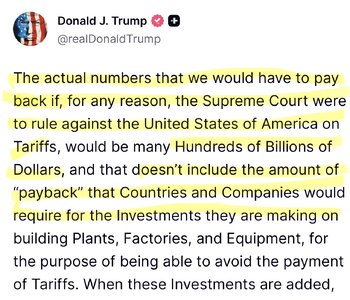
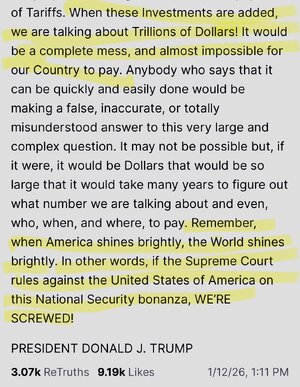
It would be impossible to pay out monies we just collected? I mean, this guy says crazy shit all the time but we shoudn't forget how bonkers even some of his less incendiary ideas are.

lightbluenc
Honored Member
- Messages
- 915
So ready for my money to be paid back to me!

- Messages
- 46,577
Hilariously, the Trump Administration defeated the initial demand for a stay of enforcement/collection of the tariffs by claiming there would be no material harm to the importers because the government could reimburse the funds if they ultimately lost the issue on the merits.It would be impossible to pay out monies we just collected? I mean, this guy says crazy shit all the time but we shoudn't forget how bonkers even some of his less incendiary ideas are.
- Messages
- 46,577
Anyway, from Covington:Hilariously, the Trump Administration defeated the initial demand for a stay of enforcement/collection of the tariffs by claiming there would be no material harm to the importers because the government could reimburse the funds if they ultimately lost the issue on the merits.
“…
First, the Administration may seek to avoid issuing refunds by arguing that at least some of the tariffs imposed under existing IEEPA Executive Orders (“EOs”) nonetheless remain effective, as to both past and future imports, because they are justified by other authorities not explicitly identified in the EOs—particularly those not requiring predicate agency action. This strategy would leverage the fact that the President is not himself subject to the Administrative Procedure Act (which requires agencies to follow certain procedural and notice requirements), and generally need not explain his decision-making except as required by statute. Though there appears to be little precedent for such a strategy, and it would face obstacles, the Administration may at least delay—and perhaps limit—refunds by pursuing it.
The viability of this strategy would depend first on the relief ordered in the IEEPA case now pending before the Supreme Court. For instance, even if the Supreme Court holds the tariffs unlawful, it is unlikely to weigh in on the proper remedy—in particular, on whether any importer can seek refunds from the unlawfully imposed tariffs, or instead only the plaintiffs to the case (or perhaps no importers at all). Instead, the Supreme Court is likely to remand the case to the lower courts to make that remedial determination in the first instance. Any remedy that enjoins agencies from implementing President Trump’s EOs would require him to issue new actions re-authorizing the tariffs under different authorities.
The Administration, though, may contest any such broad remedy by arguing that it is not permissible under recent Supreme Court precedent and should instead be limited to the plaintiffs to the case. In addition, the Administration may claim that the tariffs imposed remain lawful—in whole or in part—based on other tariff authorities not explicitly identified in the IEEPA EOs.
This latter argument, to be sure, would face challenges. While other statutory bases to impose tariffs require no predicate agency investigation or action, their use is limited to specific factual circumstances that are narrower than IEEPA’s declaration of an international emergency.…”

Don’t Count on Immediate IEEPA Refunds: What President Trump Might Do If SCOTUS Throws Out IEEPA Tariffs
On November 5, 2025, the U.S. Supreme Court is set to hear the Trump Administrations appeal of lower ...
- Messages
- 46,577
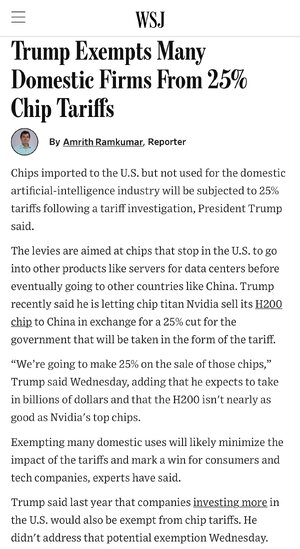
“… Paul Triolo, a partner at Albright Stonebridge Group in Washington, said it was unclear whether the administration’s approach would help with its ultimate goal of making more chips domestically.
“There is no precedent for this type of approach to tariffs and semiconductor policy,” he said.
“This is a policy designed specifically for Nvidia and AMD to be able to ship advanced GPUs to China and for the U.S. government to attach a ‘chip tax’ to this process in a way that does not violate existing laws.”…”
- Messages
- 2,749
The Italian-Built Dodge Hornet SUV Is Dead Due to Trump's Tariffs
Dodge has officially discontinued its most affordable model. The compact SUV lasted for only three years.- Dodge has officially ended production of the Hornet, which is built in Italy, due to "shifts in the policy environment."
- The compact SUV was Dodge's most affordable vehicle, with the 2025 model starting at $31,990.
- The Hornet's death follows a production pause that went into effect last summer; it only lasted for three model years.

The Italian-Built Dodge Hornet SUV Has Ended Production Due to Trump's Tariffs
Dodge has officially discontinued its most affordable model. The compact SUV lasted for only three years.

- Messages
- 4,355

- Messages
- 5,558

Canada's Carney hails warmer ties with China and signs energy pact
Prime Minister Mark Carney hailed Canada's improving ties with China as well as the leadership of President Xi Jinping on Thursday, declaring their nations were charting a new course in cooperation at a time of global division and disorder.
n the roadmap, Ottawa welcomed Chinese investments in energy, agriculture and consumer products, while Beijing looked forward to Canada's investment in services, new materials, aerospace and advanced manufacturing, among other fields.
In energy, both sides plan to explore oil and gas development, as well as cooperation in natural uranium trade.
Canada's Natural Resources Minister Tim Hodgson said he had heard "loud and clear" that China was looking for reliable trading partners and would like more Canadian energy products.
The pacts provide "an example to the world of cooperation amidst a time globally of division and disorder," Carney said in his meeting with Zhao.

ChileG
Inconceivable Member
- Messages
- 3,582
All part of the master plan, right Trump voters?

1moretimeagain
Inconceivable Member
- Messages
- 4,894
Share: