The Progressive Farmer: This Date in History

  • Thread starter Thread starter donbosco
  • Start date Start date
  • Replies: 1K
  • Views: 294K
  • Off-Topic 
"On January 4, 1969, conjoined twins Daisy and Violet Hilton were found dead in their home in Charlotte. The 60-year-old women most likely died of complications of the Hong Kong flu. Born in Brighton, England in 1908, the twins were unofficially adopted by their biological mother’s midwife, Mary Hilton, when the mother rejected the children. From the time that they were infants, they were exhibited by Hilton and her daughter. Soon Hilton’s son-in-law, Myer Myers, became their agent and exhibited them in the United States. They were kept in insolation when not being exhibited on midways across the country.

By 1931, the sisters had enough and sued for independence and damages. They won a settlement of $100,000, a fraction of what they had earned. They performed in vaudeville productions and, in 1932, they appeared in the film Freaks. They published their autobiography The Lives and Loves of the Hilton Sisters in 1942. After World War II, the popularity of sideshows diminished, and they toured drive-in theaters in support of the film Chained for Life in which they acted in 1950. Their manager abandoned them in Charlotte, where they settled and worked as produce clerks in a local grocery store."


It’s interesting that there were two sets of famous conjoined twins who eventually called NC home. Cheng and Eng Bunker being the others. Cheng and Eng also died n January.

Cheng and Eng had a very fascinating life. Despite their physical condition, nationality, and race— all things that one would think would have people view them as second-class citizens or even less than human in the mid-19th century— they went on to become very wealthy and prominent citizens in Wilkes and Surry Counties. I was shocked to learn that they owned a number of slaves.
 
IMG_2894.jpeg

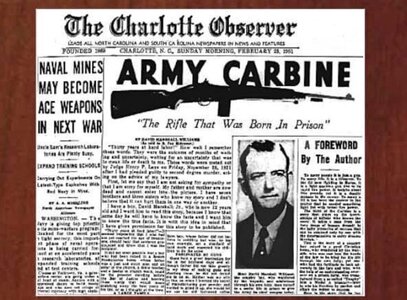
Crime paid in this case: #OTD in 1975 David ‘Carbine’ Williams (b.1900-Cumberland) died. Convicted of 2-degree murder, in prison workshop he designed guns & drew the attention of Colt. Pardoned by the Governor in ‘29, in ‘40 he created M-1 Carbine-8 Million Allies carried the gun in WW2. Williams became a rich man through his inventions. “Carbine” Williams, Inventor and Inmate
 
Not really linked to this date but an interesting story about a woman who just died: in 1935, she was a Jewish baby in Austria and someone entered a photo of her in an Aryan baby contest. Her photo won and her parents were in fear of discovery. They kept it secret for years.

 
IMG_2894.jpeg

Crime paid in this case: #OTD in 1975 David ‘Carbine’ Williams (b.1900-Cumberland) died. Convicted of 2-degree murder, in prison workshop he designed guns & drew the attention of Colt. Pardoned by the Governor in ‘29, in ‘40 he created M-1 Carbine-8 Million Allies carried the gun in WW2. Williams became a rich man through his inventions. “Carbine” Williams, Inventor and Inmate
The standard issue rifle for the US in WWII was the M1 Garand. The M1 Carbine was issued to NC0’s officers and support personnel. The Carbine did not have the range of the Garand, so it was not the weapon of choice for the average infantry soldier. Still, the Carbine played a significant role in our victory in the war.
 
ProgressiveFarmer.jpg


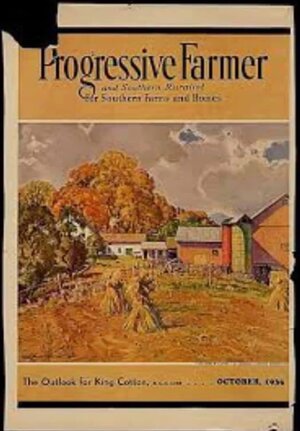
Until 2015 I had a subscription to ‘The Progressive Farmer Magazine.’ My father held one until he died and my mother continued the subscription until she passed in 2012. She also carried The Progressive Farmer’s much more successful companion publication for women, ‘Southern Living.’ I’m pretty sure that my Grandpa Dunn kept ‘TPF’ most of his life as well, certainly his elder years. I loved it as a boy for the beautiful glossy photographs of cows, horses, and oh-so-familiar scenes of the southern countryside. It mirrored the life I was living in very attractive and alluring imagery.

Deddy surely gained from the articles about feed, fencing, and farm futures. It was only many years later that I learned that there had once been a political side to the magazine. It was a bit of a ‘doh’ Moment frankly - after all, right there it was in the title - Progressive. The politics carried by ‘TPF’ was not progressive in 100% modern terms. Yes, it stood for education, healthcare, science, good roads, and investment in infrastructure, but there was also at times a Boll Weevil Democrat side to the promoted policies. It was, for the time it took political stands, essentially segregationist for years with a transition to ‘gradualist’ on issues of race.

Clarence Poe was the ‘Progressive Farmer’s’ editor from 1899 until 1954. I believe that sometime in the late 1950s the political edge receded and the magazine backed away from that early 20th century Southern Democrat worldview. Indeed, at that time it left behind the political altogether. Whether ideology was in play or not I suspect there was a little homeland of my birth partisanship in the love of the magazine in #DeepChatham. You see, Poe, who became the editor at 18 and owner at 22, was from Chatham County. Born and raised near Gulf, Poe began working on the ‘PF’ at 16. He turned down a scholarship to Wake Forest College at 18 to run the magazine.

For over half a century Poe, self-taught and a natural writer, was one of the most influential voices in the region. Imagine for a moment that he promoted cooperative marketing, much in the mold of the old Southern Farmer’s Alliance, and the label of Progressive is more understandable. Indeed historical context is important to understanding how the working class of the South found New Deal policies, also cooperative and collectivist in so many facets, attractive.

I think on what might have been had white people in the region not been hoodwinked into the continuing embrace of racism against their own best working class interests. But that’s an old, old song sung very effectively by Southern elites from the antebellum period of enslavement and beyond. Sadly that tune resonates far too loudly for far too many white workers to this day so they fall for the Populist message of a New York City millionaire like a bale of hay.

Poe also wrote books. His sense of humor was wry and quite rural southern — evidenced by the title of his autobiography, ‘My First 80 Years.’ His growing-up environment was a key part of his identity and approach to understanding the world. He also penned, ‘Southerner in Europe: being chiefly some old world lessons for new world needs as set forth in fourteen letters of foreign travel,’ True Tales of the South at War,’ and “Where Half the World Is Waking Up.”

It was #OnThisDay (Jan.10) in 1881 that Clarence Poe, the epitome of what author Rob Christiansen has dubbed, ‘The Paradox of Tar Heel Politics’ was born. https://www.ncdcr.gov/.../editor-of-the-progressive...
 
Back
Top