Three NC Congressmen refuse to sign on to "Southern Manifesto," 1956: This Date in History

  • Thread starter Thread starter donbosco
  • Start date Start date
  • Replies: 1K
  • Views: 456K
  • Off-Topic 
IMG_3957.jpeg


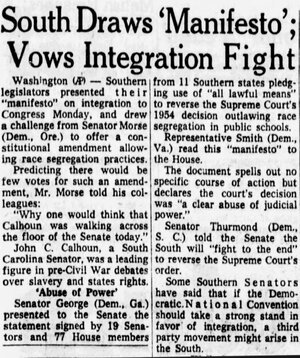
From the Omaha, Nebraska Evening World-Herald, March 12, 1956

NC Reps. Thurmond Chatham, Charles B. Deane, and Harold D. Cooley refuseed to sign on to the Declaration of Constitutional Principles (the so-called "Southern Manifesto") of 11 Mar. 1956—a document pledging its signers to the use of "every lawful means" to resist what they considered the usurpation of power by the federal judiciary in public school desegregation. (Chatham and Deane lost their bids for renomination in the state Democratic primary May 26. Their failure to sign the manifesto was a major issue used against them.)

In a later comment to his pastor, Deane said: "I do not have to remain in Washington but I do have to live with myself. I shall not sign my name to any document which will make any man anywhere a second-class citizen."


Text of the "Southern Manifesto" is here:
 
Last edited:
IMG_3957.jpeg


From the Omaha, Nebraska Evening World-Herald, March 12, 1956

NC Reps. Thurmond Chatham, Charles B. Deane, and Harold D. Cooley refuseed to sign on to the Declaration of Constitutional Principles (the so-called "Southern Manifesto") of 11 Mar. 1956—a document pledging its signers to the use of "every lawful means" to resist what they considered the usurpation of power by the federal judiciary in public school desegregation. (Chatham and Deane lost their bids for renomination in the state Democratic primary May 26. Their failure to sign the manifesto was a major issue used against them.)

In a later comment to his pastor, Deane said: "I do not have to remain in Washington but I do have to live with myself. I shall not sign my name to any document which will make any man anywhere a second-class citizen."


Text of the "Southern Manifesto" is here:
The last paragraph of the clipped article states, "Some Southern Senators have stated that if the Democratic National Convention should take a strong stand in favor of integration, a third party movement might arise in the South." WOW! They were completely wrong. Why go to the bother of starting a third party, when one of the existing parties was willing to completely reject its entire history and forfeit any shred of integrity in order to crack the "Solid South?" And just like that the modern Republican Party was born, was freed from the shackles of decency that Abaham Lincoln had imposed on it, and was able to embrace the ethics, morals, tactics, and political strategy of the Klu Klux Klan.

ETA: Sort of a shame for the Republican Party to allow itself to be consumed by the racist wing of the Democratic Party. Entirely unnecessary. If a third party had formed in the South as a result of a split of the Democratic Party, the Republican Party might not have needed to sell its soul to the racist Devil. A split of Southern Democrats between racists and non-racists probably would have resulted in the non-racist Southern Democrats being a third-place party that would have gradually bled into the National Republican Party. I know from first-hand experience, that I prefer the company of non-racist Democrats to racist Democrats. And I am old enough to remember when racist Democrats had not yet fully migrated to the Republican Party. But as the expression goes, "You dance with the one who brought you to the party." So, the Republican Party and white racists are linked together in a "til death do us part" relationship.
 
Last edited:
IMG_7883.jpeg

I grew up hearing the phrases, “They sent him off to Camp Butner...again.” “He belongs at Camp Butner” or, “Shush, don’t talk crazy like that, you’ll end up at Butner!” were common admonitions. Those remarks might be accompanied by mentions of “Dix Hill,” or if that worldview emanated from the western counties, of “Broughton.” African Americans went off to “Cherry” in Goldsboro. Once upon a time, these places were each associated with mental health in North Carolina. Such human challenges were mystified, often accompanied by ostracism, and generally spoken of insensitively in bygone days.

We all know, or ought to, that mental health care, defined widely, has never been well-understood or implemented. From genius to genuine distress, and everything in-between, successful coping by the state, community, family, and individual remains far from well-orchestrated or developed. We have to hope that progress will come. Medieval attitudes and practices are not that far behind us - nor even completely absent I suspect.

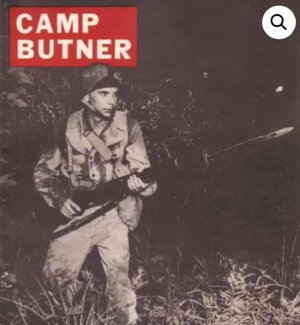
Camp Butner has been a lot of things. It was constructed originally in 1942 in Granville, Person, and Durham Counties as a World War II infantry training center. It was a work camp for German and Italian P.O.W.s during the war. “Today, the grounds house a variety of state and federal facilities including several mental health facilities, multiple correctional institutions, state-owned farms and a National Guard training facility.” A new addition at Butner is The Veterans Life Center — “a residential program for veterans in need of therapy, counseling, educational or life-skill development.”

One semester during my many, many years in college I took a Public Administration course taught by the Warden at the Butner Federal Correctional Institute. My class visited that lock-up and Warden Ingram led the tour. I’m pretty sure that prison wasn’t what people in Chatham were referring to when their quips featured Butner but rather facilities that dealt with substance abuse. To suffer from alcoholism in a dry and evangelically T-Totaling county brought forward many unique situations. Tar Heels laughed at Otis Campbell of Mayberry exactly because he hit so close to home. Such was the code being spoken. Warden Ingram also let us in on some internal Butner Federal code talk. It was over 40 years ago now when I made my pilgrimage so some of this is mildly historic.

It seems that at the penitentiary there were seven units and inmates were arranged in them by type of crime. In very North Carolina fashion each of those units were nicknamed after an Atlantic Coast Conference School (there were only seven in those days - good times!). The designations were clearly carefully thought-out. What I remember about that from the Warden is that the violent and vicious were in Clemson, sexual criminals went to NC State, scam artists were with Wake Forest, those who embezzled from the government were at Virginia, and those who pilfered from private enterprise were Duke. Those who committed unspeakable acts were put in Maryland, and of course drug dealers and moonshiners found their way to Carolina. There’s nothing quite like well-founded regional prison humor.

For more on the history of Mental Health Care in NC go here: Psychiatric Hospitals

#OTD (March 13) in 1937 Major General Henry Wolfe Butner died. The camp was named for him. Read here: Camp Butner’s Namesake, Henry Wolfe Butner


Camp Butner comes back around...
 
Back
Top