U.S. destroys Venezuelan vessels | Trump announces blockade of oil tankers

  • Thread starter Thread starter nycfan
  • Start date Start date
  • Replies: 1K
  • Views: 46K
  • Politics 
More or less. It is considered a hostile act when directed against the sovereign nation. But regardless, it seems events have overtaken you already, if the tweet from Polymarket is true.
Ok. We are "at war" with Venezuela. I hope the civilian casualties remain low.
 
You would think the words "Coast Guard" would give you an idea of their mandate, but....
 

The U.S. sank the alleged narco-terrorists’ boat — and let them go​

In blowing up the vessel, destroying evidence and repatriating the survivors, the U.S. cut short a process that’s helped bring down traffickers.

🎁 —> https://wapo.st/4qq5ymS
 

The U.S. sank the alleged narco-terrorists’ boat — and let them go​

In blowing up the vessel, destroying evidence and repatriating the survivors, the U.S. cut short a process that’s helped bring down traffickers.

🎁 —> https://wapo.st/4qq5ymS
“…Andrés Fernando Tufiño Chila was one of only two people known to have survived a U.S. strike on a vessel that the Trump administration alleged was smuggling drugs from South America. President Donald Trump had described the Ecuadorian and a fellow survivor of the Oct. 16 strike in the Atlantic Ocean as “terrorists” who would be returned to their countries of origin “for detention and prosecution.”

In Ecuador — a government closely aligned with Trump on counternarcotics enforcement — the administration had a willing partner, eager to learn, several officials here said, what the alleged trafficker could tell them about his employers.

… In his gang-controlled hometown, Tufiño was known as Fresco Solo, neighbors said, a skilled navigator they alleged was recruited by criminals to smuggle drugs north.

But in transferring him to Ecuadorian custody, three officials here said, U.S. forces didn’t provide any evidence that could be used to detain him — no seized drugs, no phone or GPS records, no videos, none of the intelligence that led them to target his vessel.

… Within hours, Tufiño was let go.

… The White House and the Pentagon have likened traffickers to members of al-Qaeda and the Islamic State — terrorists who wield drugs as weapons to kill Americans.

But in destroying rather than collecting evidence, and turning the two survivors over to foreign governments rather than prosecuting them, they set alleged enemies free, cutting short a process that U.S. law enforcement has used to investigate smuggling operations and confront the criminals behind them….”

 
“…Andrés Fernando Tufiño Chila was one of only two people known to have survived a U.S. strike on a vessel that the Trump administration alleged was smuggling drugs from South America. President Donald Trump had described the Ecuadorian and a fellow survivor of the Oct. 16 strike in the Atlantic Ocean as “terrorists” who would be returned to their countries of origin “for detention and prosecution.”

In Ecuador — a government closely aligned with Trump on counternarcotics enforcement — the administration had a willing partner, eager to learn, several officials here said, what the alleged trafficker could tell them about his employers.

… In his gang-controlled hometown, Tufiño was known as Fresco Solo, neighbors said, a skilled navigator they alleged was recruited by criminals to smuggle drugs north.

But in transferring him to Ecuadorian custody, three officials here said, U.S. forces didn’t provide any evidence that could be used to detain him — no seized drugs, no phone or GPS records, no videos, none of the intelligence that led them to target his vessel.

… Within hours, Tufiño was let go.

… The White House and the Pentagon have likened traffickers to members of al-Qaeda and the Islamic State — terrorists who wield drugs as weapons to kill Americans.

But in destroying rather than collecting evidence, and turning the two survivors over to foreign governments rather than prosecuting them, they set alleged enemies free, cutting short a process that U.S. law enforcement has used to investigate smuggling operations and confront the criminals behind them….”
“… Jeremy Warren, the San Diego lawyer who represented Tufiño in his 2020 case, has also lost contact with him, he said. He told The Post that Tufiño was an “unsophisticated” fisherman who lived simply. He was one of many skilled mariners who were recruited — sometimes lured by money, sometimes forced — to take jobs running drugs, Warren said.

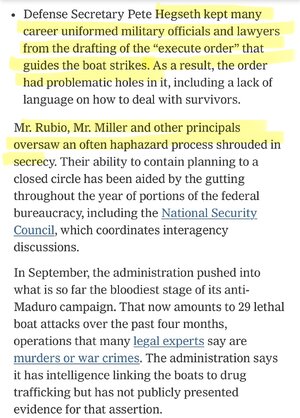
… The decision to launch a military campaign against mostly small vessels off South and Central America has been consequential. U.S. military forces do not regularly collect evidence of crimes committed by civilians like drug traffickers, according to former military lawyers and current and former DEA officials. The Coast Guard, which is part of the Department of Homeland Security, is the primary agency for intercepting maritime drug traffickers.

But instead of attempting to stop and detain suspected traffickers, the administration is launching lethal strikes.

Keeping survivors out of the U.S. justice system, critics say, helps the administration sidestep judicial scrutiny of its approach.

“They are trying to avoid having to defend their policies and standards in court,” said one DEA official who spoke on the condition of anonymity to discuss sensitive details.

“Once they had custody of these people, it was clear … they were going to try to get rid of them expeditiously,” said Brian Finucane, a former State Department legal adviser on counterterrorism and military force.

Revealing evidence in court, he said, would have been “politically disadvantageous.”…”


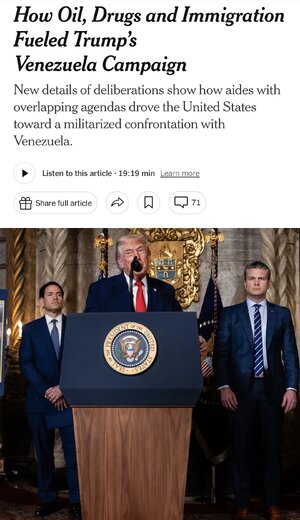
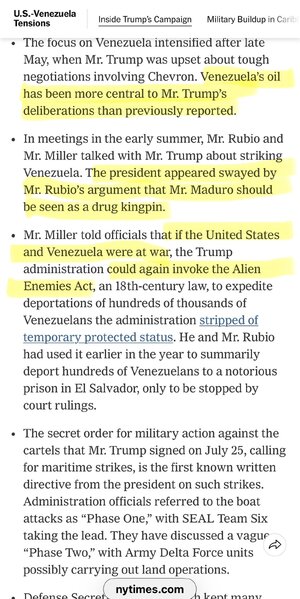
“Miller explicitly argued that if the United States were formally at war with Venezuela, the administration could again invoke the law to rapidly deport hundreds of thousands of Venezuelans whose temporary protected status had been revoked.

One former official said Miller viewed war as a way to “remove legal obstacles that courts had put in place.”

He told officials the law could be revived if the U.S. entered an actual war with Venezuela, effectively reframing migration enforcement as a wartime power rather than a civilian legal process.”
 

“… Another aide in the room, Stephen Miller, said he had ideas. As Mr. Trump’s homeland security adviser, he had been talking with other officials about Mr. Trump’s campaign vow to bomb fentanyl labs. For various reasons, that notion had faded, and in recent weeks Mr. Miller had turned to exploring attacks on boats suspected of carrying drugs off the shores of Central America.

Mr. Miller’s deliberations had not focused on Venezuela, which does not produce fentanyl.

But three separate policy goals began merging that night — crippling Mr. Maduro, using military force against drug cartels and securing access to Venezuela’s vast oil reserves for U.S. companies.

Two months later, Mr. Trump signed a secret directive ordering the Pentagon to carry out military operations against Latin American drug cartels and specifically calling for maritime strikes. Though the justification was drugs in general, the operation would concentrate enormous naval firepower off the coast of Venezuela.…”
 
Back
Top