Yes it gets a little scary frankly with the limited options depending on the care needed. They fly more serious cases to Cape Fear Valley Hospital in Fayetteville (you might be better off at Womack).You make a great point. Because of I-40, the driving time from Wilmington to either Chapel Hill or Greenville are about the same. I would have never guessed that.

Navigation
Install the app
How to install the app on iOS
Follow along with the video below to see how to install our site as a web app on your home screen.
Note: This feature may not be available in some browsers.
More options
You are using an out of date browser. It may not display this or other websites correctly.
You should upgrade or use an alternative browser.
You should upgrade or use an alternative browser.
UNC System News -- All Campus' Will Switch to Canvas (Uniformity Sought)
- Thread starter donbosco
- Start date
- Replies: 72
- Views: 2K
- Politics

- Messages
- 1,803

donbosco
Legend of ZZL
- Messages
- 7,851
The UNC System has mandated that all campuses employ Canvas beginning this Summer. “Chuang says his tool, Kerra, is not a cheat code — it’s a productivity tool. The software reads assignments, grades, and uploaded materials from the learning-mangement system Canvas, then generates study guides, detailed notes, and even assignment drafts. It also tracks deadlines and sends reminder texts designed to keep students on track.”
https://www.chronicle.com/.../another-undergrad-is-trying...
I'll post this entire piece in the next block.
https://www.chronicle.com/.../another-undergrad-is-trying...
I'll post this entire piece in the next block.
donbosco
Legend of ZZL
- Messages
- 7,851
Last week, a 20-year-old freshman at the University of Notre Dame emailed the undergraduate population with an enticing pitch.
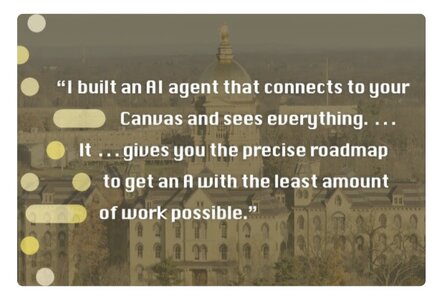
“I built an AI agent that connects to your Canvas and sees everything,” Caden Chuang wrote in the email, according to The Observer, Notre Dame’s student newspaper. “It figures out exactly where you’re falling short and gives you the precise roadmap to get an A with the least amount of work possible.” Within an hour, the university deleted the email from inboxes, Chuang said, and temporarily disabled his account. But more than 1,000 students had signed up.
Then Chuang posted a video on Instagram on Thursday saying he “might have just been expelled.” He said the university disabled his accounts and is investigating him for “creating an AI cheating tool” — a characterization he disputes.
The episode marks at least the third time over the past year that an AI tool built by current or recent students has forced colleges into a scramble. Examples include the viral rollout of an “Einstein” agent that could autonomously complete coursework and a Columbia University student’s public clash with administrators over their discrete AI software to help students pass technical interviews. Universities are confronting the fast-moving reality that students are building systems they’re not prepared for.
But unlike Einstein and the interview app, Chuang says his tool, Kerra, is not a cheat code — it’s a productivity tool. The software reads assignments, grades, and uploaded materials from the learning-mangement system Canvas, then generates study guides, detailed notes, and even assignment drafts. It also tracks deadlines and sends reminder texts designed to keep students on track.
Signing up for Kerra is free, but certain tasks and features — such as exporting a study guide or using the tool’s more aggressive iMessage accountability reminders — prompt users to pay a fee ranging from $9 to $20 a month.
Chuang’s broader argument for Kerra is blunt, and, to some instructors, provocative. Spending a lot of time in class is “not as valuable as it used to be in the past,” he told The Chronicle. Instead, the time students spend outside class doing extracurricular activities and networking with potential employers is more important to their future. Kerra lets students “spend more time taking advantage of all the opportunities at their university,” Chuang said.
That philosophy has drawn sharp criticism from faculty, including at Chuang’s own campus. In a LinkedIn post, David Smiley, an assistant teaching professor in the technology and digital-studies program at Notre Dame, wrote that while students should learn to use AI responsibly, “the administration must outright condemn this philosophy of AI use and re-examine our messaging to students immediately.”
Smiley added: “It must state unequivocally that if you do not want to be formed in the classroom and be tested by the fires of critical thinking and academic rigor, then the University of Notre Dame is not the place for you.”
Spokespeople for the university did not respond to The Chronicle’s request for comment on Kerra.
Smiley, who is the director of the undergraduate data-science minor, said in an interview that he is not opposed to AI in the classroom. He teaches courses on generative and “agentic” AI and requires students to use these tools as part of their work. But he said there is a big difference between using AI to support learning and using it to replace learning. While he hasn’t tried Kerra, he said he objects to the fact that Chuang’s pitch promised to relieve students of academic work.
“When you give your own agency over to an AI to take over something for you, you’re exchanging it for something,” Smiley said. “There’s no free lunch.”
Tools like Kerra do not neatly fit existing academic-integrity rules. Notre Dame’s honor code prohibits submitting AI-generated work as one’s own without permission, but software like Kerra appears to blur the line between acceptable assistance and prohibited substitution.
The difference is hard to define, said Jason Gulya, a professor at Berkeley College who has been paying close attention to tools like Kerra and Einstein. But when these tools begin to create drafts, he said, “that’s when we start to get really, really close to that line, and start to go over the line.”
Guyla said higher education as a whole seemed to sigh with relief when Einstein was shut down. But these kinds of tools aren’t going away, he said — and the public only aware of Kerra and Einstein because they are being marketed as startups.
“We know that there are students who are doing this and keeping it to themselves,” he said.
The Columbia student who built the tool for tech-company interviews was suspended by the university a year ago after it went viral, and he ultimately dropped out. The 22-year-old founder of Einstein, which said it could complete entire courses on Canvas, had dropped out of Brown shortly before building the platform. Einstein was shut down after the creator received cease-and-desist letters from Hebrew University of Jerusalem, which owns all of Albert Einstein’s intellectual property, and Instructure, Canvas’s parent company.
Chuang argues that the problem is not the tools themselves, but institutions’ inability to adapt to how students are already using them.
“It is ultimately up to the students to decide what is the value of education to them,” he said. If a student wants to use AI for their coursework, he added, they will — regardless of an institution’s guidelines. He suggested that universities should redesign assessments rather than attempt to limit access to widely available technologies. Guyla agrees that it’s past time to rethink assessments.
That stance aligns with a growing student perspective that AI is inevitable and even necessary, particularly in a competitive job market. Chuang said one goal of Kerra is to free up time for career preparation.
But critics like Smiley worry that such a framing risks hollowing out the educational experience. If AI systems increasingly handle the cognitive labor of classwork, they argue, students may lose the skills universities are meant to cultivate. A liberal arts education, Smiley said, is not just about acquiring information. It’s about developing the ability to think, reason and adapt.
“If you don’t develop that skill, or if you don’t build that muscle,” he said, “then whenever you graduate, you just have that credential, you have that piece of paper. You don’t have the actual knowledge there.”
“I built an AI agent that connects to your Canvas and sees everything,” Caden Chuang wrote in the email, according to The Observer, Notre Dame’s student newspaper. “It figures out exactly where you’re falling short and gives you the precise roadmap to get an A with the least amount of work possible.” Within an hour, the university deleted the email from inboxes, Chuang said, and temporarily disabled his account. But more than 1,000 students had signed up.
Then Chuang posted a video on Instagram on Thursday saying he “might have just been expelled.” He said the university disabled his accounts and is investigating him for “creating an AI cheating tool” — a characterization he disputes.
The episode marks at least the third time over the past year that an AI tool built by current or recent students has forced colleges into a scramble. Examples include the viral rollout of an “Einstein” agent that could autonomously complete coursework and a Columbia University student’s public clash with administrators over their discrete AI software to help students pass technical interviews. Universities are confronting the fast-moving reality that students are building systems they’re not prepared for.
But unlike Einstein and the interview app, Chuang says his tool, Kerra, is not a cheat code — it’s a productivity tool. The software reads assignments, grades, and uploaded materials from the learning-mangement system Canvas, then generates study guides, detailed notes, and even assignment drafts. It also tracks deadlines and sends reminder texts designed to keep students on track.
Signing up for Kerra is free, but certain tasks and features — such as exporting a study guide or using the tool’s more aggressive iMessage accountability reminders — prompt users to pay a fee ranging from $9 to $20 a month.
Chuang’s broader argument for Kerra is blunt, and, to some instructors, provocative. Spending a lot of time in class is “not as valuable as it used to be in the past,” he told The Chronicle. Instead, the time students spend outside class doing extracurricular activities and networking with potential employers is more important to their future. Kerra lets students “spend more time taking advantage of all the opportunities at their university,” Chuang said.
That philosophy has drawn sharp criticism from faculty, including at Chuang’s own campus. In a LinkedIn post, David Smiley, an assistant teaching professor in the technology and digital-studies program at Notre Dame, wrote that while students should learn to use AI responsibly, “the administration must outright condemn this philosophy of AI use and re-examine our messaging to students immediately.”
Smiley added: “It must state unequivocally that if you do not want to be formed in the classroom and be tested by the fires of critical thinking and academic rigor, then the University of Notre Dame is not the place for you.”
Spokespeople for the university did not respond to The Chronicle’s request for comment on Kerra.
Smiley, who is the director of the undergraduate data-science minor, said in an interview that he is not opposed to AI in the classroom. He teaches courses on generative and “agentic” AI and requires students to use these tools as part of their work. But he said there is a big difference between using AI to support learning and using it to replace learning. While he hasn’t tried Kerra, he said he objects to the fact that Chuang’s pitch promised to relieve students of academic work.
“When you give your own agency over to an AI to take over something for you, you’re exchanging it for something,” Smiley said. “There’s no free lunch.”
Tools like Kerra do not neatly fit existing academic-integrity rules. Notre Dame’s honor code prohibits submitting AI-generated work as one’s own without permission, but software like Kerra appears to blur the line between acceptable assistance and prohibited substitution.
The difference is hard to define, said Jason Gulya, a professor at Berkeley College who has been paying close attention to tools like Kerra and Einstein. But when these tools begin to create drafts, he said, “that’s when we start to get really, really close to that line, and start to go over the line.”
Guyla said higher education as a whole seemed to sigh with relief when Einstein was shut down. But these kinds of tools aren’t going away, he said — and the public only aware of Kerra and Einstein because they are being marketed as startups.
“We know that there are students who are doing this and keeping it to themselves,” he said.
The Columbia student who built the tool for tech-company interviews was suspended by the university a year ago after it went viral, and he ultimately dropped out. The 22-year-old founder of Einstein, which said it could complete entire courses on Canvas, had dropped out of Brown shortly before building the platform. Einstein was shut down after the creator received cease-and-desist letters from Hebrew University of Jerusalem, which owns all of Albert Einstein’s intellectual property, and Instructure, Canvas’s parent company.
Chuang argues that the problem is not the tools themselves, but institutions’ inability to adapt to how students are already using them.
“It is ultimately up to the students to decide what is the value of education to them,” he said. If a student wants to use AI for their coursework, he added, they will — regardless of an institution’s guidelines. He suggested that universities should redesign assessments rather than attempt to limit access to widely available technologies. Guyla agrees that it’s past time to rethink assessments.
That stance aligns with a growing student perspective that AI is inevitable and even necessary, particularly in a competitive job market. Chuang said one goal of Kerra is to free up time for career preparation.
But critics like Smiley worry that such a framing risks hollowing out the educational experience. If AI systems increasingly handle the cognitive labor of classwork, they argue, students may lose the skills universities are meant to cultivate. A liberal arts education, Smiley said, is not just about acquiring information. It’s about developing the ability to think, reason and adapt.
“If you don’t develop that skill, or if you don’t build that muscle,” he said, “then whenever you graduate, you just have that credential, you have that piece of paper. You don’t have the actual knowledge there.”
donbosco
Legend of ZZL
- Messages
- 7,851
My thoughts on this:
First off I'd rather not move to Canvas but see the pros and cons. Pros seem to be $$ savings and student familiarity brought on from universal design (Canvas is already the designated LMS for public schools and community colleges). Cons involve the level of distrust that I have in classroom freedom, i.e., now it would seem to be infinitely easier for administration to access every class Canvas site than previously.
As for the AI element here there is no doubt that assessment must be redesigned. We're caught to a degree in a free market worldview that is increasingly thrust upon education since so often now at the system level the student is considered to be no more than a consumer and the university simply the provider of a product that consumer is purchasing. How does assessment work then in such an arrangement when literally "the customer is always right"? There's a disconnect there that can be too readily/easily manipulated from so many angles of approach -- students, teachers, and administrators can each 'game' that sort of set-up with little genuine attention paid to whether or not education or learning is going on. I guess, thirdly, this specific AI "program" seems like it could be turned toward learning rather than "getting an A" but that would require the fundamentals of the consumer/provider situation to change direction from its current trajectory.
First off I'd rather not move to Canvas but see the pros and cons. Pros seem to be $$ savings and student familiarity brought on from universal design (Canvas is already the designated LMS for public schools and community colleges). Cons involve the level of distrust that I have in classroom freedom, i.e., now it would seem to be infinitely easier for administration to access every class Canvas site than previously.
As for the AI element here there is no doubt that assessment must be redesigned. We're caught to a degree in a free market worldview that is increasingly thrust upon education since so often now at the system level the student is considered to be no more than a consumer and the university simply the provider of a product that consumer is purchasing. How does assessment work then in such an arrangement when literally "the customer is always right"? There's a disconnect there that can be too readily/easily manipulated from so many angles of approach -- students, teachers, and administrators can each 'game' that sort of set-up with little genuine attention paid to whether or not education or learning is going on. I guess, thirdly, this specific AI "program" seems like it could be turned toward learning rather than "getting an A" but that would require the fundamentals of the consumer/provider situation to change direction from its current trajectory.
- Messages
- 2,747
One of my committee members was fond of saying students are the customer and the product. I think that’s a good perspective.My thoughts on this:
First off I'd rather not move to Canvas but see the pros and cons. Pros seem to be $$ savings and student familiarity brought on from universal design (Canvas is already the designated LMS for public schools and community colleges). Cons involve the level of distrust that I have in classroom freedom, i.e., now it would seem to be infinitely easier for administration to access every class Canvas site than previously.
As for the AI element here there is no doubt that assessment must be redesigned. We're caught to a degree in a free market worldview that is increasingly thrust upon education since so often now at the system level the student is considered to be no more than a consumer and the university simply the provider of a product that consumer is purchasing. How does assessment work then in such an arrangement when literally "the customer is always right"? There's a disconnect there that can be too readily/easily manipulated from so many angles of approach -- students, teachers, and administrators can each 'game' that sort of set-up with little genuine attention paid to whether or not education or learning is going on. I guess, thirdly, this specific AI "program" seems like it could be turned toward learning rather than "getting an A" but that would require the fundamentals of the consumer/provider situation to change direction from its current trajectory.
donbosco
Legend of ZZL
- Messages
- 7,851
One of my committee members was fond of saying students are the customer and the product. I think that’s a good perspective.
Do they believe that "The customer is always right?"
- Messages
- 2,747
NoDo they believe that "The customer is always right?"

- Messages
- 4,673
I would kind of like Faculty-not students-to be the Key in what is taughtDo they believe that "The customer is always right?"
donbosco
Legend of ZZL
- Messages
- 7,851
Depending on the state of the institution, finances, enrollments, perceived system value and other elements, the buyer may very well be running the show.

CRHeel94
Iconic Member
- Messages
- 1,101
As I would tell my marketing peeps:
The customer wants a car that gets 100 miles to the gallon, goes fast, is never in the shop, has plenty of trunk space, seats seven, helps you attract the opposite sex and costs $10,000.
The customer is king.
The customer has no clue.
The customer wants a car that gets 100 miles to the gallon, goes fast, is never in the shop, has plenty of trunk space, seats seven, helps you attract the opposite sex and costs $10,000.
The customer is king.
The customer has no clue.
- Messages
- 2,747
It was certainly a different environment then.Depending on the state of the institution, finances, enrollments, perceived system value and other elements, the buyer may very well be running the show.

- Messages
- 5,552
and never needs to be replacedAs I would tell my marketing peeps:
The customer wants a car that gets 100 miles to the gallon, goes fast, is never in the shop, has plenty of trunk space, seats seven, helps you attract the opposite sex and costs $10,000.
The customer is king.
The customer has no clue.
Share: