- Messages
- 45,375

Follow along with the video below to see how to install our site as a web app on your home screen.
Note: This feature may not be available in some browsers.
The Magic R’s control the White House, Military, Intelligence, both Houses of Congress, and the Judiciary.How is this still being allowed to happen?

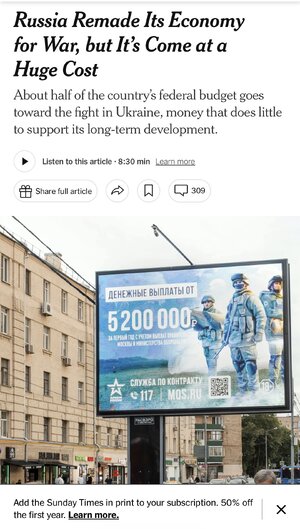

 —> Russia Remade Its Economy for War, but It’s Come at a Huge Cost
“… Nearly 40 percent of Russia’s federal budget is now devoted to the military and security. Another 9 percent goes to interest payments on the debt that Mr. Putin has decided to take on to finance the war, a departure from years of tight fiscal discipline.SOTU Address coincides with fourth anniversary of the newest Russian invasion of Ukraine.
“… The war has also exacerbated Russia’s demographic crisis. As many as 325,000 troops have died on the battlefield, according to a recent report by the Center for Strategic and International Studies in Washington. Some studies predict that the Russian population could, in pessimistic scenarios, drop below 100 million by 2100, down from a prewar population of roughly 145 million.“… Nearly 40 percent of Russia’s federal budget is now devoted to the military and security. Another 9 percent goes to interest payments on the debt that Mr. Putin has decided to take on to finance the war, a departure from years of tight fiscal discipline.
Russia is quickly burning through its National Wealth Fund, a rainy-day financial cushion that Mr. Putin had built up using oil and gas revenues. The fund’s liquid reserves were worth about $55 billion this month, down from $113 billion before the war.
… “The war is really eating up a lot of resources,” said Janis Kluge, a Russia expert at the German Institute for International and Security Affairs in Berlin. “If it hadn’t started, they would have had so much money to spend, simply.”
In addition to being a money pit, the war has shattered Russia’s remaining ties with the West and made it less attractive for investors. Foreign direct investment has cratered. Domestic investment has been crimped by high interest rates aimed at taming inflation, in an economy pumped up by heavy military spending.…”
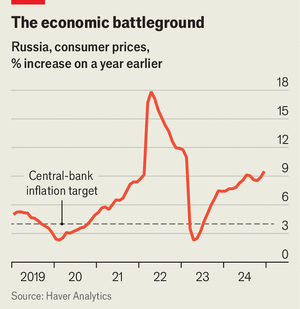
I read several years ago (before its invasion of Ukraine) that Russia, with about 145 million people, has the same GNP as Texas, which has just 31 million people. Russia's economy is a mess and has been for many years, and many Russians endure terrible poverty and hardship on a regular basis. One of the Russian military recruiting commercials when the war with Ukraine started showed a father who was so poor that he couldn't afford to get his teen daughter a cellphone and she hated him, but when he joined the Russian Army he finally made enough to get her a cellphone and so she loved him again. I've also read that it's an incredibly corrupt society from top to bottom, a kleptocracy fueled by Putin's administration, which is probably one reason why Trump loves him so. It's a failed nation-state in many respects, but it's still got lots of nukes and a big military and lots of oil and natural resources so they can still play at being a major world power, even while a great many Russians live in squalid, poverty level conditions.SOTU Address coincides with fourth anniversary of the newest Russian invasion of Ukraine.