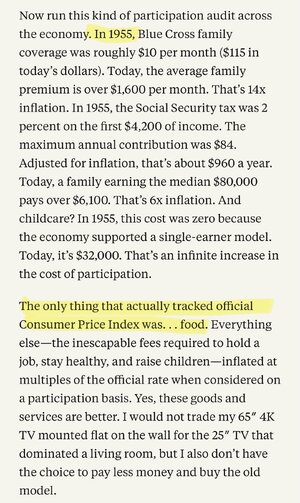
But it is an informative way to think about the affordability question.
With all due respect, it is not an informative way to think about anything. Whoever wrote that Free Press "analysis" does not appear to have any understanding of the subject at all. There are so many confusions in there that I can't really address them all. I'll just explain the reality and let the contrast speak for itself.
1. In the 1960s, the government (and many outside political groups) set the goal of "eliminating poverty." The famous War on Poverty. Sounds good. Problem #1, though: what is poverty? How will we know when we've won the war? So there needed to be a definition of poverty.
The author describes this as a measurement problem, but it is not. Measurement issues come later. The first task is to construct an objective standard out of economic data that is always subjective. Economic data is good at capturing differences between people. You can say, "this is how much you have to make to be in the 20th percentile of income, or 50th percentile, or 90th" but what economics cannot tell you is "how much money is required to be not destitute." That was the task presented.
2. So one way to address the problem is the additive approach -- i.e. find what needs to be bought for a minimally decent life in each category. For instance, let's say you can define a "minimum food level." This isn't the average food budget for an American, or a skimpy food budget, or anything like that. It's dietary. It's "what is required to enough calories, proteins, and nutrients for a reasonably health life." It is not an economic quantity at all.
Because I can't do notation on this website, I'll continue with a hypothetical function I'll call MinDec (category). So you give it "food" and it gives you a set of various minimally decent diets. For transport, it gives you a set of options there (bus everywhere, junker car, bike, whatever). And so on. MinDec would be generated by subject matter experts; you'd ask a transportation expert to design MinDec (transport), a health care expert for MinDec (health), etc.
Only after you posit the MinDecs does cost come into play to create an equation for the poverty threshold:
Pov$ = MinDec (food) * $ (food)* coeff + MinDec (housing) * $ (housing) * coeff + MinDec (health) * $ (health) * coeff . . . and so on for all categories of spending.
This is where food times 3 is going to come from.
3. The thing about that equation is that many of the terms are really difficult to define. What counts as minimum decent housing? Does living in a trailer count? What about a beaten up house that barely passes inspection? Does location matter? How do we balance factors like "space" against "how much lead paint"? Most of the categories have similar conceptual difficulties. What counts as acceptable transportation? Are we talking about getting to work? To work and the grocery store? What about traveling to visit your elderly parents on the weekends?
Again, these are not measurement problems. They are definitional problems. IAnd they doom the entire approach, unless there is some way of avoiding that analysis. In fact, the only category in which it's easy to define a MinDec is food. Everything else is too subjective or multi-dimensional.
This is where food times three comes in. It's a kludge. It's a self-admittedly highly imperfect way of avoiding these problems. It observes that empirically, on average:
$(food) * 2 = $ (everything else).
So if we plug that into the formula above, we get Pov$ = MinDec(food)*$(food)*3.
4. This has nothing to do with "what does the average American spend." It is conceptually different. We don't want to know whether a given level of spending is average, above average, below average -- none of that is relevant to the task of determining "what does it cost to live a minimally decent life in America."
This is where the Free Press author really goes off the rails. [There are other major problems too, like the mysterious category of "other essentials," which seems oxymoronic; if you can't define "essentials" then maybe they aren't actual essentials but in any case, $2000 a month on top of food, housing, transport and health is not reasonable for "other essentials"]. The analysis clearly does not understand what poverty measurement is about.
The assumptions about "no Netflix, no vacations" is such a blinkered middle class way of thinking about necessities. Having Netflix or not isn't the difference between poverty and not-poverty. It's whether you can afford to put food on the table. It's whether you have to eat bacon or chicken offal for most meals, or whether you can afford chicken breast or the occasional pork chop, whether all your veggies come in a can or whether you can afford to buy fresh.
5. Now, the formula of food times three sucks as a general measure of poverty. But it quickly became evident that "eliminating poverty" is not a feasible goal. In that case, the actual threshold isn't very important (which is why it is almost never reported). What matters are relative shifts. If the poverty threshold goes up by 10%, that means more people will be in poverty; if it then declines by 5%, there will be fewer. You can design policy on this measure so long as you remember that its absolute value doesn't tell you much about the world. And indeed, that is how it is used.
The "poverty rate" is more often reported, but isn't the poverty rate also subject to the same problem? Of course it is, since it's defined in terms of the poverty threshold. But again, we care about relative levels. When we say the poverty rate is 19%, we don't mean that 19% of Americans are destitute. Our definition was never adequate for that. But if it's 19% this year and was 17% last year, that 2% shift is meaningful.
6. This explains how a person came to the absurd conclusion that making below $130K is "poverty." It's because the person probably sat with a calculator and google for 10 minutes and thinks s/he understands poverty. It's basically a ZenMode "analysis."





 —>
—>