Economic News

  • Thread starter Thread starter nycfan
  • Start date Start date
  • Replies: 4K
  • Views: 175K
  • Politics 


“… In 1963, Mollie Orshansky, an economist at the Social Security Administration, observed that families spent roughly one-third of their income on groceries. Since pricing data was hard to come by for many items (e.g., housing), if you could calculate a minimum adequate food budget at the grocery store, you could multiply by three and establish a poverty line. Orshansky presented her findings in 1965. She was drawing a floor, a line below which families were clearly in crisis.

… Orshansky’s food-times-three formula was crude, but as a crisis threshold—a measure of “too little”—it roughly corresponded to reality.

But everything changed between 1963 and 2024. … The composition of household spending transformed completely.

In 2024, food-at-home is no longer 33 percent of household spending. For most families, it’s 5 to 7 percent. Housing now consumes 35 to 45 percent. Healthcare takes 15 to 25 percent. Childcare, for families with young children, can eat 20 to 40 percent.

… If you keep Orshansky’s logic—if you maintain her principle that poverty could be defined by the inverse of food’s budget share—but update the food share to reflect today’s reality, the multiplier is no longer three.

It becomes 16. Which means if you measured income inadequacy today the way Orshansky measured it in 1963, the threshold for a family of four—the official poverty line in 2024—wouldn’t be $31,200. If the crisis threshold—the floor below which families cannot function—is honestly updated to current spending patterns, it lands at close to $140,000. …”


“… In 1963, Mollie Orshansky, an economist at the Social Security Administration, observed that families spent roughly one-third of their income on groceries. Since pricing data was hard to come by for many items (e.g., housing), if you could calculate a minimum adequate food budget at the grocery store, you could multiply by three and establish a poverty line. Orshansky presented her findings in 1965. She was drawing a floor, a line below which families were clearly in crisis.

… Orshansky’s food-times-three formula was crude, but as a crisis threshold—a measure of “too little”—it roughly corresponded to reality.

But everything changed between 1963 and 2024. … The composition of household spending transformed completely.

In 2024, food-at-home is no longer 33 percent of household spending. For most families, it’s 5 to 7 percent. Housing now consumes 35 to 45 percent. Healthcare takes 15 to 25 percent. Childcare, for families with young children, can eat 20 to 40 percent.

… If you keep Orshansky’s logic—if you maintain her principle that poverty could be defined by the inverse of food’s budget share—but update the food share to reflect today’s reality, the multiplier is no longer three.

It becomes 16. Which means if you measured income inadequacy today the way Orshansky measured it in 1963, the threshold for a family of four—the official poverty line in 2024—wouldn’t be $31,200. If the crisis threshold—the floor below which families cannot function—is honestly updated to current spending patterns, it lands at close to $140,000. …”

IMG_1840.jpeg

IMG_1841.jpeg

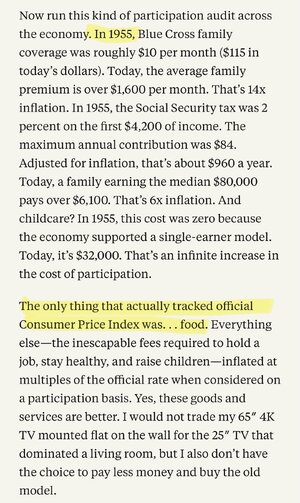
“… During the Covid lockdowns, the costs of participating in the economy were suspended while government transfers replaced or even increased income for those at the lower income scale. Childcare ($32,000), commuting ($15,000), and work lunches ($5,000) disappeared, and families earning $80,000 actually felt comparatively rich. Then it all came back, with the costs inflated. The rage we feel today is the hangover from that brief moment. …”


“… In 1963, Mollie Orshansky, an economist at the Social Security Administration, observed that families spent roughly one-third of their income on groceries. Since pricing data was hard to come by for many items (e.g., housing), if you could calculate a minimum adequate food budget at the grocery store, you could multiply by three and establish a poverty line. Orshansky presented her findings in 1965. She was drawing a floor, a line below which families were clearly in crisis.

… Orshansky’s food-times-three formula was crude, but as a crisis threshold—a measure of “too little”—it roughly corresponded to reality.

But everything changed between 1963 and 2024. … The composition of household spending transformed completely.

In 2024, food-at-home is no longer 33 percent of household spending. For most families, it’s 5 to 7 percent. Housing now consumes 35 to 45 percent. Healthcare takes 15 to 25 percent. Childcare, for families with young children, can eat 20 to 40 percent.

… If you keep Orshansky’s logic—if you maintain her principle that poverty could be defined by the inverse of food’s budget share—but update the food share to reflect today’s reality, the multiplier is no longer three.

It becomes 16. Which means if you measured income inadequacy today the way Orshansky measured it in 1963, the threshold for a family of four—the official poverty line in 2024—wouldn’t be $31,200. If the crisis threshold—the floor below which families cannot function—is honestly updated to current spending patterns, it lands at close to $140,000. …”

I believe that. I know the salaries of everyone in my family and how each of us is able to live. That a major factor in why my wife and I are still living together. We would both struggle if we separated. The additional cost of separate housing would be prohibitive.
I see the struggles of my children who make less than us.
 
IMG_1840.jpeg

IMG_1841.jpeg

“… During the Covid lockdowns, the costs of participating in the economy were suspended while government transfers replaced or even increased income for those at the lower income scale. Childcare ($32,000), commuting ($15,000), and work lunches ($5,000) disappeared, and families earning $80,000 actually felt comparatively rich. Then it all came back, with the costs inflated. The rage we feel today is the hangover from that brief moment. …”
And this doesn't include everything we should be paying for.

What about retirement and other insurance?
Emergency savings?

And those are in the low half for transportation and housing.

This also don't consider the job market and staying employed. One stint of unemployment can take years to recover from.
 
IMG_1840.jpeg

IMG_1841.jpeg

“… During the Covid lockdowns, the costs of participating in the economy were suspended while government transfers replaced or even increased income for those at the lower income scale. Childcare ($32,000), commuting ($15,000), and work lunches ($5,000) disappeared, and families earning $80,000 actually felt comparatively rich. Then it all came back, with the costs inflated. The rage we feel today is the hangover from that brief moment. …”
Unfortunately (from my perspective), the author uses this as a jumping off point for arguing that middle class Americans don’t oppose welfare because they are racist but because they are rightly indignant that the poor don’t work as hard but get enough benefits to live nearly as well as the middle class. But it is an informative way to think about the affordability question.

Fo instance the median rent in America is now around $1,500. We used to have a rule of thumb that rent/mortgage should cost no more than 30% of your monthly income. That is not realistic in many regions of America anymore. But using a conservative 33.333% of income today, that would put the poverty line around $54,000/year using a similar approach as the food-based poverty line (the current official poverty line is $32,150 for a family of 4 in the contiguous United States and higher in Alaska and Hawaii).
 
Unfortunately (from my perspective), the author uses this as a jumping off point for arguing that middle class Americans don’t oppose welfare because they are racist but because they are rightly indignant that the poor don’t work as hard but get enough benefits to live nearly as well as the middle class. But it is an informative way to think about the affordability question.

Fo instance the median rent in America is now around $1,500. We used to have a rule of thumb that rent/mortgage should cost no more than 30% of your monthly income. That is not realistic in many regions of America anymore. But using a conservative 33.333% of income today, that would put the poverty line around $54,000/year using a similar approach as the food-based poverty line (the current official poverty line is $32,150 for a family of 4 in the contiguous United States and higher in Alaska and Hawaii).
Can't imagine a family of 4 at $32,150-obviously the cost of living varies greatly from place to place
 

“… Over the past 11 months, consumers filed 253,000 complaints about collection companies to the Consumer Financial Protection Bureau (CFPB), up from 140,000 during the same period in 2024.

The complaints range from collectors failing to provide proof that a debt was owed to aggressively contacting “current and previous employers, relatives, friends, even acquaintances.” The potential for heavy-handed tactics and abuse is large–nearly one in four Americans with a credit report has at least one debt in collections, according to the Urban Institute.

… According to Pew, more than 90% of consumers don’t show up in court when they get sued by collectors. Many don’t recognize the debt collection company’s name and think the notices are a scam, or they ignore them, hoping the issue will disappear. But when consumers don’t show, the debt collector gets a default judgment against them, which often gives them the legal right (depending on the state) to garnish their wages or bank account.…”
 
“… Over the past 11 months, consumers filed 253,000 complaints about collection companies to the Consumer Financial Protection Bureau (CFPB), up from 140,000 during the same period in 2024.

The complaints range from collectors failing to provide proof that a debt was owed to aggressively contacting “current and previous employers, relatives, friends, even acquaintances.” The potential for heavy-handed tactics and abuse is large–nearly one in four Americans with a credit report has at least one debt in collections, according to the Urban Institute.

… According to Pew, more than 90% of consumers don’t show up in court when they get sued by collectors. Many don’t recognize the debt collection company’s name and think the notices are a scam, or they ignore them, hoping the issue will disappear. But when consumers don’t show, the debt collector gets a default judgment against them, which often gives them the legal right (depending on the state) to garnish their wages or bank account.…”
“… Yet in August 2025, despite the ramp-up in debt collectors’ activity, acting CFPB director Russell Vought issued a public request for information on whether to reduce the number of debt collection-companies under its supervision from between 200 and 250 to as low as 11.

Such a change could mean only 18% of debt collection activity (by revenue) would fall under the federal regulator’s purview. Vought cited concerns about unnecessary compliance burdens on debt collectors and inefficient use of “limited Bureau resources” as reasons for the proposed changes.

Fewer cops on the beat will only embolden debt collectors, and things are likely to get worse for consumers.

Says April Kuehnhoff, a senior attorney at the nonprofit consumer advocacy group the National Consumer Law Center (NCLC), “With the cuts to Medicaid and to subsidies for health care plans, cuts today are debts tomorrow.”“
 
Can't imagine a family of 4 at $32,150-obviously the cost of living varies greatly from place to place
It's been 17 years ago now but I remember filling out the FAFSA when I first got into UNC and having to include my parents' tax returns, which was the first time I'd ever known what my parents made. Granted this was in 2009, but it was just shy of $30,000 combined- somewhere in the upper $29K. As still a teenage kid at the time, I didn't really have context for understanding what that meant; I just knew that we didn't have a lot of money and that finances were a tremendous strain on my parents' relationship. Now as an adult, with a wife and two young children of my own, the thought of any family of four surviving on that kind of money in this day and age is truly unfathomable.
 
“… Over the past 11 months, consumers filed 253,000 complaints about collection companies to the Consumer Financial Protection Bureau (CFPB), up from 140,000 during the same period in 2024.

The complaints range from collectors failing to provide proof that a debt was owed to aggressively contacting “current and previous employers, relatives, friends, even acquaintances.” The potential for heavy-handed tactics and abuse is large–nearly one in four Americans with a credit report has at least one debt in collections, according to the Urban Institute.

… According to Pew, more than 90% of consumers don’t show up in court when they get sued by collectors. Many don’t recognize the debt collection company’s name and think the notices are a scam, or they ignore them, hoping the issue will disappear. But when consumers don’t show, the debt collector gets a default judgment against them, which often gives them the legal right (depending on the state) to garnish their wages or bank account.…”
I've had people call me about my brother and my niece.

I respond with: "according to the fair debt collection practices act, you are not to contact relatives", normally by this point they have hung up, if they stay in the line, I ask for their information so I can sue them if they call back. None have called back.

So much of it is the industries fault by over extending credit.
 
“… Yet in August 2025, despite the ramp-up in debt collectors’ activity, acting CFPB director Russell Vought issued a public request for information on whether to reduce the number of debt collection-companies under its supervision from between 200 and 250 to as low as 11.

Such a change could mean only 18% of debt collection activity (by revenue) would fall under the federal regulator’s purview. Vought cited concerns about unnecessary compliance burdens on debt collectors and inefficient use of “limited Bureau resources” as reasons for the proposed changes.

Fewer cops on the beat will only embolden debt collectors, and things are likely to get worse for consumers.

Says April Kuehnhoff, a senior attorney at the nonprofit consumer advocacy group the National Consumer Law Center (NCLC), “With the cuts to Medicaid and to subsidies for health care plans, cuts today are debts tomorrow.”“
Vought is a project 2025 piece of shit. He would probably be happy if we go back to debtors prisons.
 
But it is an informative way to think about the affordability question.
With all due respect, it is not an informative way to think about anything. Whoever wrote that Free Press "analysis" does not appear to have any understanding of the subject at all. There are so many confusions in there that I can't really address them all. I'll just explain the reality and let the contrast speak for itself.

1. In the 1960s, the government (and many outside political groups) set the goal of "eliminating poverty." The famous War on Poverty. Sounds good. Problem #1, though: what is poverty? How will we know when we've won the war? So there needed to be a definition of poverty.

The author describes this as a measurement problem, but it is not. Measurement issues come later. The first task is to construct an objective standard out of economic data that is always subjective. Economic data is good at capturing differences between people. You can say, "this is how much you have to make to be in the 20th percentile of income, or 50th percentile, or 90th" but what economics cannot tell you is "how much money is required to be not destitute." That was the task presented.

2. So one way to address the problem is the additive approach -- i.e. find what needs to be bought for a minimally decent life in each category. For instance, let's say you can define a "minimum food level." This isn't the average food budget for an American, or a skimpy food budget, or anything like that. It's dietary. It's "what is required to enough calories, proteins, and nutrients for a reasonably health life." It is not an economic quantity at all.

Because I can't do notation on this website, I'll continue with a hypothetical function I'll call MinDec (category). So you give it "food" and it gives you a set of various minimally decent diets. For transport, it gives you a set of options there (bus everywhere, junker car, bike, whatever). And so on. MinDec would be generated by subject matter experts; you'd ask a transportation expert to design MinDec (transport), a health care expert for MinDec (health), etc.

Only after you posit the MinDecs does cost come into play to create an equation for the poverty threshold:

Pov$ = MinDec (food) * $ (food)* coeff + MinDec (housing) * $ (housing) * coeff + MinDec (health) * $ (health) * coeff . . . and so on for all categories of spending.

This is where food times 3 is going to come from.

3. The thing about that equation is that many of the terms are really difficult to define. What counts as minimum decent housing? Does living in a trailer count? What about a beaten up house that barely passes inspection? Does location matter? How do we balance factors like "space" against "how much lead paint"? Most of the categories have similar conceptual difficulties. What counts as acceptable transportation? Are we talking about getting to work? To work and the grocery store? What about traveling to visit your elderly parents on the weekends?

Again, these are not measurement problems. They are definitional problems. IAnd they doom the entire approach, unless there is some way of avoiding that analysis. In fact, the only category in which it's easy to define a MinDec is food. Everything else is too subjective or multi-dimensional.

This is where food times three comes in. It's a kludge. It's a self-admittedly highly imperfect way of avoiding these problems. It observes that empirically, on average:

$(food) * 2 = $ (everything else).

So if we plug that into the formula above, we get Pov$ = MinDec(food)*$(food)*3.

4. This has nothing to do with "what does the average American spend." It is conceptually different. We don't want to know whether a given level of spending is average, above average, below average -- none of that is relevant to the task of determining "what does it cost to live a minimally decent life in America."

This is where the Free Press author really goes off the rails. [There are other major problems too, like the mysterious category of "other essentials," which seems oxymoronic; if you can't define "essentials" then maybe they aren't actual essentials but in any case, $2000 a month on top of food, housing, transport and health is not reasonable for "other essentials"]. The analysis clearly does not understand what poverty measurement is about.

The assumptions about "no Netflix, no vacations" is such a blinkered middle class way of thinking about necessities. Having Netflix or not isn't the difference between poverty and not-poverty. It's whether you can afford to put food on the table. It's whether you have to eat bacon or chicken offal for most meals, or whether you can afford chicken breast or the occasional pork chop, whether all your veggies come in a can or whether you can afford to buy fresh.

5. Now, the formula of food times three sucks as a general measure of poverty. But it quickly became evident that "eliminating poverty" is not a feasible goal. In that case, the actual threshold isn't very important (which is why it is almost never reported). What matters are relative shifts. If the poverty threshold goes up by 10%, that means more people will be in poverty; if it then declines by 5%, there will be fewer. You can design policy on this measure so long as you remember that its absolute value doesn't tell you much about the world. And indeed, that is how it is used.

The "poverty rate" is more often reported, but isn't the poverty rate also subject to the same problem? Of course it is, since it's defined in terms of the poverty threshold. But again, we care about relative levels. When we say the poverty rate is 19%, we don't mean that 19% of Americans are destitute. Our definition was never adequate for that. But if it's 19% this year and was 17% last year, that 2% shift is meaningful.

6. This explains how a person came to the absurd conclusion that making below $130K is "poverty." It's because the person probably sat with a calculator and google for 10 minutes and thinks s/he understands poverty. It's basically a ZenMode "analysis."

 
For instance the median rent in America is now around $1,500. We used to have a rule of thumb that rent/mortgage should cost no more than 30% of your monthly income. That is not realistic in many regions of America anymore. But using a conservative 33.333% of income today, that would put the poverty line around $54,000/year using a similar approach as the food-based poverty line (the current official poverty line is $32,150 for a family of 4 in the contiguous United States and higher in Alaska and Hawaii).
It isn't a similar approach to the 1960s food-based poverty line. You're using a median, so all you are going to find is something approaching a median. And that 30% is merely a rule of thumb, and it's a rule of thumb meant for younger, upwardly mobile people. It's a measure of "what is the maximum I should splurge to live in a cool place," as opposed to a measure of how rich or poor you are.

And you can't have a food-based approach and a housing-based approach, because they conflict. And what if you try for child care or transport? Plus, the categories overlap. You need less income if one spouse provides child care, so now your child care needs are defined by relative wage levels. Transport and housing go together -- if you live far out, your housing is cheaper but you will need more transport expenses.
 
Can't imagine a family of 4 at $32,150-obviously the cost of living varies greatly from place to place
Are you or have you ever been in poverty? I haven't. And that's the point. It shows us how life is lived on the other side of the tracks, so to speak. But that you can't imagine it doesn't mean it can't be done.

For instance: kids having their own bedrooms. You got three kids and you're in poverty? They share one room. You need to eat? Buy a box of pasta, add a little bit of cheap cheese-like lipid-based goo (i.e. Velveeta) and maybe a bit of cheap meat and a potato. The poverty rate is telling us the extent to which those kind of compromises are OK with us. Obviously people can live that way. The political/ethical/economic question is: do we want to live in a society where people live this way.
 
I actually think the idea of subsidized housing, SNAP, subsidized Health insurance and subsidized child care is not a bad set of things to provide some decent level of living for a person, family.
We get those programs wrong for a few reasons
1. They should be entitlements-not waiting lists
2. They should have COLAs so to speak so they don't erode quickly
3. Most difficultly they need considerably new approaches sometimes. Such as Jared Kushners of the world sucking up huge portions of susidized housing-while providing nasty unsafe housing units. Such as the Healthcare "industrial complex" being allowed to have nearly unlimited increases in costs/profits in some cases. I am not smart enough to tell you exactly what the new approach would be.....
And yes Easy access to Planned Parenthood birth control services is a must
 
I actually think the idea of subsidized housing, SNAP, subsidized Health insurance and subsidized child care is not a bad set of things to provide some decent level of living for a person, family.
We get those programs wrong for a few reasons
1. They should be entitlements-not waiting lists
2. They should have COLAs so to speak so they don't erode quickly
3. Most difficultly they need considerably new approaches sometimes. Such as Jared Kushners of the world sucking up huge portions of susidized housing-while providing nasty unsafe housing units. Such as the Healthcare "industrial complex" being allowed to have nearly unlimited increases in costs/profits in some cases. I am not smart enough to tell you exactly what the new approach would be.....
And yes Easy access to Planned Parenthood birth control services is a must
I don't like subsidizes. I feel like they mask the problems.

For healthcare, if we look at the total amount of money that's moving around in healthcare, I believe it's more than enough to have a robust single payer system. The issue is, in my opinion, that we don't want the shock of a switch flip transition. Many who have 401k or other investments in the insurance companies would be hurt as well as insurance company employees. So, we need really smart people to help figure it out.

I like the idea of a universal basic income replacing all forms of welfare, a single payer health system, and SS as the pillars of a functioning society where everyone is valued.
 
Back
Top