Economic News

  • Thread starter Thread starter nycfan
  • Start date Start date
  • Replies: 4K
  • Views: 204K
  • Politics 
Not an economist here, but ... I thought I heard at some point that in a good economy, hiring SHOULD be in the neighborhood of 200,000 jobs per month to support new entrants into the job market and to replace those retiring. 30,000 per month sounds like somebody's not getting the job done. Or perhaps somebody's (ICE? CBP?) getting a bad job done way too well.
1. When we talk about job creation, it's indeed that -- job creation. If a person retires and another person takes that job, it counts as no job growth.
2. The necessary job growth to support new entrants is basically "number of people entering the labor market - number of people retiring" as that nets you the total increase in job seekers.
3. It isn't 200K any more. It's probably more like 100, 110K. But it's more than what we are seeing now.
4. Deportations do affect the number of jobs necessary to create -- a deportation is someone who leaves the work force and is essentially a retiree.
5. But the tell is not only the paucity of job creation; it's the paucity of the hiring.
 
Not an economist here, but ... I thought I heard at some point that in a good economy, hiring SHOULD be in the neighborhood of 200,000 jobs per month to support new entrants into the job market and to replace those retiring. 30,000 per month sounds like somebody's not getting the job done. Or perhaps somebody's (ICE? CBP?) getting a bad job done way too well.
During Obama's presidency, the number was 300,000/month necessary to keep up with population growth. I have a hard time believing it is now only 1/3 of that.
 
During Obama's presidency, the number was 300,000/month necessary to keep up with population growth. I have a hard time believing it is now only 1/3 of that.
It looks like a big decline but that's illusory.

The real data is like this (I'm making up numbers but it's at the right scale): We have 127 million people in the labor market this year; we had 126 million last year and so we need 1 million jobs to break even on unemployment. Divide that million by 12 and you get less than 100,000.

Now, during Obama's presidency, the numbers might have been a little bit more like this. We have 129 million people in the labor market this year; we had 126 million last year, so we need 3 million jobs to break even.

On the actual data, the difference between the two scenarios is only 2 million, or ~2%; but when that is compared to a different residual it seems like a lot.

It's the same idea as this: a team that is down by 1 and then gives up a three pointer is now down by four. The deficit has quadrupled in one possession! How did that happen? It's because you're comparing aggregate increments to residual values.
 
Wasn’t sure where to throw this question, so figured this thread was as good as any.

Anyone who’s getting a tax refund waiting longer than normal? Early next week will be the 21 day window ending for me, and still nothing on the IRS side except “Accepted”. Got my state refund over a week ago, and have never (before now) gotten that before federal. Who would have ever thought cutting a mass number of positions would slow the process down?? Amazing how that works.
 
I feel like the market realized yesterday the unresolvable contradiction with valuations.

> If AI is overhyped, equities are massively overvalued (needs no explanation). Not to mention the data center debt time bomb..
> Otherwise, if AI is not overhyped, once these efficiencies are realized the workforce shrinks dramatically, and with rising unemployment corporate profits take huge hits as people can no longer afford to buy, and valuations plummet.

Either way, seems like we are in for a valuation reckoning.
 
I feel like the market realized yesterday the unresolvable contradiction with valuations.

> If AI is overhyped, equities are massively overvalued (needs no explanation). Not to mention the data center debt time bomb..
> Otherwise, if AI is not overhyped, once these efficiencies are realized the workforce shrinks dramatically, and with rising unemployment corporate profits take huge hits as people can no longer afford to buy, and valuations plummet.

Either way, seems like we are in for a valuation reckoning.
Good points and I wonder if corporations have done a cost benefit analysis for going all in on AI which will reduce the cost of labor compared to the potential loss in their product sales with a more narrow consumer base.
 
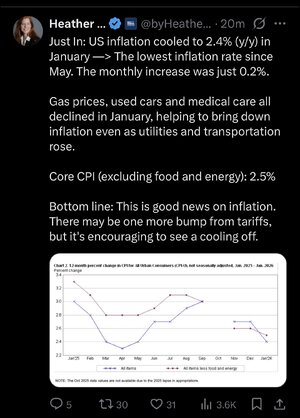
Core CPI is published by ... wait for it ... the Bureau of Labor Statistics.

Do better, Heather Long. Please report on the source of these "happy talk" stats. The BLS of past administrations, both Democratic and Republican, is not the same as the current regime. Even members of the Federal Reserve have expressed apprehension with many of today's economic stats.

My just as reliable "statistics" show that, other than gasoline, prices continue to rise. Gas will rise too once seasonal increases kick in, as they do every year. Consumers I've surveyed are almost uniformly paying more for less. And let's not even talk about the business folks I've spoken to. Their prices are WAY up.

So, come on Ms. Long. If you're not reporting the real story about the bastardization of government statistics, you're just one of the happy talkers.
 
Back
Top