Here’s how I view it. My career will likely be automated within 10 years, before I’m 50. I hedge against that automation partially by investing in industries that will benefit by said automation. I lose my career but my investments do well. The downside risk is that AI automates white collar work and the market still crashes. Then I am screwed, but at least will have plenty of company.

Navigation
Install the app
How to install the app on iOS
Follow along with the video below to see how to install our site as a web app on your home screen.
Note: This feature may not be available in some browsers.
More options
You are using an out of date browser. It may not display this or other websites correctly.
You should upgrade or use an alternative browser.
You should upgrade or use an alternative browser.
Economic News
- Thread starter nycfan
- Start date
- Replies: 5K
- Views: 238K
- Politics

BubbaOtis
Exceptional Member
- Messages
- 249
I did one on my wife's IRA over the weekend. It's my goal to convert all hers before I have to start RMD's on mine.Perhaps time to think about some Roth conversions - buy low??
If the market tanks more, I may convert more.
Change the L for an N?Thanks trump.


- Messages
- 8,837
Extraneous how?
Extraneous in that trump will need to fire the person that released the data and bring in a more capable liar, to keep the cult misinformed.

- Messages
- 45,330
“…
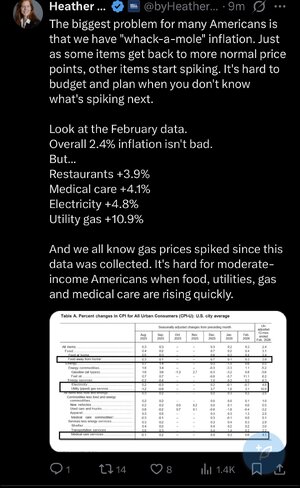
Core prices, which exclude volatile food and energy items, rose 2.5% from a year earlier, in line with expectations.
Prior to the launch of the U.S.-Israeli war with Iran on Feb. 28, Wednesday’s inflation report would have been a key reading, shaping expectations for Federal Reserve policy in the months ahead. It has been transformed by the conflict into something more like a baseline—the reading against which economists will measure whatever the war does to prices in the months ahead.…”
- Messages
- 45,330
“…
Core prices, which exclude volatile food and energy items, rose 2.5% from a year earlier, in line with expectations.
Prior to the launch of the U.S.-Israeli war with Iran on Feb. 28, Wednesday’s inflation report would have been a key reading, shaping expectations for Federal Reserve policy in the months ahead. It has been transformed by the conflict into something more like a baseline—the reading against which economists will measure whatever the war does to prices in the months ahead.…”
“… Benchmark U.S. oil futures have swung sharply since the Iran conflict started and have traded at an average of about $82 a barrel so far this month, compared with a February average of about $65. As a result, inflation in March will likely be hotter.
As a rule of thumb, each additional $10 increase in a barrel of oil adds about 0.2 percentage point to the Labor Department’s inflation reading, calculates Brusuelas, chief economist at RSM. The backs of different economists’ envelopes can look a little different, but most are betting on oil prices boosting inflation in March.
Economists also believe that missing data on housing-cost increases in October—the result of last year’s government shutdown—are keeping year-over-year inflation readings artificially low. But that downward bias should disappear in the April inflation report, with measured inflation picking up as a result.…”
The aging billionaire population.

lawtig02
Legend of ZZL
- Messages
- 6,376
This is the most under appreciated fact in our modern political landscape, in my opinion. Presumably, a lot of that wealth will eventually pass down. But in the meantime, younger people are struggling not just in absolute terms, but more importantly in relative terms.
yeah, I’m curious at how much of this was driven by the ultra wealthy being older. I’m not sure there is a growing divide between the wealth of the median boomer and median millennial, but there certain is a growing divide between the ultra wealthy and everyone else, and the ultra wealthy are an older population.The aging billionaire population.
lawtig02
Legend of ZZL
- Messages
- 6,376
This is an incredibly complicated topic but the former is also an issue.yeah, I’m curious at how much of this was driven by the ultra wealthy being older. I’m not sure there is a growing divide between the wealth of the median boomer and median millennial, but there certain is a growing divide between the ultra wealthy and everyone else, and the ultra wealthy are an older population.

Shifting Wealth of US Age Groups
The wealth of households aged 75 and over increased from 5 percent above the overall average in 1983 to 16 percent above it in 2007, then continued to rise to 55 percent above by 2022. Correspondingly, the relative wealth of all other age groups declined during this period. For example, the mean net worth of households under 35 slipped from 21 percent of the overall mean in 1983 to 17 percent in 2007 to 16 percent in 2022.
Wolff identifies three principal factors driving these shifts. First, homeownership rates among the oldest Americans rose by 11.5 percentage points (from 69 to 81 percent) between 1983 and 2022. Meanwhile, younger households saw their homeownership rates remain essentially flat at around 39 percent, falling further behind the overall national average of 66 percent in 2022.
Second, direct and indirect stock holdings—through mutual funds, trusts, IRAs, and 401(k) plans—of households aged 75 and older rose from 56 percent of the overall average in 1989 to 347 percent in 2022.
Third, while debt levels rose in absolute terms across all ages, the ratio of mortgage debt to house value declined for older households, from 21 percent in 1983 to 10 percent in 2010, where it remained through 2022. Meanwhile, for younger households, this ratio rose from 23 percent in 1983 to 76 percent in 2010 before moderating to 57 percent in 2022.
Wolff finds that at least for the latter part of his sample period, 2007 through 2022, educational debt explains only a small fraction of young households’ relative wealth decline.
- Messages
- 4,623
People like me who are over 55yo are rich because we know how the real world works. We know how to pay our bills and how to use real money to pay for our groceries. We are savvy investors . We are more intelligent and have earned our right to be rich.The aging billionaire population.
We would be even richer but we pay higher taxes than we should, because we have a strong sense of noblesse oblige which you of little wealth should be more appreciative.
The aging billionaire population.
I wonder how much of this will be transferred to hospitals and assisted living facilities in the next 20-30 years vs what’s being passed down, and how that has compared historically.
My feeling (as a millennial) is that it’s not going to be great for younger generations, unless you’ve managed to get an executive position in one of those industries.
The average life expectancy in the US increased three years between 2000 and 2025, so that certainly explains some of it.yeah, I’m curious at how much of this was driven by the ultra wealthy being older. I’m not sure there is a growing divide between the wealth of the median boomer and median millennial, but there certain is a growing divide between the ultra wealthy and everyone else, and the ultra wealthy are an older population.
Also, not all of the uber wealthy are old. Elon Musk, for example is under 55.

- Messages
- 2,260
Extraneous how?
Who knew America would give Donald Trump a second shot at being President after he was so disastrously incompetent the first time?

- Messages
- 5,483
The average life expectancy in the US increased three years between 2000 and 2025, so that certainly explains some of it.
Also, not all of the uber wealthy are old. Elon Musk, for example is under 55.


This is a few years old, but relevant. I’m always wary of anything that uses averages (or totals) when you have big outliers (such as the ultra wealthy). Albeit, not sure if the study accounts for NPV of pensions which would be a big advantage for boomers.

 www.newsweek.com
Millennials financially better off than boomers at same stage: Study
Millennials have higher net worths that older generations at comparable ages, a new study has found.
www.newsweek.com
Share: