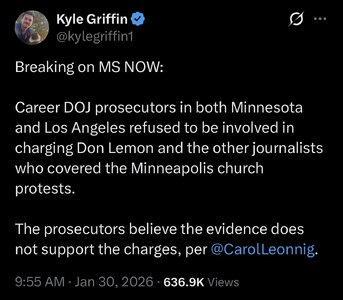
Former CNN anchor Don Lemon taken into custody, sources say

You’d think they’d have the sense to pull back from their nonsense in the wake of the backlash over the murders, all their scrambling to find the right positioning on that… but they’re too brazen (and stupid) for that.

I can’t stand Don Lemon personally, he’s a smug grandstander more than a reporter… but if it’s as hollow as it sounds, then this won’t do anything to help team trump while they’re spiraling. These are stupid people with ill intentions led by a stupid man with ill intentions.

Silver lining is that swing voters (many of them also stupid) are watching this clown show, day after day.
 
You’d think they’d have the sense to pull back from their nonsense in the wake of the backlash over the murders, all their scrambling to find the right positioning on that… but they’re too brazen (and stupid) for that.

I can’t stand Don Lemon personally, he’s a smug grandstander more than a reporter… but if it’s as hollow as it sounds, then this won’t do anything to help team trump while they’re spiraling. These are stupid people with ill intentions led by a stupid man with ill intentions.

Silver lining is that swing voters (many of them also stupid) are watching this clown show, day after day.
We must keep in mind that these ICE agents are not law enforcement officers. They are Trump's private jackbooted brown shirted stormtroopers whose mission is to round up black and brown skin people , terrorize citizens who come out to support them, and threaten and intimidate those who report what is happening.
 
What exactly did the protesters at the church do that was illegal? I mean, aren't church services open to people? So they entered the church and said the pastor is part of ICE and that his being part of ICE is at odds with being a Christian? I mean did they do any vandalism? Did they physically assault anyone? What did they do that deserves their arrest?
My understanding is they were invited in and sat and sang hymns with them. They then stood up and started protesting.
 
Potential FACE Act violation for interfering and disrupting a Church service - so much more than trespass. Fact question as to whether Lemon was a participant in the "protest" or acting solely as a journalist.

Multiple right ring journalists claimed 1st Amendment protections on J6 when they filmed and commented on the J6 activities in the Capital. They were convicted and jailed without a peep of protest from the mainstream press and media.
 
Potential FACE Act violation for interfering and disrupting a Church service - so much more than trespass. Fact question as to whether Lemon was a participant in the "protest" or acting solely as a journalist.

Multiple right ring journalists claimed 1st Amendment protections on J6 when they filmed and commented on the J6 activities in the Capital. They were convicted and jailed without a peep of protest from the mainstream press and media.
Who?
 
Thanks. I guess they were trespassing. I don't think they entered with the intent to commit a felongy.

So it appears this is something that was not that big of a deal and the Trump administration is turning it into a big deal. Shocker.
Tresspassing is a State misdermeor. The feds can arrest for tesspassing (at least not on federal property).

There is an excelent Lawfare podacst on the precise legal basis for these charges (or lack theeref) which can be found here: Lawfare Daily: The Trials of the Trump Administration, Jan. 23
 
And specifically for Super who doesn't listen to pods and who would rather read, here's the relevant part of the pod transcript...

Anna Bower: Yeah. So a few things here. One is that we don't yet have a complaint or an indictment.

So that is still under seal. But we do have video that was recorded by Don Lemon who both was with these, this group of protestors before the protest happened, and then recorded them throughout the process of this occurring. My understanding is that an ICE official works at this church, so that is the reason why this church was selected as a site of protest.

They show up to the service it is already happening, and there's not video exactly video of when they first confront the pastor who is in the middle of speaking, doing the service. But there is audio where you can hear one of the protestors, you know, after they've gone in, they sit down, you can hear the pastor saying, here, fill in here.

So they've joined the service and then someone stands up and says something, or it sounds like they, you know, kind of, I don't know if they stood up, but someone says something to the pastor at some point. They have an exchange, and then that's when everyone at some point stands up and starts chanting.

I, based on the video that I have seen. Did not see any effort to obstruct people from entering or leaving the service. Although people did, it did cause people to leave. And the service was disrupted. Many people left. Some people though did stick around and have conversations, it looks like, with some of the people who had been the protesters.

You know, Don Lemon goes and interviews the pastor at one point. It's all kind of over, it seems like within like half an hour to an hour. So it's a kind of quick thing that happens. It's not it's not something that seemed to be an effort to block people from entering the service.

And that's important for the conversation that I assume we're gonna have about the basis of these allegations and the crime that potentially the government alleges here.

Benjamin Wittes: Yeah, so I am confused about what the crime is purported to be. They're not trespassing. It was open, a church, like the church services open to the public, right? They are not impeding anybody from walking in, which is, as I understand the FACE Act, what the FACE Act violates. I don't know that there is a law against shouting down a pastor.

And so though I find it distasteful and I don't approve of it, what is—walk me through what the actual, what are they being held for or what are they being arrested for?

Anna Bower: So, look I'll say on the trespass point, I'm not sure that it's not trespass at the point where they are asked to leave, because I believe that at least some of them were asked to leave by people who were there in the service.

Benjamin Wittes: Okay. Misdemeanor trespass.

Anna Bower: That's probably a misdemeanor trespass situation, right? We're talking about, there have been three people who have been arrested and they've been arrested for, at least as far as we know, because it's not entirely clear without having the filings unsealed, they've been arrested for felony conduct.

And what I understand we talked a little bit about the FACE Act, so let's start with the FACE Act, because I don't—

Benjamin Wittes: Before you get to the FACE Act, we have some comments in the chat that are correct. Yes. A misdemeanor trespass is not a federal offense.

Anna Bower: So to Yes. And to be clear, that would be a state crime issue.

Benjamin Wittes: Right, so we know it is not, they're not being charged federally with a trespass.

Anna Bower: Yeah. And that's, and so that's but what I, yes. So even if you put that aside though, that's not what they're charged with here. What we do know is that the government, based on reporting of these arrest warrants that were issued because three people were arrested in recent days and the government has made a really big deal out of these three protesters having been arrested.

And one photo that we've seen of one of those arrest warrants showed that the magistrate actually did not find probable cause for a FACE Act violation, but did find probable cause for an 18 U.S.C. 241 violation, which is the conspiracy against right statute.

Now, what's interesting about that, let's start, let me just start first with the FACE Act, because actually there's, you need to know a little bit about the FACE Act to understand what they're charged with under the Conspiracy Against Rights statute. The FACE Act is this law that was passed in the wake of a lot of protests that were going on around reproductive healthcare facilities.

You know, people were seeking abortions. Abortion is a really controversial topic. You have you know, pro-life protesters, that kind of thing, who blockaded, you know, would like do things like chain themselves together and try to stop people from entering facilities.

There were threats of violence. There were just some really awful things that, that happened outside of these reproductive health facilities. And so, Congress passed this law, the FACE Act, that basically was to try to—that criminalized activities that tried to block access or the making of threats to intimidate people or interfere with their access to, or the provision of reproductive health services.

But in the course of that legislation being passed, I think it was Orrin Hatch, kind of wanted to make things like, ‘oh, if we're gonna have it, this thing about abortion facilities, we should have it also be about access to religious worship sites.’ So they put in an additional provision that it that says, like, in the same way that you can't interfere with people trying to go to a reproductive health facility, you can't interfere with a person trying to go to a religious site of worship.

And the specific provision that's relevant here is that you can't interfere with by physical obstruction, a person who is you know, seeking or exercising their right of religious freedom. And physical obstruction in that statute bin actually means something very specific.

It's like it, it means that you can't do some activity that makes it difficult or hazardous for someone to enter or exit the facility, or the site of religious worship. So here it seems that there actually isn't really a physical obstruction because all the people did was go in and stand up and chant, and that caused people to leave, yes. But it wasn't like they were blockading the entry or exits of this church.

So I think maybe that's why the magistrate found that there's no probable cause for a FACE Act violation, right. However, that's where you then get to the conspiracy against rights statute, which basically says that you can't conspire—if two or more people conspire to interfere with someone in the exercise of a right provided by the Constitution or by statute, or if they conspire to interfere with the exercise of that right, or because of the exercise of that right.
 
Benjamin Wittes: I wanna correct you on the specific language because,

Anna Bower: Yeah I'm paraphrasing here, so please correct me.

Benjamin Wittes: The language is not protected by the right protected by the Constitution or statute.

The language is secured by statute, and this is, I think, important because it is not at all clear to me how you can say you conspired, you didn't violate the FACE Act. But you conspired with to, to violate, to deprive somebody of a right secured by the face act. This FACE Act, in my view, does not secure a right if you didn't, if you didn't violate, if you didn't violate the FACE Act when you interfered with that right. I think it's, I think the specific language of the statute here strikes me as very difficult to reconcile with prosecuting these people.

Anna Bower: Yeah. And so, what's happening here, just to make sure people have the right picture in their minds is like, the idea is that even though they, there's not probable cause to violate the FACE Act.

The idea is that they conspire to interfere with someone exercising this right secured by the FACE Act. And that's the specific language that's on this arrest warrant where the government, it appears to say that, I believe the phrase they use is tha, the interference with was with the free exercise of religion secured by the FACE Act.

And so then the question becomes, well, what is the right, how do you define the right created under the statute? It could be defined really broadly, but also it could be defined more narrowly of like a right to be free from physical obstruction to enter or exit a site of religious worship.

Benjamin Wittes: Yeah, I would say the part that's secured by the FACE Act is the part that you could be indicted for the FACE Act by The FACE Act, by violating.

And if you can't be indicted under the FACE Act, it's hard to say to me at least that the FACE Act is securing the right.

Anna Bower: Yeah. And so it's like hard to see right now. I mean, we'll see, the government's theory could also be a different theory because the conspiracy against rights statute also has this provision, and again, I'm paraphrasing so someone correct me on the language, but they have this provision and it's written in kind of old timey language because this is a really old statute where they're like, if someone goes in disguise on the highway or a premise the premise of another, and in doing that, going in disguise on the premise of another person they, you know, interfere with their property or something to that effect then that could be also a violation of 241.

So maybe like a kind of more of a stretch, even more so than the one we just discussed. Another theory could be that these protestors, by going in kind of, purporting to be people who were joined the congregation, they were kind of disguising themselves and then, you know, intruded on the premises of the church by then revealing themselves to actually be kind of these intruders.

I, that's put a potential theory, but we don't know because we haven't seen the complaint. It's still sealed.

Benjamin Wittes: Yeah. So I have a, oh, sorry. Go ahead, Eric.

Eric Columbus: Yeah, I was jumping, I mean, I would get back to the conspiring part of it, that language in 241 which they could have violated 241 without ever arriving at the church, even. They could have just planned this whole thing and taken together—

Benjamin Wittes: And some gotten on the bus to the church. You need an overt act, right?

Anna Bower: I think for 241, you maybe actually don't even need an overt act.

Benjamin Wittes: Oh, that's right. I think that's right.

Eric Columbus: And so that, you know, backs it up in time, that gives them a broader, like with most conspiracy statutes, it gives the prosecutors a broader timeframe to look at.

And they could, you could have probable cause for that type of conspiracy.

Benjamin Wittes: That's a really interesting point. So you have you have some probable cause of some sort that somebody in the course of the conversation say, yeah, let's barricade the entrance.

Eric Columbus: Yeah.

And though they didn't end up barricading the entrance you could still have some degree of meeting of the minds to do something like that, which is what, yeah.

Anna Bower: And that's where you have, like the Don Lemon meeting, the Don Lemon footage of the meeting that took place beforehand might be relevant to I need to go back and look at that video again to see the exact language they were using during that meeting.

But that might be relevant to the government's complaint at this moment.

Roger Parloff: Okay. Why do they need the FACE Act at, at all? I mean, why can't it just be conspiring to deprive them of their free exercise of religion.

Anna Bower: So, so under the 241, it has to be a right in the Constitution or by it, under the laws of the United States.

So either, you know, the Constitution or statute, but if you wanted to use the free exercise of religion under the First Amendment of the Constitution, well, that's a negative limitation on governmental interference. Here. We just have private actors who are interfering with you know, religious service.

So you, it wouldn't necessarily be a right secured by the Constitution that is being interfered with. It's a right in statute. Does that make sense?

Roger Parloff: I have to think. I think…

Anna Bower: See—

Benjamin Wittes: ‘Cause they're not acting under color of law, so they can't deprive somebody of their free exercise rights.

Roger Parloff: Mm-hmm.

Anna Bower: Alright.

Benjamin Wittes: Yeah. So we're gonna have to wait for another week—

Anna Bower: Can I say one more thing before we move on?

Benjamin Wittes: Please.

Anna Bower: And it's important because you asked at the beginning, there's no allegation of violence, that actually got more complicated today. Because even though on the facts, there very clearly was no violence and no threats of violence as far as I can tell. The government, however, today there was a detention or a, there was a first appearance hearing for two of the people who are arrested.

And during that first appearance based on reporting and then also an order that just came out, the government argued that this is a crime of violence that warrants a detention hearing. The magistrate and then the district judge have sub subsequently rejected that assertion as baseless. But it is pretty remarkable that the government made this claim that this is a crime of violence when it very clearly is not.

Benjamin Wittes: And it's not clear what the basis for that claim. I mean, obviously it didn't persuade the magistrate didn't persuade the district judge, but it's not clear what the basis for it was.

Anna Bower: It's not clear. Although there was reporting that one of the claims the government made was that in the course of people leaving the church, a woman slipped and fell and injured her arm in some way, potentially breaking her arm.

So it seems that it potentially was related to that claim. But it otherwise, in the order itself, the judge says they provided no factual or legal basis for this.

Benjamin Wittes: Gotcha.

Anna Bower: But—and a detention hearing was found to not be warranted. And so they are apparently going to be released.

Benjamin Wittes: So we are going to have to sit tight on both the criminal inquiries into state officials and on protestors in Minnesota as to what the government's theory of these cases are. We will keep an eye on it and we will come back to it in future episodes.
 
Back
Top