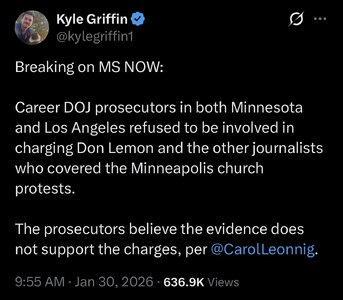
Benjamin Wittes: I wanna correct you on the specific language because,
Anna Bower: Yeah I'm paraphrasing here, so please correct me.
Benjamin Wittes: The language is not protected by the right protected by the Constitution or statute.
The language is secured by statute, and this is, I think, important because it is not at all clear to me how you can say you conspired, you didn't violate the FACE Act. But you conspired with to, to violate, to deprive somebody of a right secured by the face act. This FACE Act, in my view, does not secure a right if you didn't, if you didn't violate, if you didn't violate the FACE Act when you interfered with that right. I think it's, I think the specific language of the statute here strikes me as very difficult to reconcile with prosecuting these people.
Anna Bower: Yeah. And so, what's happening here, just to make sure people have the right picture in their minds is like, the idea is that even though they, there's not probable cause to violate the FACE Act.
The idea is that they conspire to interfere with someone exercising this right secured by the FACE Act. And that's the specific language that's on this arrest warrant where the government, it appears to say that, I believe the phrase they use is tha, the interference with was with the free exercise of religion secured by the FACE Act.
And so then the question becomes, well, what is the right, how do you define the right created under the statute? It could be defined really broadly, but also it could be defined more narrowly of like a right to be free from physical obstruction to enter or exit a site of religious worship.
Benjamin Wittes: Yeah, I would say the part that's secured by the FACE Act is the part that you could be indicted for the FACE Act by The FACE Act, by violating.
And if you can't be indicted under the FACE Act, it's hard to say to me at least that the FACE Act is securing the right.
Anna Bower: Yeah. And so it's like hard to see right now. I mean, we'll see, the government's theory could also be a different theory because the conspiracy against rights statute also has this provision, and again, I'm paraphrasing so someone correct me on the language, but they have this provision and it's written in kind of old timey language because this is a really old statute where they're like, if someone goes in disguise on the highway or a premise the premise of another, and in doing that, going in disguise on the premise of another person they, you know, interfere with their property or something to that effect then that could be also a violation of 241.
So maybe like a kind of more of a stretch, even more so than the one we just discussed. Another theory could be that these protestors, by going in kind of, purporting to be people who were joined the congregation, they were kind of disguising themselves and then, you know, intruded on the premises of the church by then revealing themselves to actually be kind of these intruders.
I, that's put a potential theory, but we don't know because we haven't seen the complaint. It's still sealed.
Benjamin Wittes: Yeah. So I have a, oh, sorry. Go ahead, Eric.
Eric Columbus: Yeah, I was jumping, I mean, I would get back to the conspiring part of it, that language in 241 which they could have violated 241 without ever arriving at the church, even. They could have just planned this whole thing and taken together—
Benjamin Wittes: And some gotten on the bus to the church. You need an overt act, right?
Anna Bower: I think for 241, you maybe actually don't even need an overt act.
Benjamin Wittes: Oh, that's right. I think that's right.
Eric Columbus: And so that, you know, backs it up in time, that gives them a broader, like with most conspiracy statutes, it gives the prosecutors a broader timeframe to look at.
And they could, you could have probable cause for that type of conspiracy.
Benjamin Wittes: That's a really interesting point. So you have you have some probable cause of some sort that somebody in the course of the conversation say, yeah, let's barricade the entrance.
Eric Columbus: Yeah.
And though they didn't end up barricading the entrance you could still have some degree of meeting of the minds to do something like that, which is what, yeah.
Anna Bower: And that's where you have, like the Don Lemon meeting, the Don Lemon footage of the meeting that took place beforehand might be relevant to I need to go back and look at that video again to see the exact language they were using during that meeting.
But that might be relevant to the government's complaint at this moment.
Roger Parloff: Okay. Why do they need the FACE Act at, at all? I mean, why can't it just be conspiring to deprive them of their free exercise of religion.
Anna Bower: So, so under the 241, it has to be a right in the Constitution or by it, under the laws of the United States.
So either, you know, the Constitution or statute, but if you wanted to use the free exercise of religion under the First Amendment of the Constitution, well, that's a negative limitation on governmental interference. Here. We just have private actors who are interfering with you know, religious service.
So you, it wouldn't necessarily be a right secured by the Constitution that is being interfered with. It's a right in statute. Does that make sense?
Roger Parloff: I have to think. I think…
Anna Bower: See—
Benjamin Wittes: ‘Cause they're not acting under color of law, so they can't deprive somebody of their free exercise rights.
Roger Parloff: Mm-hmm.
Anna Bower: Alright.
Benjamin Wittes: Yeah. So we're gonna have to wait for another week—
Anna Bower: Can I say one more thing before we move on?
Benjamin Wittes: Please.
Anna Bower: And it's important because you asked at the beginning, there's no allegation of violence, that actually got more complicated today. Because even though on the facts, there very clearly was no violence and no threats of violence as far as I can tell. The government, however, today there was a detention or a, there was a first appearance hearing for two of the people who are arrested.
And during that first appearance based on reporting and then also an order that just came out, the government argued that this is a crime of violence that warrants a detention hearing. The magistrate and then the district judge have sub subsequently rejected that assertion as baseless. But it is pretty remarkable that the government made this claim that this is a crime of violence when it very clearly is not.
Benjamin Wittes: And it's not clear what the basis for that claim. I mean, obviously it didn't persuade the magistrate didn't persuade the district judge, but it's not clear what the basis for it was.
Anna Bower: It's not clear. Although there was reporting that one of the claims the government made was that in the course of people leaving the church, a woman slipped and fell and injured her arm in some way, potentially breaking her arm.
So it seems that it potentially was related to that claim. But it otherwise, in the order itself, the judge says they provided no factual or legal basis for this.
Benjamin Wittes: Gotcha.
Anna Bower: But—and a detention hearing was found to not be warranted. And so they are apparently going to be released.
Benjamin Wittes: So we are going to have to sit tight on both the criminal inquiries into state officials and on protestors in Minnesota as to what the government's theory of these cases are. We will keep an eye on it and we will come back to it in future episodes.




 www.nbcnews.com