Latin America Politics General Thread

  • Thread starter Thread starter CRHeel94
  • Start date Start date
  • Replies: 272
  • Views: 7K
  • Politics 
From James Bosworth...AKA Boz

Eight points on Costa Rica's 2026 election

A hardline mano dura populist with a congressional majority would be a reason to worry elsewhere, but probably not in Costa Rica.​


Laura Fernandez, the candidate of the ruling party and President Rodrigo Chaves, won the Costa Rican presidential election in the first round with 48% of the vote. In the final week, some of the anti-incumbent vote coalesced around Alvaro Ramos, who won about 33% of the vote, but it was not enough given the 40% threshold to win.

Good Graphics Here: Resultados elecciones 2026 Costa Rica: presidencia y diputados

A president with the congressional majority that Chaves never had. The Pueblo Soberano Party (PPSO) will have 31 of the 57 seats in the legislature, giving Fernandez a majority. That will make it easier to pass legislation and avoid routine opposition from the Congress. The PPSO did not win a super-majority, meaning the president will not be able to call for any constituent assembly or change the constitution, something her party had promised in its platform. La Nacion has a good breakdown of what the president-elect can and cannot accomplish with her 31 seats.
The Chaves controversies will continue. Fernandez promised to include the current president in her government to maintain his immunity from prosecution. She is likely to deliver that to her former boss, at least at first. The new legislature will be more friendly, meaning that Chaves’s presence won’t hinder her early agenda. Yet, his personality and lingering scandals will hang over her administration and leave questions of whether she is acting as a puppet.

Her own presidency? There are plenty of examples in Latin America of presidents who dedazo’d a successor, only to have that person turn on them. That should be Chaves’s big fear. One reason Fernandez will struggle to become independent from her patron is that at least some of the members of the congressional majority are loyal to Chaves rather than to the new president. They are true Chavistas (yes, it’s weird to use that word in the Costa Rican context).

Fernandez, the populist. In some ways, the new dynamic in Costa Rica resembles the Sheinbaum-AMLO relationship, where the president both needs her predecessor and is harmed by the controversies that follow him. However, the big difference between Sheinbaum and Fernandez is that Mexico’s president has a credible technocrat-focused administration, despite her embrace of some populist characteristics, while the new Costa Rican president went full populist during the campaign.
Mano Dura, but does it work? Fernandez ran on a hardline approach to crime. Salvadoran President Nayib Bukele visited during the campaign and appeared to back her promises. However, as I wrote last week for subscribers, Costa Rica has also seen a sharp rise in crime under the current administration’s hardline approach. The Salvadoran approach, both in fact and myth, struggles when applied to other contexts. So while hardline rhetoric is popular during campaigns, I expect the security agenda to struggle under the next administration (another difference between Fernandez and Sheinbaum), and that security struggle will likely damage the new president’s popularity over the early part of her term.
Watch the relationship with China. Unlike the recently inaugurated Nasry Asfura in Honduras, Fernandez made no promises to quit Beijing and recognize Taipei during the campaign. Still, Chaves’s relationship with Beijing was not calm during his term in office and there will be pressure from the Trump administration to reduce ties with China over the coming four years. Beijing did not honor its investment commitments made after Costa Rica reversed recognition in 2007, and there is lingering controversy over how Beijing convinced Costa Rican politicians to support that reversal.

The opposition lacks a vision. Fernandez’s opponents focused on the threat she, her party, and, most importantly, the influence of Rodrigo Chaves represented to Costa Rican democracy. Polling on Chaves was decidedly mixed, with general approval reaching near 60%, but majority disapproval when asked about how he was handling specific issues. To the extent the feelings about the current president were negative, most Costa Ricans viewed Chaves as an annoyance and a controversial and mildly corrupt figure rather than a real threat. The opposition failed to offer a more pro-active vision for the country beyond opposing Chaves (I feel like I wrote that sentence decades ago). And that opposition gave Costa Ricans little reason to vote against his tough-on-crime successor.

“Costa Rica will remain Costa Rica.” That was my quote in the Guardian this weekend, predicting that Costa Rica will remain a democracy with free and fair elections still being held in four years. For whatever concerns I have about Fernandez and her agenda, I don’t view her as a Bukele or a Chaves (or a Chavez) type of politician who threatens the country’s institutions in a significant way. Costa Rican institutions will hold. Political reality will force her to back down if she pushes to far."

Latin America Risk Report | Boz | Substack
[td width="550px"]
[/td]​
 
Nicaragua has decided to start asking Cubans and Venezuelans for consular visas.
Things that make you go HMMM.
 
"Rubio is right to place democratic values at the center of U.S. policy toward the Americas, but consistency matters. In practice, democratic norms are too often invoked rhetorically rather than treated as operational constraints. Governments that align geopolitically are granted latitude; democratic erosion is tolerated so long as cooperation continues.

That contradiction is compounded when democracy is championed abroad by an administration actively hollowing it out at home. The erosion of democratic norms within the United States weakens both moral authority and strategic credibility. It becomes harder to persuade partners that democratic governance is a source of strength when the United States appears willing to subordinate its own institutions to political expediency. While Rubio may seek to distance himself from the Trump administration’s domestic overreach, his role in articulating U.S. policy abroad inevitably ties him to its consequences.

This posture offers tactical convenience. Over time, it corrodes influence. It signals to judges, journalists, opposition leaders, and civil society actors that democratic commitments are conditional and that Washington’s support is transactional.

Democracy is not a moral luxury. It is the United States’ comparative advantage. Unlike authoritarian competitors, the United States engages societies, not just governments. In the Western Hemisphere, business leaders, unions, courts, media, and civil society shape political outcomes and institutional resilience. A strategy that privileges short-term alignment over democratic legitimacy sacrifices the very ecosystems that make influence durable. Coercion can silence governments. It cannot mobilize societies."


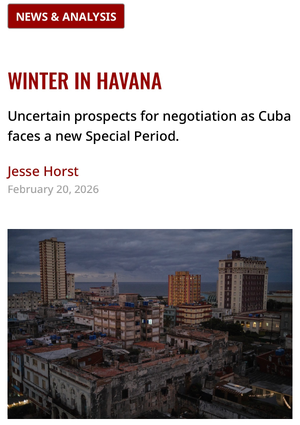
Jesse Horst for NACLA: "The last weeks of January were historically cold in this city of eternal summer, coloring it with a touch of the surreal. “It’s el carnaval de los pobres,” a friend tells me. “This is when people who don’t have winter clothes put on absolutely everything they have.” I bike past a man wearing yellow socks and sweatpants topped with shorts. Another dons a full-body snowsuit saved from the former Soviet Union. Waves crash over the malecón as temperatures dip into the 50s. I find myself wearing my own strange combinations. In the chill, there is a sense that normal constraints have washed away.


It is not just the weather in Havana that is out of sync. Since the U.S. commando raid on January 3 that led to the capture of Venezuelan president Nicolás Maduro and the death of 32 Cuban members of his security detail, changes within Cuba have been constant and unpredictable. “If I lived in Havana, and I was in the government, I’d be concerned,” declared U.S. Secretary of State Marco Rubio, the son of Cuban immigrants. Cuban authorities marked the deaths with a period of national mourning, punctuated by fiery speeches. In the following weeks, heightened political mobilization, increased blackouts, and deteriorating services unfolded beneath chatter about the possibility of a “deal” between the Cuban government and Donald Trump. These tensions escalated in February as the White House threatened debilitating tariffs on any country that shipped oil to Cuba. Coming amid naval actions against unregistered tankers and longstanding economic sanctions, Cuban officials face limited options as oil and gas gradually disappears.


Worry and Adaptation


I have lived in Havana for more than 10 years as a researcher and director of a study abroad program for U.S. students, who arrived for this surreal semester on January 31. What is difficult to convey to those outside is how the perception of these changes is marked by a messy collage of disorientation and tense normalcy as society grinds to a halt. News of change arrives in a fractured media environment, channeled through spotty internet, amid blackouts that alter daily rhythms. Unlike the Special Period of the 1990s, the impact of the crisis is delivered to Cuba’s overlapping social layers with spectacular inequality, though even the most privileged strata are not immune. And despite all that, many normal activities go on….

Cont next post…
 
Worry and adaptation mix in Havana as blackouts of 12, 16, 14 hours set in, mixed with unexpected days of virtually no blackouts. Rental houses scramble to install batteries and solar panels. A skyscraper is equipped with a generator for its elevator. Between power cuts, the Havana Jazz Festival goes on. The city fills with musicians of stunning virtuosity. Tourists appear out of nowhere. Crowds ignore rumors of a power outage in the National Theater to hear pianist Robert Fonseca close the festival with high energy. Yet even Fonseca looks stressed, at one point furiously waving off dueling saxophone solos, tapping his watch.


News comes as a speculative trickle, filtered through social media. People talk, but no one knows. An intriguing post describes back-channel negotiations. Is it verified? A local santera writes of Neptune moving from Pisces to Aries, towards impulse, conquest, fire, the culmination of a long cycle.


For days after Trump threatened Cuba’s oil suppliers with tariffs on January 29, there was little official Cuban acknowledgement of the circumstances visibly changing around us. Many I talk to bet on aid from China or Russia, though at the necessary scale, this is unlikely. In Vedado, meanwhile, the line for gas purchased in U.S. dollars extends for more than a kilometer. A man tells me he slept there 3 nights. Scuffles break out over line-crashing. Four soldiers guard the tanks. “They’re forming a society here,” a friend jokes.


Just as it seems like news will never come, a speech by President Miguel Díaz-Canel is announced for Thursday, February 6. Professors at the University of Havana reorganize classes to watch, though many cannot for lack of power. In one state institution, workers gather as the president denounces U.S. aggression and calls for “creative resistance,” but after an hour, one exclaims that we need the “pollo of the arroz con pollo.” The speech offers little clarity about concrete plans to address the mounting crisis. Soon after, I receive messages from the University of Havana that in person classes are suspended. Taxis become scarce. Flights from Canada and Russia end as jet fuel runs out. The gas lines are now gone because there is little gas.


Yet as the sun emerges from the clouds, impatience is more common than panic: “This will be fine,” my neighbor says. “They say so many things, it’s hard to tell how bad it really is,” says another. “Either they come in and change things this year, or I’m leaving,” one contact tells me. “They’re finally proving that the blockade is real,” says another. Vegetables are sold on the street. The local gym is packed. Impoverished elderly people sift through trash heaps. Cars circulate on emptier streets. Restaurants serve gourmet food and play music to emptier rooms. Private enterprises will import fuel, government ministers hint. The jazz clubs will be open. After wind and rain, everything seems poised for change, and everything stays the same.

Crossing the Rubicon


Will everything continue to stay the same? These days are filled with rumors that Raúl Castro’s son, Alejandro, or his grandson Raúl, are negotiating with U.S. officials in a reprise of the Obama administration’s secret talks in the 2010s. Day after day, Trump repeats that a deal with Cuba is close. On the surface, the chance seems slim. Rubio once called President Obama’s Cuba negotiations a “reward” for “repressive tactics.” Cuban diplomats announce that they will not negotiate their political or economic system.


Yet in raising Cuba to the top of his agenda so quickly, Rubio has crossed a Rubicon with few precedents. Like Obama in 2014, he looks to move beyond the status quo of sanctions and heated rhetoric, where hardline politicians from both Cuba and Florida feel comfortable. Backing down will not be easy, and aggressive platitudes will not lead to change.


Despite Cuba’s difficult position, Rubio faces constraints. If he pushes too hard, a humanitarian crisis will generate instability and backlash. The U.S. public seems unlikely to tolerate a violent military occupation focused on nation building. Such a project could generate blowback across the Western Hemisphere and give the revolution new life. Whatever the results, the Trump administration will own them.


There is also a real possibility that Cuban officials may adapt to even these harshest of restrictions. The notion that Cuba mostly suffers from an “internal blockade” of government control, often repeated by government critics, is hard to sustain as oil tankers are seized. In the short term, solar power cannot solve the energy crisis, but in the long term it probably can. Midterm elections in the United States could alter Trump’s calculus.


Yet adaptation cannot minimize the crisis Cuba faces. Political survival for current leaders is one thing, but quality of life for the population is another.


The Specter of Economic Engagement


As the Trump Administration and Cuban leaders talk behind the scenes, many things may happen, but a central truth remains. It is not sanctions or humanitarian catastrophes that strike fear into those who have opposed change on both sides. Instead, it is the specter of economic engagement.


What we know of this specter comes from a brief glimpse, during the last years of Obama’s presidency, as both sides opened the door to deep investment in Cuba’s private sector. It led to a Cuba with significant openings in commerce and travel, as well as widespread cultural exchange with the United States. This was a Cuba where state control over daily life diminished. Cosmopolitan intellectuals crowded onto the lanchita de Regla to hear rappers craft poetry about freedom, planeloads of Mexican initiates travelled to Havana’s peripheries for Santeria ceremonies, X Alfonso’s Fabrica de Arte night club showcased critical art and music unaffiliated with the state, empowered taxi drivers staged protests in front of the Capitolio against rising gas prices. In this Cuba, the circulation of money refused to stay within Cruise ship itineraries and state-run resorts. Visitors preferred private casas over hotels, even before U.S. restrictions. Private restaurants and clubs owned by Cuban Americans from Miami dotted Havana’s trendiest corners.


At the time, political scientist Jorge Domínguez called Obama’s focus on the Cuban private sector “a bet” that, for Obama, investment could lead to democratization, and, for Raúl Castro, this same investment would strengthen socialism and his own power. Naïve observers like me dared to dream the bet could be won by both sides, that socialism, prosperity, and democracy could coexist.


Donald Trump’s election and Fidel Castro’s death in 2016 set off parallel retreats, even as travel from the U.S. continued to surge. U.S. restrictions limited investment and tourist activity. On the Cuban side, half-hearted efforts at political and economic reform were smothered by baffling restrictions and the prioritization of central planning, even at the expense of the welfare state. More than any U.S. hostility, there is a direct line between the era’s naive dreams and the cruel, pandemic-driven hangover that ended in disorganized mass protests on July 11, 2021. These were the largest protests since the early years of the revolution, and they triggered the largest wave of emigration in Cuban history in the following years.

Prospects for a Deal


Cont…
 

Attachments

  • 1771819507721.png
    1771819507721.png
    1.5 MB · Views: 0
In a just world, Cuba would not face coercion from a Trump administration that invades its own cities, flouts international law, and threatens even its allies. Yet Cuban leaders also face an entrenched crisis of legitimacy largely of their own making. This is a dark moment, but it may hold unique possibilities.


As the dust settles from Maduro’s capture, Rubio appears open to the idea that economic engagement can be more a productive political lever than troops in Venezuela. He now has unprecedented credibility to convince the Cuban American community of this same hard truth. Cuba has signaled a willingness to collaborate on national security issues. Foreign investment in Cuban Hotels is technically already open. Cuba’s national assembly is already home to several de-facto political groupings, even as the single party mandate limits their organization. Restaurants and boutique hotels are already owned by Cubans who are also U.S. citizens. Ending sanctions would disorient authoritarian tendencies in Cuba. There are many deals to be made.


If Cuban leaders navigate pragmatically, they may have an historic opportunity to reduce U.S. sanctions, potentially more than in negotiations with Obama. Any deal with Democrats will weaken as Florida Republicans get closer to power. A deal from Miami’s own Secretary of State, however, could be delivered persuasively to all but the most hardline factions of the Cuban American community.


For both sides the path of negotiation is uncertain. The likely outcome is neither regime change favored by Rubio nor rigid control of the economy favored by Cuban powerbrokers. Yet as the dark, winter carnival lifts and all things seem possible, why not step into the unknown?"


Juno Diaz


Winter in Havana
 
Back
Top