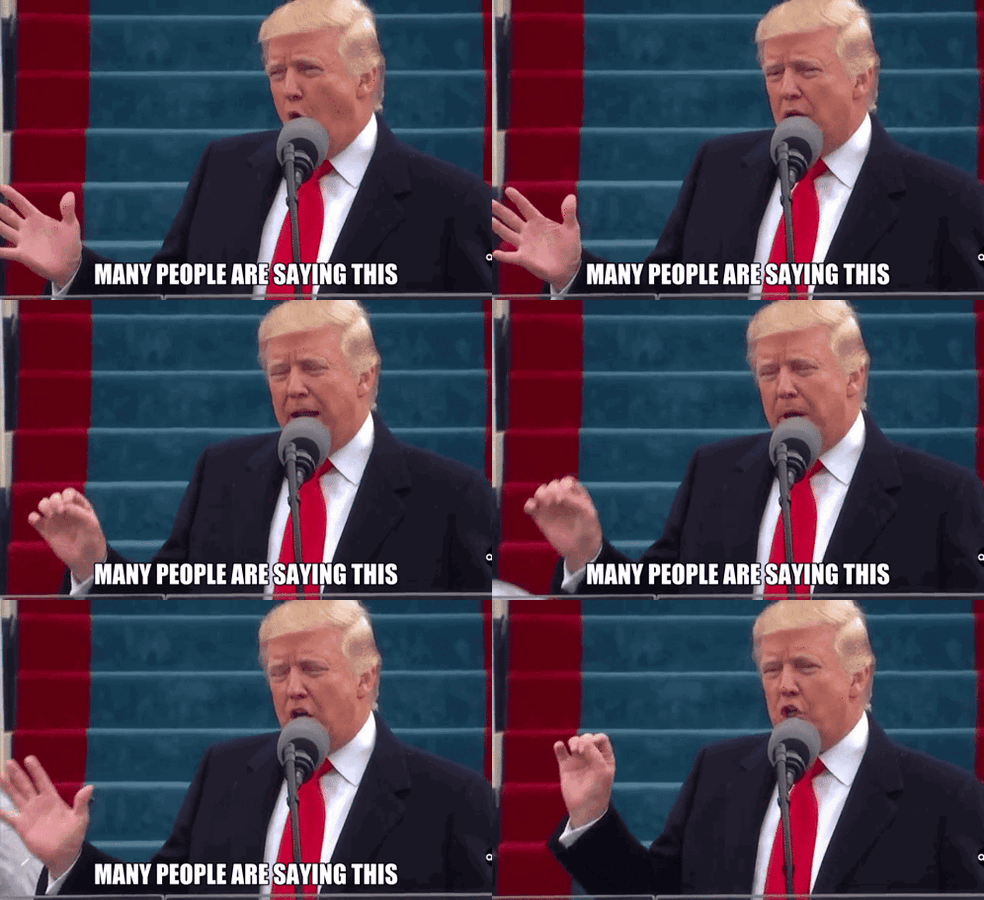
Many, many people, rightfully so, saw it as massive federal government overreach to force people to get a vaccine or literally lose their ability to feed their families, keep a roof over their head, etc.
There will always be disagreement on gray area topics in regard to individual rights. As a person who gladly got the first vaccine and a booster, I found it to be horrifying that the government was basically threatening the livelihood of 80 million people to force them to get a vaccine.
I found it nearly as horrifying that people, like you, have so little appreciation for individual rights that you think it was acceptable.
1. There was a third option -- employees could submit to weekly COVID tests and wear face masks. People just didn't want the inconvenience.
2. Individual rights/freedom is only a useful policy or moral principle when there are no externalities. When your conduct affects other people, then it's not exclusively your conduct any more, and the government can regulate. Let me give you some examples.
A. You are required to put your trash in trash bins. You cannot exercise the freedom to toss a Doritos bag on the side of the road. If everyone did that, the litter problem would be immense.
This is even true for household trash. Sometime you should see what happens when you drop your trash bags on the road outside your home.
B. In cold environments, you are generally required to keep your sidewalk free of snow and ice. If you do not, you can be fined. The government can indeed force you to shovel or snow-blow or hire someone to do it. That's because failure to do so would ruin the walking experience for everyone.
C. Governments can even require you to mow your lawn. Many jurisdictions have rules that grass has to be less than a certain length or else you will get fined.
D. Insider trading is illegal. It's just a matter of freedom, isn't it? You got private info from the CEO; now you want to trade on it. Why shouldn't you be allowed?
3. You see, governments can address collective action problems without infringing on freedoms. In fact, the inability to address collective action problems is a deprivation of freedom. A community should be able to say that it wants its rain not to be acidic, its smog not deadly, its public water germ-free and so forth.
Vaccines are a collective action issue. Everyone has an incentive to free ride on everyone else. Vaccines hurt a little, and they can make you sick for a day. Why do that if, instead, you could just count on everyone else to get the vaccine and then you will be safe indirectly. This is the sort of problem that governments confront every day, and rectify with regulation. It happens all the time. Why do you need a license to drive? Why can the government force you to sell your land through eminent domain?
This is the final time I will explain this to you. If you repeat the same errors, I'm not going to engage. I'll just refer you to this explanation. BTW this is standard conventional wisdom. It is not a controversial view. It is taught in basic economics courses, regulatory courses, law school courses. It is ensconced in thousands of laws and thousands of judicial opinions. The government can regulate collective action problems. End of story.



www.nytimes.com

www.theguardian.com