
Navigation
Install the app
How to install the app on iOS
Follow along with the video below to see how to install our site as a web app on your home screen.
Note: This feature may not be available in some browsers.
More options
You are using an out of date browser. It may not display this or other websites correctly.
You should upgrade or use an alternative browser.
You should upgrade or use an alternative browser.
Tariffs Catch-All
- Thread starter BubbaOtis
- Start date
- Replies: 5K
- Views: 191K
- Politics

evrheel
Esteemed Member
- Messages
- 622
Usually changes to form, fit, and function require requalificationNo idea. Don't know anything about the subject. Just recognize the principle involved.

ChileG
Inconceivable Member
- Messages
- 3,578
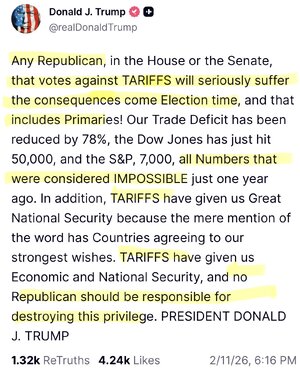
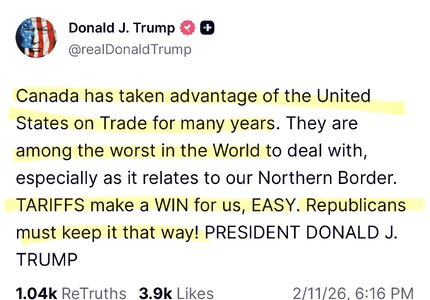
When will MAGA admit to themselves that this man is dangerous to our economic future?

- Messages
- 46,548

- Messages
- 46,548

Trump Backtracks on Steel and Aluminum Tariffs
"Donald Trump is planning to scale back some tariffs on steel and aluminum goods as he battles an affordability crisis that has sapped his approval ratings ahead of November’s midterm elections," the Financial Times reports.
 politicalwire.com
- Messages
- 46,548
 —> https://www.wsj.com/opinion/donald-...c?st=u1r6Rg&reflink=desktopwebshare_permalink
“… On Thursday it was the New York Federal Reserve’s turn. In an analysis on the bank’s website, four researchers write that last year “nearly 90 percent of the tariffs’ economic burden fell on U.S. firms and consumers.”
They reach that conclusion by examining import data, to see whether foreign suppliers cut their prices in response to Mr. Trump’s added tariff costs. Over the first eight months of 2025, “94 percent of the tariff incidence was borne by the U.S.,” the analysis says, meaning “a 10 percent tariff caused only a 0.6 percentage point decline in foreign export prices.”
This outcome drifted as the year wore on, but only slightly: The figures for November suggest the tariffs had “an 86 percent pass-through to U.S. import prices,” the researchers say. “Our results show that the bulk of the tariff incidence continues to fall on U.S. firms and consumers. These findings are consistent with two other studies that report high pass-through of tariffs to U.S. import prices.”
This is a problem for both shoppers and Republicans, including Mr. Trump. Even if tariffs aren’t generally inflationary, they’re taxes that can push up prices on specific imported items, as well as on the products of the protected domestic competitors. Recent inflation reports, including the one that came out Friday, show some notable jumps, such as for furniture and bedding, which in January was up 4%, year over year.…”
- Messages
- 46,548
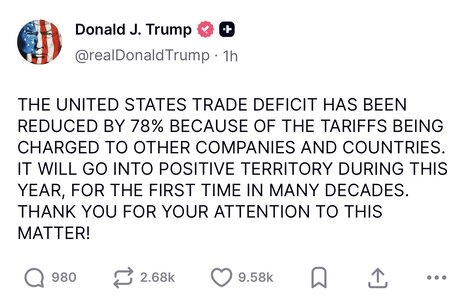
FLASHBACK:
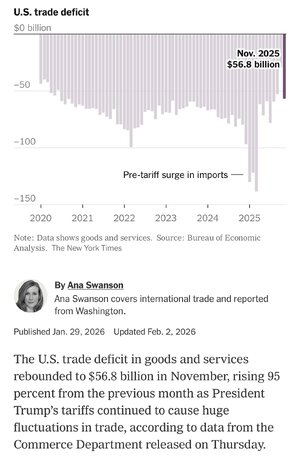
Not sure if Trump is promoting a large one month drop in the trade deficit in October or if he got a preview of the next trade deficit report due tomorrow morning and is prematurely publishing it.

lawtig02
Legend of ZZL
- Messages
- 6,501
Also, the October numbers are completely unreliable because of the shutdown, if I remember correctly.Not sure if Trump is promoting a large one month drop in the trade deficit in October or if he got a preview of the next trade deficit report due tomorrow morning and is prematurely publishing it.
ChileG
Inconceivable Member
- Messages
- 3,578
“… On Thursday it was the New York Federal Reserve’s turn. In an analysis on the bank’s website, four researchers write that last year “nearly 90 percent of the tariffs’ economic burden fell on U.S. firms and consumers.”
They reach that conclusion by examining import data, to see whether foreign suppliers cut their prices in response to Mr. Trump’s added tariff costs. Over the first eight months of 2025, “94 percent of the tariff incidence was borne by the U.S.,” the analysis says, meaning “a 10 percent tariff caused only a 0.6 percentage point decline in foreign export prices.”
This outcome drifted as the year wore on, but only slightly: The figures for November suggest the tariffs had “an 86 percent pass-through to U.S. import prices,” the researchers say. “Our results show that the bulk of the tariff incidence continues to fall on U.S. firms and consumers. These findings are consistent with two other studies that report high pass-through of tariffs to U.S. import prices.”
This is a problem for both shoppers and Republicans, including Mr. Trump. Even if tariffs aren’t generally inflationary, they’re taxes that can push up prices on specific imported items, as well as on the products of the protected domestic competitors. Recent inflation reports, including the one that came out Friday, show some notable jumps, such as for furniture and bedding, which in January was up 4%, year over year.…”
Tax and spend Republicans.
- Messages
- 46,548
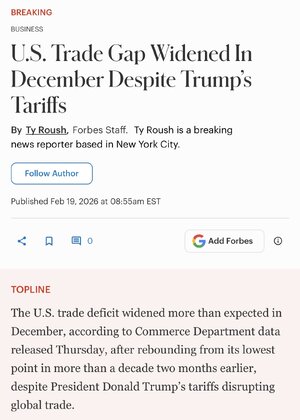
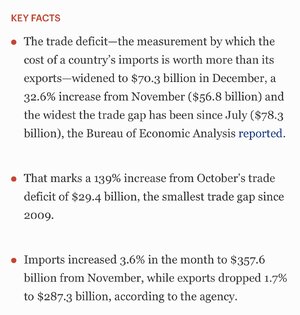
“…experts immediately said [the October drop] was going to be temporary because it was related to short-term fluctuations in gold and pharma trade…and indeed, the November trade deficit was 95% higher than October’s. The December and full-2025 figures will be out [Thursday] morning”
ChileG
Inconceivable Member
- Messages
- 3,578
“…experts immediately said [the October drop] was going to be temporary because it was related to short-term fluctuations in gold and pharma trade…and indeed, the November trade deficit was 95% higher than October’s. The December and full-2025 figures will be out [Thursday] morning”
Hard to believe Trump voters actually trust this guy - both an idiot and a liar (he has to lie to cover up his idiotic decisions) - to be a good steward of the economy.
- Messages
- 46,548
Share: