
JCTarheel82
Inconceivable Member
- Messages
- 2,822
Aaaaand markets are in the green now after Trump signals another TACO.


Follow along with the video below to see how to install our site as a web app on your home screen.
Note: This feature may not be available in some browsers.
Yeah, Trump is the master manipulator. So is this hint a TACO signal or just his way to stop the stock market carnage for a few days ?Aaaaand markets are in the green now after Trump signals another TACO.
The latter, imo.Yeah, Trump is the master manipulator. So is this hint a TACO signal or just his way to stop the stock market carnage for a few days ?

It seems to me the stock market moves because there are a bunch of traders and speculators who sit around every minute trying to figure out the tea leaves on everything so they can get a jump on the rest of us and make a killing. Reports of members of Congress and this Administration doing just that based on inside knowledge is proof. Watch the business channel for 30 minutes and you will also see the mindset of reading the tea leaves and how to play it.Can someone explain how the stock market goes up and down based on anything Trump says?
It's like he can just say whatever he wants and it reacts as if he's telling it what to do.
What's the Y axis measuring?This seems to me to be the #1 reason the market is so quick to rebound in circumstances that would have caused a prolonged slide in the past --
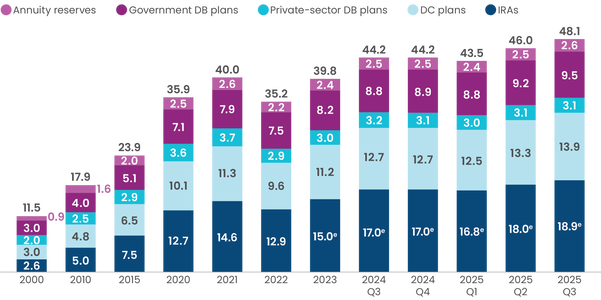

Sorry, should have linked. It's trillions of dollars.What's the Y axis measuring?
Sorry, should have linked. It's trillions of dollars.
Release: Quarterly Retirement Market Data, Fourth Quarter 2025 | Investment Company Institute
Retirement Assets Total $49.1 Trillion in Fourth Quarter 2025www.ici.org


FYI, standard financial economics says this more or less does not matter. I'm not sufficiently well versed in advanced financial economics (i.e. current leading edge models) to know what they say. Standard financial economics does a decent job explaining how irrationality doesn't undermine the market. It doesn't address mass irrationality -- e.g. a lot of people who make financial decisions ahead of time, like "putting 5% of my income into the market rain or shine." Maybe the scale factor here does some work.This seems to me to be the #1 reason the market is so quick to rebound in circumstances that would have caused a prolonged slide in the past --
Private credit = loans made by private investment funds, like private equity or hedge funds. Public credit = corporate bonds. Bank credit = well, you know.Boaz Weinstein warns private credit problems are multiplying by the quarter
Boaz Weinstein warns of private credit’s 'financial alchemy,' says problems are multiplying by the quarter
Saba, alongside Cox Capital Management, launched a tender offer to purchase shares in one of Blue Owl's non-traded private credit funds at a 34.9% discount.www.cnbc.com
This seems to be similar to the 2008 housing bubble in that these investments are much less regulated, but there is a lot here I don't understand. Would anyone with expertise take time to explain:
"Weinstein said he thinks private credit is trading at pessimistic levels and public credit is trading at “incredibly optimistic levels.” He’s shorted public credit through credit default swaps and credit derivatives. Weinstein said that the gating of private credit funds means that investors will have to sell more liquid assets to raise cash, which would weigh on the market.
“I think that public credit is incredibly mispriced and part of my short-term thinking about it is informed by the issues that the private credit markets are having,” he said. "
And
"He added that “one of the best opportunities” in his career would be investing in private credit at a massive discount “when the economy slows.”
“Maybe that’s not for a year, maybe it’s about to happen. Maybe it’s going to happen years from now,” Weinstein said. “It’s about to get super interesting.”"
Thanks for the explanation. Is private credit largely unregulated and riskier, and therefore carries a higher interest rate? I'm also assuming private credit is a much smaller total dollar amount, than what was at risk during the housing bubble. Is that correct?Private credit = loans made by private investment funds, like private equity or hedge funds. Public credit = corporate bonds. Bank credit = well, you know.
This person is saying that the debt markets are misreading the economic situation. Everyone knows that private credit is facing defaults. There are two possible explanations: first, the private credit operations were making too many risky loans, probably in a dynamic similar to 2008 (i.e. fund managers get rich if their bets pay off; they lose only reputation if the bets fail), or second, that credit in general is shaky because of macroeconomic conditions.
This person is saying the second: loans are underperforming in general. Thus, private credit and public credit should be trading at similar levels. But the market seems to be pricing them very differently, which generally speaking falls into the first category (i.e. private credit is struggling because loan quality is bad). So this guys says, "if I buy private credit and short public credit, then when the spread between them narrows, I win."
Assets, Y is trillions of dollars. "Total US retirement assets".FYI, standard financial economics says this more or less does not matter. I'm not sufficiently well versed in advanced financial economics (i.e. current leading edge models) to know what they say. Standard financial economics does a decent job explaining how irrationality doesn't undermine the market. It doesn't address mass irrationality -- e.g. a lot of people who make financial decisions ahead of time, like "putting 5% of my income into the market rain or shine." Maybe the scale factor here does some work.
Also, is that diagram plotting flows? Or assets? Because some of what you'd be seeing is just the expansion of equity valuation, which would make your chart symptom, not cause.
Note that the "5% every month" behavior isn't irrational in an individual financial sense. From the perspective of the market as a whole, it is, because investment decisions are being made without reference to valuation factors. It doesn't mean that people who follow the strategy are fools. It means they are smart enough to know they would be fools if they were trying to time the markets, etc. Still, a financial economist would call it non-rational.
Gallop saysI remember reading some analysis that it was retail investors and retirement accounts that prevented the initial COVID sell-off from reaching 1929 crash levels.
So I’ve subsequently wondered- what happens when all the boomers are deep into retirement and start drawing heavily on their accounts, and then Gen X starts retiring en masse, etc. Is it reasonable to expect slower growth just due to those structural factors?

I see how that got through Spellcheck.Thanks trump.

1. I don't know how much private credit there is. Remember: the biggest issue in the housing bubble wasn't the volume of mortgages that were issued. It was all the side bets on those mortgage pools, the CDOs, CDO squareds, CDS, etc.Thanks for the explanation. Is private credit largely unregulated and riskier, and therefore carries a higher interest rate? I'm also assuming private credit is a much smaller total dollar amount, than what was at risk during the housing bubble. Is that correct?

