
Navigation
Install the app
How to install the app on iOS
Follow along with the video below to see how to install our site as a web app on your home screen.
Note: This feature may not be available in some browsers.
More options
You are using an out of date browser. It may not display this or other websites correctly.
You should upgrade or use an alternative browser.
You should upgrade or use an alternative browser.
US strikes Venezuela / Captures Maduro
- Thread starter nycfan
- Start date
- Replies: 2K
- Views: 101K
- Politics

- Messages
- 5,452
Rubio says US action costs nothing in Venezuela. "If they are not here, they are being paid to be somewhere else." Also muttered something else about it costs us nothing to get the oil we will sell for profit.
Then Hegseth shoved him away from the mic to look like he is a big boy and took some shots at CNN.
Then Hegseth shoved him away from the mic to look like he is a big boy and took some shots at CNN.

He's Not Here
Distinguished Member
- Messages
- 346
I'll give you a hint, it's not the ones running the country.
Well done to you.
I love David Mitchell
He's Not Here
Distinguished Member
- Messages
- 346
I’m good with it, provided they also take entire cabinet and every enabler in Congress with himTo be fair, I’m sure most Venezuelans are happy specifically about Maduro being gone. I’m sure all Venezuelans have serious trepidation about what is to come.
And I’m sure many Americans would be happy to see Trump out of office. That does mean it is a good thing if another country attacked the White House and abducted him, however.

4thgenheel
Iconic Member
- Messages
- 2,307
@Paine touched on Rubio's motivations earlier itt as well.True, but I'd also argue that CRHeel's post is probably the clearest, and most succinct, analysis of what motivates Marco Rubio that I have read.

Do you really think he cares? Rubio isn’t trying to look smart or respected, he’s getting policies enacted that were impossible before Trump. These are things he’s wanted for decades. The collapse of Bolivarianism in Caracas directly weakens Cuba, which has always been the real prize for him. Whether it looks embarrassing on TV is completely irrelevant to someone finally achieving long-standing strategic goals.I wonder what it's like to be Marco Rubio and know that you're on national tv saying really stupid stuff in support of a president who doesn't respect you at all?

Rubio doesn’t experience this as humiliation in the way you or I would. He’s already accepted reputational loss as the price of achieving policy outcomes he’s wanted for decades, his very presence in the Trump administration is proof of that.I know you're a person who has big political goals...would you be willing to go on national tv and look like an absolute clown - knowing that everyone you know and love is seeing you look like an absolute clown - to have one step of a small portion of those goals realized?
From his perspective, the embarrassment is temporary, while the...

CRHeel94
Iconic Member
- Messages
- 1,050
yeah. good points made that generally all come back around to what everyone who isn't a maga shill has been saying:
maduro sucks but this was absolutely not a good or remotely legal way to remove him from power and our actions here will likely have some very negative long term ramifications that far outweigh the short and medium term benefits of this move.
Legal? No. Dangerous precedent? Absolutely. Good? Sure I'll take it. And I hate myself for that.
Short term vs long term...think it might be the other way. In the short and medium term, could be very sticky. In the long run, could pay off.
Have told my Venezulean friends that they need to study understand what happened in Nicaragua. We got rid of the Sandinistas (who were in power for 11 years), and has three "opposition" presidents. The second one (aleman) was corrupt as hell, which eventually led to the Sandinistas getting back in power (have been in power since 2008). Venezuela could very well get rid of the Chavez/Maduro regime...only to fall right in that bucket down the road (we've seen that happen in Eastern Europe as well).
4thgenheel
Iconic Member
- Messages
- 2,307
in the long run it may pay off regarding venezuela in particular but the "might makes right" precedent we're setting here is absolutely not good overall in the long run.Legal? No. Dangerous precedent? Absolutely. Good? Sure I'll take it. And I hate myself for that.
Short term vs long term...think it might be the other way. In the short and medium term, could be very sticky. In the long run, could pay off.
Have told my Venezulean friends that they need to study understand what happened in Nicaragua. We got rid of the Sandinistas (who were in power for 11 years), and has three "opposition" presidents. The second one (aleman) was corrupt as hell, which eventually led to the Sandinistas getting back in power (have been in power since 2008). Venezuela could very well get rid of the Chavez/Maduro regime...only to fall right in that bucket down the road (we've seen that happen in Eastern Europe as well).

Paine
Exceptional Member
- Messages
- 166
I think it’s dangerous to acknowledge that what happened in Venezuela was illegal and a violation of sovereignty, and then endorse it anyway by deferring the justification to some undefined future outcome. Even if Venezuela somehow ends up a stable, thriving democracy, that would not retroactively justify the act itself.
CRHeel says it himself: for small countries, “might makes right” is terrifying. So how does that logic suddenly become acceptable simply because the U.S. is the one exercising the might, and because it produces an outcome you prefer? That isn’t much of a principle at that point.
The Nicaragua example shows where this road leads. Regime change produced years of violence, corruption, and instability, and it never resolved the underlying question of political legitimacy. That’s the pattern almost everywhere. But I’m sure this time will be different.
CRHeel says it himself: for small countries, “might makes right” is terrifying. So how does that logic suddenly become acceptable simply because the U.S. is the one exercising the might, and because it produces an outcome you prefer? That isn’t much of a principle at that point.
The Nicaragua example shows where this road leads. Regime change produced years of violence, corruption, and instability, and it never resolved the underlying question of political legitimacy. That’s the pattern almost everywhere. But I’m sure this time will be different.
gtyellowjacket
Inconceivable Member
- Messages
- 3,177
I agree. Short-term, those CIA backed coups in the 50s and 60s seemed like a great idea. We got rid of a lot of communist regimes. We got a real friend in Iran for a while.in the long run it may pay off regarding venezuela in particular but the "might makes right" precedent we're setting here is absolutely not good overall in the long run.
But most of those coups didn't stick and people all over Latin America aren't huge fans of those Yankee imperialist dogs and their meddling. Feel like after 50 years, we were mostly losing that reputation but Trump just blew that.

CRHeel94
Iconic Member
- Messages
- 1,050
Thats a really great post. Two follow questions.
1. The six different factions, are they regional or political or cultural or what? In Libya it was tribes and they basically broke up the country based on where their geographic power base was. Is that the case in Venezuela?
2. What are the handouts and could Venezuela realistically afford them if the oil got up to a higher level of production and the elites didn't keep all the money?
1. The way it was described its factions within the government based on interests and bases of power. So for example, Cabello is the guy who's in charge of the police, paramilitaries and intelligence apparatus (tightest with the Cubans). Real piece of work, has a $25MM bounty on his head. Vladimir Padrino is the guy who leads the armed forces (highest with the Russians). Maduro's son is supposed to be the guy closest with the drug organization. Then there's Delay (VP) and her brother who's base of power is more in the civil government apparatus. I don't have the name of the guy with the economic angle (Nicaragua has the same setup)...use to be the guy in charge of PDVSA, their state owned oil company.
2. I'll try to be objective about this. Venezuela has always had great wealth for a Latin American country. That wealth was poorly distributed and squandered. Might be one of those urban legends, but growing up I heard how gas in Venezuela was less than 50 cents a gallon. Their thinking was that the people should be the first to benefit from their oil wealth. Like much of Latin America, Venezuela was a land of contrast, great wealth and great poverty. Chavez came to power on the promise of eradicating corruption and using oil money for the people. When he came to power he had a host of social programs, capitalizing on robust oil prices. Those social programs included boosting literacy, community healthcare, affordable housing, land reform, and subsidizing food for the poor (as well as many others...think they had free clinics for pets at one point). From 1999 to 2006, poverty rates in Venezuela dropped from 49% to 30%. From 2006 to 2015 there was a reversal....and since 2015 there has been a dramatic increase...estimates are at 70% of the population are living in poverty. Aside from falling oil prices which affected funding, it's suspected that those social programs have been mired in tremendous corruption (ask anyone who does business in the country).

- Messages
- 44,681
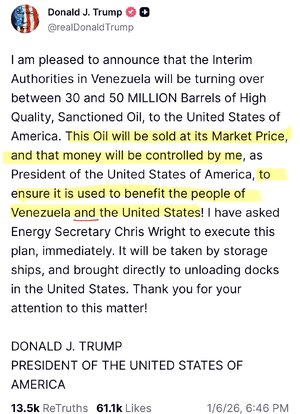
MSNOW reporting that Energy Secretary said the US will be in charge of Venezuela's oil industry indefinitely.
- Messages
- 44,681
“… Step one is the stabilization of the country. We are going to take between 30 and 50 million barrels of oil. We are going to sell it in the marketplace at market rates. We will control how that money is dispersed.
The second phase will be recovery, ensuring that American, Western, and other countries have access to Venezuelan markets.
The third phase will be one of transition….”
gtyellowjacket
Inconceivable Member
- Messages
- 3,177
2. That's kind of what I figured. It's a real shame. Knew a couple of folks from Venezuela. Their parents and by extension they had left when Chavez came to power. Their parents at least were upper middle class and the parents didn't like Chavez but the kids kind of admitted that the poor folks in that country were getting screwed before Chavez.1. The way it was described its factions within the government based on interests and bases of power. So for example, Cabello is the guy who's in charge of the police, paramilitaries and intelligence apparatus (tightest with the Cubans). Real piece of work, has a $25MM bounty on his head. Vladimir Padrino is the guy who leads the armed forces (highest with the Russians). Maduro's son is supposed to be the guy closest with the drug organization. Then there's Delay (VP) and her brother who's base of power is more in the civil government apparatus. I don't have the name of the guy with the economic angle (Nicaragua has the same setup)...use to be the guy in charge of PDVSA, their state owned oil company.
2. I'll try to be objective about this. Venezuela has always had great wealth for a Latin American country. That wealth was poorly distributed and squandered. Might be one of those urban legends, but growing up I heard how gas in Venezuela was less than 50 cents a gallon. Their thinking was that the people should be the first to benefit from their oil wealth. Like much of Latin America, Venezuela was a land of contrast, great wealth and great poverty. Chavez came to power on the promise of eradicating corruption and using oil money for the people. When he came to power he had a host of social programs, capitalizing on robust oil prices. Those social programs included boosting literacy, community healthcare, affordable housing, land reform, and subsidizing food for the poor (as well as many others...think they had free clinics for pets at one point). From 1999 to 2006, poverty rates in Venezuela dropped from 49% to 30%. From 2006 to 2015 there was a reversal....and since 2015 there has been a dramatic increase...estimates are at 70% of the population are living in poverty. Aside from falling oil prices which affected funding, it's suspected that those social programs have been mired in tremendous corruption (ask anyone who does business in the country).
If someone could come in and use that oil money to help all the people in that country and keep corruption to a bare minimum, it could be a real paradise. Just doesn't seem likely though.
- Messages
- 5,452
Chris Murphy talking about the confidential WH briefing to Congress on the WH plan
1. Military blockade will remain
2. US will take any oil we want and sell it and spend that money in Venezuela if and how we see fit
3. If Venezuela resists, the US military will move in
1. Military blockade will remain
2. US will take any oil we want and sell it and spend that money in Venezuela if and how we see fit
3. If Venezuela resists, the US military will move in
-IMHO, Marco Rubio has played the long game. I think he'd give his left nut to topple the Cuban government. Think this is why he swallowed his pride, kissed up to Trump and took the SecState job. He has navigated the Trump inner circle, building his case on why taking out Maduro was the right move. Taking out Venezuela puts a huge amount of pressure on Cuba (will Mexico supply them with oil?). He has a couple of years to squeeze the Cubans.
A tell was when the VP was sworn in. She made a point of shaking all the hands of the representatives from China, Russia, Iran and Cuba. That's giving the finger to Trump.Nice post from someone closer to this then most of us. I would argue with one point. I highly doubt that "Taking out Venezuela" has happened. Perhaps their assistance to Cuba will be curtailed for awhile. There are just too many power centers or groups in that country to effectively give in to Trump.
As to Rubio, I have little confidence in his ability. He never has shown much. He just doesn't have a track record of success. Luck in his life, yes. So I suppose luck shouldn't be discounted.

Batt Boy
Iconic Member
- Messages
- 1,080
it appears the tanker is empty

 www.reuters.com
Trump's oil push widens with seizure of Russian-flagged tanker linked to Venezuela
The U.S. seized an empty Russian-flagged, Venezuela-linked oil tanker in the Atlantic Ocean on Wednesday as part of President Donald Trump's aggressive push to dictate oil flows in the Americas and force Venezuela's socialist government to become an ally.
Paine
Exceptional Member
- Messages
- 166
Once sanctions and regime-change pressure are introduced, corruption and authoritarian consolidation aren’t simply internal failures, they become adaptations to a hostile environment. If that weren’t true, it’s hard to explain why Venezuela wouldn’t simply follow a Norway-style path.2. That's kind of what I figured. It's a real shame. Knew a couple of folks from Venezuela. Their parents and by extension they had left when Chavez came to power. Their parents at least were upper middle class and the parents didn't like Chavez but the kids kind of admitted that the poor folks in that country were getting screwed before Chavez.
If someone could come in and use that oil money to help all the people in that country and keep corruption to a bare minimum, it could be a real paradise. Just doesn't seem likely though.
Share: