We’ve been intervening in Latin America since our founding. This is just more of the same and it will have the same predictable results it always does.With the disclaimer that I and everyone else cannot predict the future, I am reasonably confident that this military exercise will have enormous long-term consequences that this administration has not considered or foreseen. We have just shifted the geopolitical landscape in the Western hemisphere. We are now heading down the road of colonialism.

Navigation
Install the app
How to install the app on iOS
Follow along with the video below to see how to install our site as a web app on your home screen.
Note: This feature may not be available in some browsers.
More options
You are using an out of date browser. It may not display this or other websites correctly.
You should upgrade or use an alternative browser.
You should upgrade or use an alternative browser.
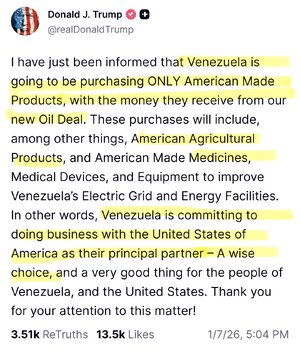
US strikes Venezuela / Captures Maduro
- Thread starter nycfan
- Start date
- Replies: 2K
- Views: 102K
- Politics

- Messages
- 6,734
Are you suggesting the Trump Administration didn't create a reasonable, achievable long-term plan before taking action?With the disclaimer that I and everyone else cannot predict the future, I am reasonably confident that this military exercise will have enormous long-term consequences that this administration has not considered or foreseen. We have just shifted the geopolitical landscape in the Western hemisphere. We are now heading down the road of colonialism.


CRHeel94
Iconic Member
- Messages
- 1,079
Corruption existing before sanctions doesn’t answer the core question. The issue is the scale, entrenchment, and why it consolidated under siege.
Once you start to explain corruption as cultural rather than institutional, you stop analyzing political economy and start pathologizing entire societies. That also conveniently erases the role of sanctions, capital flight, and external pressure. Somehow, this logic only ever gets applied to countries on the receiving end of U.S. power.
I had to read your reply a couple of times. Several things come to mind.
I believe a degree of corruption exists in all societies; the first world just has glossier mechanisms for the trafficking of influences. In Latin America, for the most part, sadly, the corruption is crude and open. There is a pretty consistent pattern of most countries (with all sorts of governments) of persons abusing their positions of power for economical gain. In some countries (Uruguay and Chile come to mind) there is a social aversion to corruption, while in others it's a daily way of life (Mexico is always the poster boy). Venezuela has always been corrupt society.
There's a saying in Spanish that the bad thing about a circle of influence (argolla) is not to be in it. When Chavez came to power one arolla was traded for another. The Chavez people in charge of these programs saw the opportunity to benefit personally and took it.
Can external factors (sanctions, capital flight) exacerbate corruption? Of course...those pressures create choke points of power that create opportunity. But I think it starts with a base corruption.


- Messages
- 45,720

Paine
Exceptional Member
- Messages
- 166
I don’t disagree that corruption exists everywhere, or that Latin American states entered the 21st century with weaker institutions than the U.S. or Europe. That still doesn’t answer the question I’m trying to surface.I had to read your reply a couple of times. Several things come to mind.
I believe a degree of corruption exists in all societies; the first world just has glossier mechanisms for the trafficking of influences. In Latin America, for the most part, sadly, the corruption is crude and open. There is a pretty consistent pattern of most countries (with all sorts of governments) of persons abusing their positions of power for economical gain. In some countries (Uruguay and Chile come to mind) there is a social aversion to corruption, while in others it's a daily way of life (Mexico is always the poster boy). Venezuela has always been corrupt society.
There's a saying in Spanish that the bad thing about a circle of influence (argolla) is not to be in it. When Chavez came to power one arolla was traded for another. The Chavez people in charge of these programs saw the opportunity to benefit personally and took it.
Can external factors (sanctions, capital flight) exacerbate corruption? Of course...those pressures create choke points of power that create opportunity. But I think it starts with a base corruption.
Appealing to the idea of a “base” level of corruption fails to explain why corruption scales and becomes system-defining under sanctions and siege conditions, rather than remaining diffuse. That requires a causal account of how institutions change when formal markets collapse, discretionary power concentrates, and informal networks replace legal ones.
You gesture at this when you note that sanctions and capital flight create choke points. My point is that those choke points are the mechanism by which corruption becomes entrenched. Once access to currency, imports, or trade licenses is politically rationed, corruption stops being incidental and becomes structural.
Since you raised Chile and Uruguay, I think they actually reinforce the institutional argument. The social aversion to corruption in those cases emerged alongside longer periods of bureaucratic professionalization, more predictable access to trade and capital, and the absence of durable bottlenecks where discretion could be converted into rents.
Where rule-bound institutions are stable and markets function, corruption stays costly and risky, so social norms form against it. Under siege conditions, the reverse happens: discretion expands, informal networks become necessary for survival, and corruption becomes normalized regardless of prior norms.
If corruption were primarily cultural, we wouldn’t see such consistent patterns across very different societies subjected to external pressure. Of course Venezuela wasn’t pure before sanctions, but the question remains: why does siege reliably produce institutional degeneration rather than institutional reform?
I might just be misunderstanding your argument. When you say “base corruption,” can you clarify what you mean analytically? Are you describing a cultural disposition that precedes institutions, or an institutional history that shapes incentives over time? I’m asking because if corruption is treated as a starting condition rather than an outcome, it’s not clear how that explains the shift in scale and structure once sanctions and other choke points emerge.
Last edited:

1moretimeagain
Inconceivable Member
- Messages
- 4,806
Free Market Capitalism
1moretimeagain
Inconceivable Member
- Messages
- 4,806
- Messages
- 45,720
 —> https://www.wsj.com/business/energy...1?st=x1akcA&reflink=desktopwebshare_permalink
“… Trump has repeatedly raised the prospect of lowering oil prices to $50 a barrel, his preferred level, two senior administration officials said.
But oil prices are already low, with the U.S. benchmark hovering around $56 a barrel Wednesday, and Trump has struggled to persuade U.S. oil-and-gas producers to crank out more crude and help him accomplish his political goals. Many companies see $50 a barrel as a threshold below which it becomes unprofitable to drill, and a sustained period of low oil prices could decimate the U.S. shale industry, which has been a key backer of the president….”

LeoBloom
Esteemed Member
- Messages
- 585
The sun never sets on racist dumbassery.
- Messages
- 45,720

- Messages
- 5,506
“… Trump has repeatedly raised the prospect of lowering oil prices to $50 a barrel, his preferred level, two senior administration officials said.
But oil prices are already low, with the U.S. benchmark hovering around $56 a barrel Wednesday, and Trump has struggled to persuade U.S. oil-and-gas producers to crank out more crude and help him accomplish his political goals. Many companies see $50 a barrel as a threshold below which it becomes unprofitable to drill, and a sustained period of low oil prices could decimate the U.S. shale industry, which has been a key backer of the president….”
I see Wharton really hammered in the concept of supply and demand to Donald.

mynameisbond
Honored Member
- Messages
- 773
Shocking, I know.Are you suggesting the Trump Administration didn't create a reasonable, achievable long-term plan before taking action?
I think the long-term plan was/is focused primarily on financial gain for the interests of those with corporate and political clout. I'm not saying there was NO plan, only that it was probably not focused on the impact to the welfare of the rest of both American continents. That ultimately affects us as well. IOW a MAGA view of things. It is not a broad enough focus.
Psst.........JD, I think you are talking about imperialism.

Share: